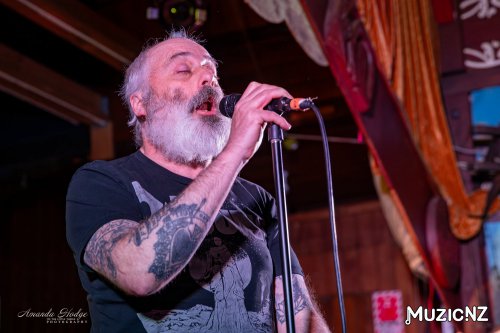
Gig Review: Shayne P Carter @ Snails, Palmerston North – 29/03/2026
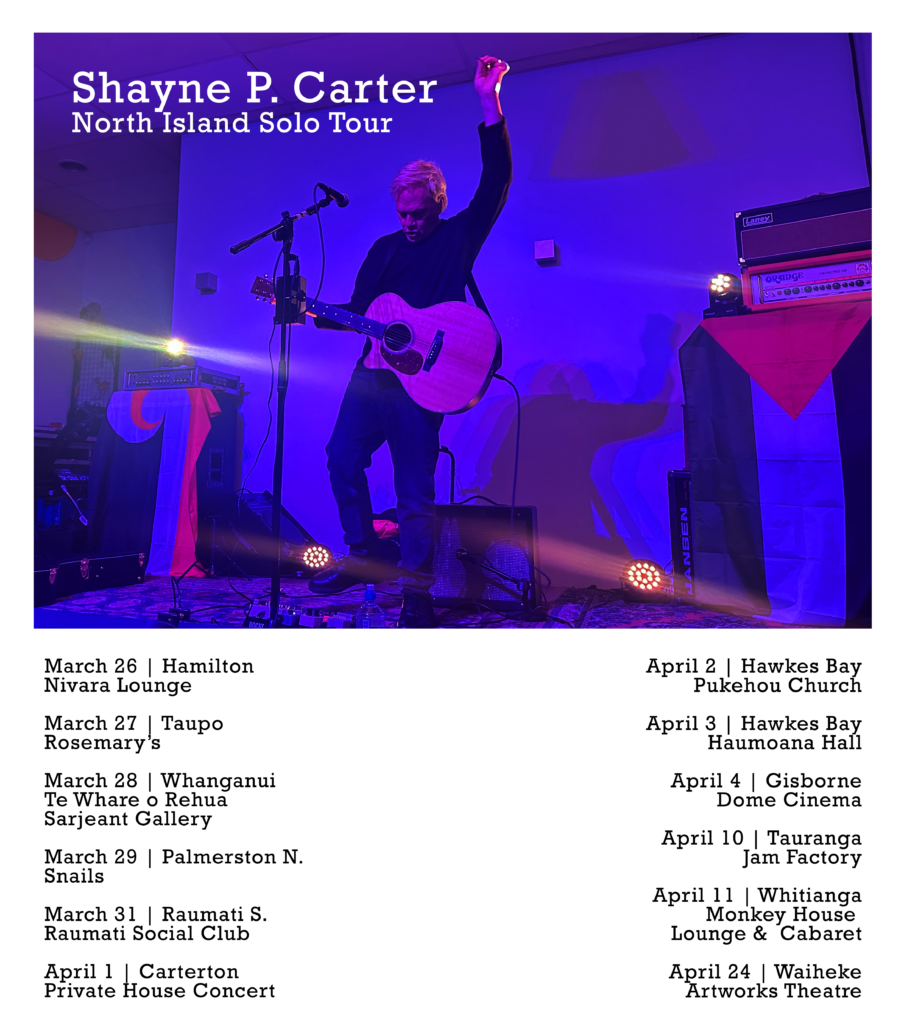
There are artists who make music, and then there are artists who make history. With over four decades as one of New Zealand’s most enduring musical forces, Shayne P Carter is firmly in the latter camp. From the loud post-punk urgency of Bored Games and The DoubleHappys, through the soaring, guitar-drenched indie rock of Straitjacket Fits, to the polished experimentalism of Dimmer and into his substantive solo work, Carter has often led the way in progressing New Zealand’s alternative sound to new heights.
A member of the New Zealand Music Hall of Fame and the recipient of multiple New Zealand Music Awards, Carter is a figure who looms as large in our musical scene as any artist this country has ever produced.
His 2019 memoir Dead People I Have Known and Margaret Gordon’s acclaimed 2025 documentary Life in One Chord, which traced his remarkable journey from the working-class suburbs of Brockville, Dunedin to the heights of international acclaim and back again, have only deepened appreciation of the man and his music. It’s little wonder Duncan Greive found it “hard to think of a better film about music out of this country”. Against that backdrop, Carter’s solo performance at Snails last Sunday felt less like just another gig and rather more like a privilege.
Snails Artist Run Space is the kind of intimate venue that suits Carter perfectly: a room where every plucked note and whispered vocal can land with full force, and where the gap between artist and audience collapses. The atmosphere on the day was warm and lively, the crowd sharp with wit and banter, and Carter, ever the consummate showman, seemed entirely at ease navigating it all.
Armed with a trusty Martin guitar whose factory-high action both challenged and energised his playing throughout the show, and his new favourite POG effects pedal adding harmonic depth where needed, Carter reached deep into his back catalogue to deliver a show that was truly exceptional.
He opened with Burn It Up, the hard-driving rocker from Straitjacket Fits’ 1993 album Blow; a song built on an insistent guitar riff that invigorated the room immediately. His playing and effects conjured cascading harmonics that gave the tune an almost orchestral breadth for a solo performance, each angular chord shift landing with real punch.
From there, Carter moved into what he described as a more obscure piece: Garden Frozen In The Frost, an emotionally rich tune that showcased just how much feeling he’s capable of creating within a single song. A tempo shift at its heart built suspense beautifully, the room leaning in as though drawn by some invisible current.
Short Change, a newer song co-written with Jon Toogood, was dedicated, Carter noted wryly, to those “arseholes” who currently hold the reins of power. It was a stunning piece: droning open strings wrapped in dissonant shimmer, falsetto vocals perfectly rising above the chords before the strumming doubled in intensity through an abundance of chord changes. The crowd responded warmly, and rightly so.
Pendulum built on this energy with its gentle vocals and a Middle Eastern progression to add another dimension, its semitone shifts and timing turnarounds keeping the room entranced.
Microphone problems turned into one of the day’s unexpected highlights when Carter made light of the venue’s sound issues. He then stepped up magnificently during Hail to do the work of two guitarists in a ‘naked’ lead break that left the audience visibly and vocally delighted. The guitar’s high action allowed him to attack the strings, obtaining a ferocious sound that many acoustics wouldn’t endure.
There is something extraordinary about a musician fully in the moment, and Carter was precisely that – at ease and entirely in his element.
Evolution brought things down a notch, with delicate vocals drawing attention while unusual chord structures kept things beautifully unsettled. Stripped back to a solo acoustic format, the song took on a quietly haunting quality; an experience that reinforced just how timeless this material remains.
Pausing briefly to recommend director Ti West’s horror trilogy, Pearl, X, and MaXXXine, Carter noted a personal connection to a local filming location, his enthusiasm for these films and Mia Goth’s leading roles, clearly genuine.
Carter then launched into Degrees of Existence, the title track from Dimmer’s final album. This was a craftsman working overtime: energetic strumming, numerous melodic changes, and intricate chord arrangements that bordered on jazz in their complexity. At moments like these, we were reminded that he isn’t merely a singer who can also play guitar, but an exceptional guitarist who also writes breathtakingly beautiful songs.
A brand-new offering, No One Is A Dream, written after a friend requested something celebratory, came with characteristic candour: Carter declared that he didn’t previously have a single celebratory song to his name. He started with a lovely fingerpicked phrase before swapping to strumming closer to the saddle for extra twang, this song was full of lament and hope, the kind of thing Carter does exceptionally well.
The emotional centrepiece of the show was undoubtedly Randolph’s Going Home, released on Flying Nun in 1986. Written in the immediate aftermath of Wayne Elsey’s death, it was Carter’s first recording following the loss of his closest friend and DoubleHappys bandmate, who died tragically in a train accident in June 1985. The song still carries that grief within every note.
As the doco Life in One Chord made clear, this was the song that, in many respects, gave rise to everything that followed. Here, Carter expertly worked the song to a crescendo, sometimes holding back to build anticipation then pushing forward to give the chorus increased prominence. The numerous turnarounds, syncopation and double-time changes were all deployed with the assured hand of a songwriter who has lived deeply with this material for many years.
Left To Defend followed with a poetic lyrical style before If I Were You, one of the three Straitjacket Fits songs to feature in the APRA Top 100 New Zealand Songs of All Time, was presented with heartbreaking delicacy. The fingerpicking flowing into strumming, the vocals almost effeminate in their tenderness, it was quietly spine-tingling, regardless of how many times you’ve heard that stunning song before.
Both Left To Defend and If I Were You also feature on Carter’s recently released collaborative album REforms, in which the New Zealand Symphony Orchestra reimagines ten songs from his remarkable songbook. Those wanting to experience it live can catch the world premiere performance at the Michael Fowler Centre in Wellington on Friday 19 June, as part of the Lōemis Festival 2026.
Life In One Chord, from the Straitjacket Fits’ landmark 1987 debut EP, brought the house down as the penultimate song, Carter’s fantastic bar chords driving the beat forward with impressive force. His extended solo drew shimmering harmonics from the acoustic instrument with a confidence that felt both rehearsed and entirely spontaneous. This punk offering has lost none of its power in the decades since its release, and in this stripped-back solo version it carried an almost mythic weight.
The show closed with Comfortable, from Degrees of Existence, a considered finale that slowed everything down to a contemplative hush. Feeling both carefully crafted and wholly in the moment, another solo beautifully completed the song, leaving the audience mesmerised and reluctant to move in case they broke the spell.
It would be remiss not to acknowledge that numerous plosives, the result of a technical issue with the sound system, intruded somewhat on an otherwise impeccable concert. Carter handled these moments with characteristic good humour, and consequently they did little to detract from his overall performance.
With his music enjoying a renewed wave of appreciation, this solo show felt like a statement of intent from an artist who has absolutely nothing to prove and everything still to give. Reaching across the breadth of his songwriting, from the raw grief of Randolph’s Going Home to the newly minted No One Is A Dream, Carter reminded a packed room in Palmerston North exactly why he has received numerous accolades, and why Nick Bollinger’s assertion that he stands head and shoulders above his fellow musicians isn’t such an overstatement.
At times supremely heavy, at others carefully soft and intimate, this was a wonderfully dynamic performance comprising four decades of work distilled into one remarkable show. Make sure you catch Shayne P Carter at a good music venue near you.
Related Acts:
About the author River Tucker
Hi, My name is River, and I’m a music tutor, multi-instrumentalist (mainly playing drums), and freelance graphic and web designer from Aotearoa, New Zealand. Over the years I’ve worked in numerous bands playing styles ranging from jazz and ska to grunge and metal. I’ve also recorded and self-produced a number of releases consisting of original compositions. This experience, along with an inherent appreciation of music, has helped with my ability to review music for Muzic.NZ. The landscape of our music scene in New Zealand is rich with potential, yet often overshadowed by underutilized talent waiting to be discovered. As a reviewer, I’ve enjoyed the opportunity to highlight some of these emerging voices, which has provided me with an appreciation of the diverse musical tapestry that Aotearoa has to offer. Writing reviews is my way of promoting some of that musical talent to a local and international audience. By inspiring the
More by River Tucker
Gig Review: Manfeild Live @ Manfeild, Feilding – 31/01/2026

Gig Review: Andrew Fagan @ Globe Theatre, Palmerston North – 18/11/2025
Album Review: Queen
EP Review: One

Album Review: Heavy Machinery
Festival Review: Homegrown 2025 Saturday Part 3 @ Wellington Waterfront – 15/03/2025

EP Review: Aonaran
EP Review: Embers
EP Review: Silcrow
EP Review: Promo EP
Album Review: The Death Spell
Gig Review: Reign of the Beast @ Whanganui Musicians Club, Whanganui – 13/10/2023