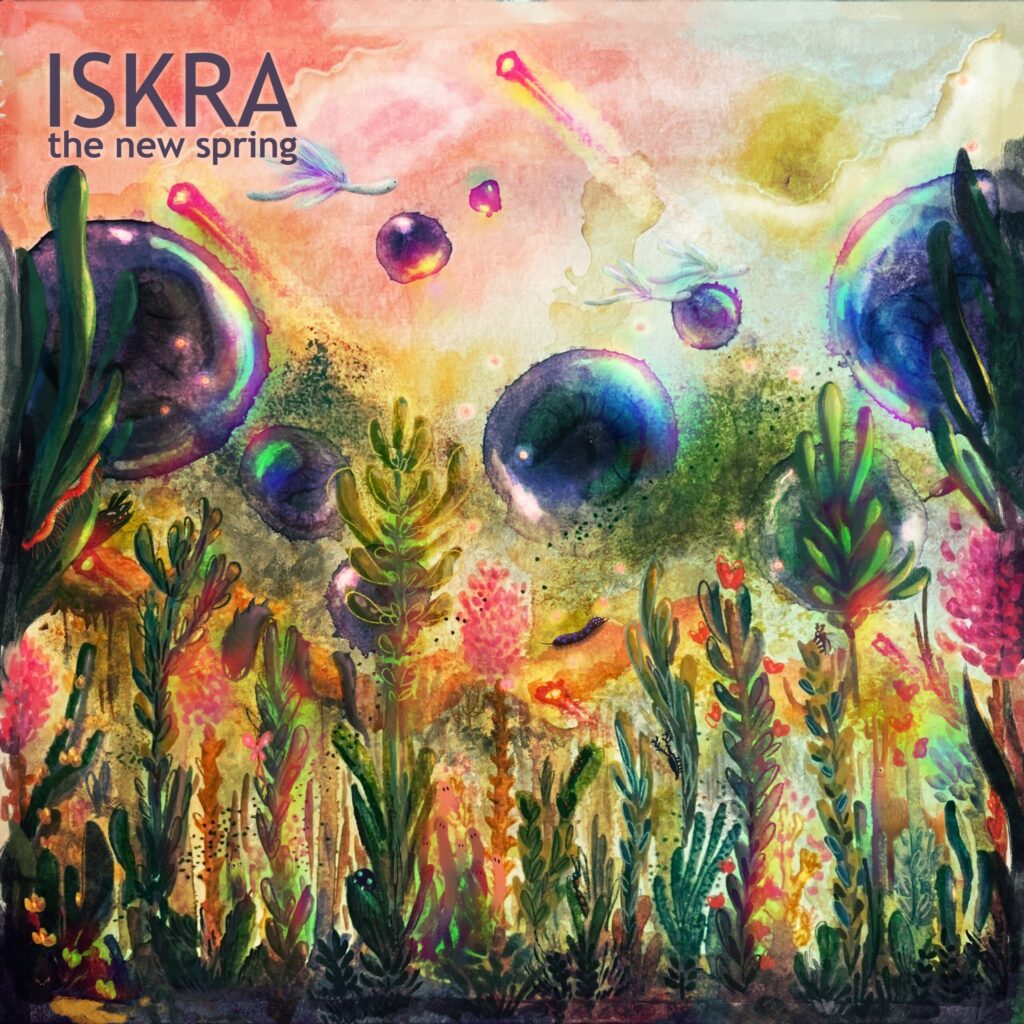
ISKRA have taken the unusual step of stripping their ensemble down to saxophone, helicon and two percussionists, removing the conventional chordal instruments and building an entire musical world from rhythm, breath, brass, texture and groove. The result is The New Spring, a five-track EP that feels less like a collection of songs than an invitation into a moving, breathing ecosystem.
The band cite Sons of Kemet as an influence, and the connection is immediately apparent: jazz improvisation collides with African rhythmic traditions, brass-band sensibilities and something approaching dance music. Simon Grove’s helicon occupies the role of both bass instrument and sonic anchor, its huge, rounded voice sometimes sounding like a tuba, sometimes like an eccentric brass synth, while Josh Buckler’s saxophone moves above it with everything from smooth melodic lines to wild improvisation. Beneath them, Ato Kwamena and David McGurk create a constantly shifting rhythmic architecture.
It is a deceptively simple setup. The music itself is anything but.
Into The Fire opens the EP with what feels like New Orleans calling. The helicon immediately establishes a huge low-brass presence, percussion locks into a driving groove and Buckler’s saxophone is given room to roam. There are moments of tightly homophonic riffing before the quartet breaks back open into improvisation, giving the track a feeling of controlled combustion. The whole thing has the atmosphere of an outdoor festival, a masquerade or a street procession that has somehow wandered into a jazz club.
It is worth noting how unusual this sound is within the New Zealand musical landscape. There are plenty of jazz groups here; plenty of Afrobeat-influenced projects; plenty of brass, percussion and experimental music. But this particular combination of forces is genuinely unique.
Caves of Ilus continues with similar momentum; the appeal is in the accumulation of texture. The percussion is relentless without becoming monotonous, with intricate details constantly appearing around the central pulse. ISKRA understands groove above and beyond simplicity: there is a great deal happening underneath the surface.
Then comes Sun Sands, and this is where the EP really reveals its depth.
This is my favourite track, and possibly the clearest demonstration of what makes ISKRA special. The melodic material is gorgeous, but it is the combination of sounds that makes it so compelling. The helicon brings an almost traditional oom-pah quality to the bottom end; the percussion turns that into something contemporary and deeply danceable; and Buckler’s saxophone glides over the top with a smooth-jazz melodic sensibility. Then the clarinet appears, somehow making the whole strange combination make even more sense.
It’s wholly unexpected, exciting, and beautiful.
At nearly seven minutes, Sun Sands also demonstrates ISKRA’s confidence as composers. There is enough rhythmic, melodic and textural development to justify the length, and the track never feels as though it is simply waiting for its conclusion. It is spacious without being empty, intricate without becoming self-indulgent. This is soundtrack-of-my-life material.
In Her Arms (I Belong) shifts the atmosphere again. There is still something unmistakably New Orleans-inflected in the relationship between the helicon and Afrobeat-derived rhythms, but the saxophone and clarinet move into a more lyrical, almost cinematic territory. This is perhaps the EP’s most harmonically considered piece. It feels like a soundtrack to a mission: purposeful, mysterious and slightly fantastical.
And then ISKRA finish by throwing the doors wide open.
Garden Party is an absolute banger. It begins almost deceptively: saxophone and helicon drenched in reverb, creating the impression of a foghorn sounding across some enormous, mist-covered landscape. The harmonic language is dark and lyrical in harmonic minor. Then the reverb disappears and the rhythm section detonates.
Suddenly the helicon and percussion are making something that sounds startlingly close to electronic dance music without the use of electronic instruments. Buckler’s saxophone darts across the top, at times approaching a kind of Flight of the Bumblebee frenzy, while the composition continually cuts between homophonic riffs and polyphonic textures, relentless dance groove and sudden moments of calm.
There is an impressive amount of compositional thought inside this EP, but the music never loses its bodily relationship with rhythm. You can analyse the interlocking parts, the harmonic language, the improvisation and the instrumentation, but ultimately ISKRA make music that wants you to move.
There are echoes here of the rhythmic jazz of Sons of Kemet, the streetwise brass energy of Hypnotic Brass Ensemble, the Afrobeat vocabulary of Antibalas and the exuberance of New Orleans brass bands. But those comparisons are only signposts. ISKRA’s particular alchemy – the enormous low-end voice of the helicon, the saxophone’s melodic and improvisational freedom, and two percussionists capable of creating an almost orchestral rhythmic field – feels fantastical.
That is especially exciting in Aotearoa.
ISKRA have managed to make something that feels simultaneously ancient and futuristic, acoustic and electronic, composed and improvised, sophisticated and feral. It sounds like jazz that has escaped the club and gone for a jaunt outside.
And perhaps that is exactly where it belongs.
The New Spring is music for festivals, dance floors, street corners, late-night parties and strange outdoor gatherings where nobody quite knows what is going to happen next.
ISKRA have made something rare: music that rewards close listening while never forgetting to have a bloody good time.
Related Acts:
About the author Maggie Cocco

Maggie CoccoReviewer | muzic.net.nz, Melodic Magazine (US) Maggie Cocco is a singer, multi-instrumentalist, and songwriter living in Te Tai Tokerau. Originally from Detroit, she’s spent the past few years building community and sharing music across Aotearoa — from living rooms and libraries to galleries and festivals. As a reviewer for muzic.net.nz, USA-based Melodic Magazine, and Whangārei’s local rags, Maggie approaches music journalism with a deep respect for the mahi behind the music. Her writing aims to support artists by witnessing their work generously and with a deep desire to understand and connect with the music itself. Maggie collaborates on a wide range of NZ and international projects as a composer and vocalist. Her latest passion is focused closer to home: developing infrastructure for the music scene in Te Tai Tokerau, where she currently serves as the Music Advisor for Creative Northland. Her personal projects include Science for Sociopaths (Adult Contemporary,
More by Maggie Cocco
Album Review: Mischievous Eyes
Album Review: Wings of Desire

EP Review: Pale Light

Gig Review: Springboard Music Showcase @ OneOneSix, Whangarei – 2/08/2025

Album Review: The Summer Sessions
Gig Review: Talute @ Whangarei Central District Library, Whangarei – 23/05/2025
Festival Review: Vibes On Vine @ Vine Street, Whangārei – 8/02/2025

EP Review: In My Chambers

Album Review: whole life waiting
Album Review: Your Unbelievable Head

Album Review: Another Round
Album Review: HELLo