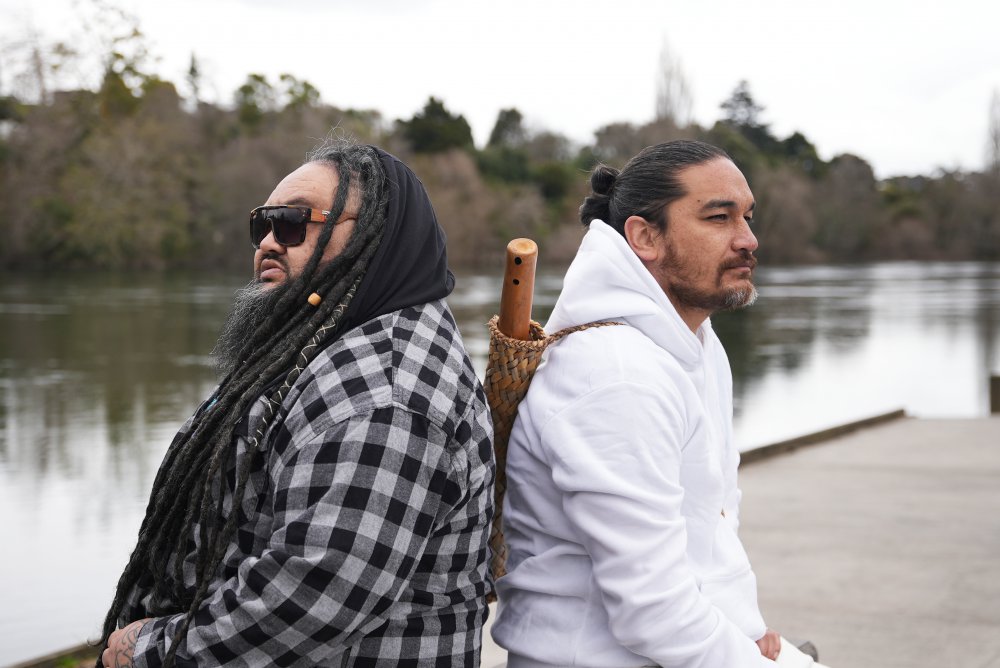
Soul duo IA Gives Voice to Lost Babies in New Oriori Waiata ‘Whakakai Marihi’

Indigenous-soul duo IA have released Whakakai Marihi, a dreamy acoustic waiata inspired by oriori, written in remembrance of babies who never made it into the world.
Traditionally, oriori are composed for tamariki from conception, continuing to be sung while the child grows. Similar to lullabies, they carry whakapapa, tūpuna stories, and aspirations across generations. Oriori continued to be sung for pēpi who did not survive so they could be recognised by tūpuna meeting them in the next world.
Lead singer and taonga puoro artist Reti Hedley (Ngāti Tūwharetoa) says the waiata became a way of remembering babies they had lost themselves, and giving them a place to live through music and oriori.
“The melody came to me on a summer afternoon. It had this gentle, almost lullaby-like feeling to it, and initially I imagined singing it to our babies at bedtime. We thought we were writing a song about the babies we had, but as we developed the lyrics, we realised it was actually about the babies we had lost,” says Hedley.
Whakakai Marihi carries a gentle lullaby melody, accompanied by fingerstyle ukulele and taonga pūoro, including kōauau (wooden flute) and ponga ihu (clay nose flute), creating space to remember those lost babies and hold their wairua close.
The wooden kōauau heard throughout the waiata, carved by Jo’el Komene, depicts the tamariki of Hedley. Its middle hole is a ruru (morepork), representing his pēpi who passed on, with the holes on either side representing his other two tamariki. In te ao Māori, the ruru moves between the worlds as a messenger of the night, carrying messages from te ao wairua (the spirit world).
“The kōauau has traditionally carried a mournful voice, accompanying people through times of loss. The particular kōauau used in this waiata holds a personal significance. It is named Te Ata Pō, after an unborn baby my wife and I lost. When this kōauau is heard in the waiata, there is a wairua and memory carried within it,” says Hedley.
Multi-instrumentalist Moetu Smith (Ngāti Māhanga, Ngāti Maniapoto) says Whakakai Marihi has been an unexpected gift in their own healing. The waiata will be released ahead of Baby Loss Awareness Week in October in the hope it can support others too.
“There is something really vulnerable about singing for a baby you never got to hold. This is our way of acknowledging those little lives.
We hope people can hear their own stories in this waiata, especially those who have experienced loss. And it can be a way of to remember and honour them, them, and keep that connection alive,” Smith says.
Whakakai Marihi is made with the support of Te Māngai Pāho and is available now on all major streaming platforms.

If you, or someone you know wants help and support, reach out to the free helplines in Aotearoa:
● Need to talk? Free call or text 1737 any time for support from a trained counsellor.
● Lifeline 0800 543 354 (0800 LIFELINE)
● Youthline 0800 376 633, free text 234, webchat at youthline.co.nz, DM on Instagram
● @youthlinenz, WhatsApp message on 09 886 5696
● Samaritans 0800 726 666
● Suicide Crisis Helpline 0508 828 865 (0508 TAUTOKO)
● Visit mentalhealth.org.nz/helplines for a wider list of helplines.
● Aoake te Rā – A free service providing support and manaaki to people who have lost
someone to suicide. Visit www.aoaketera.org.nz