
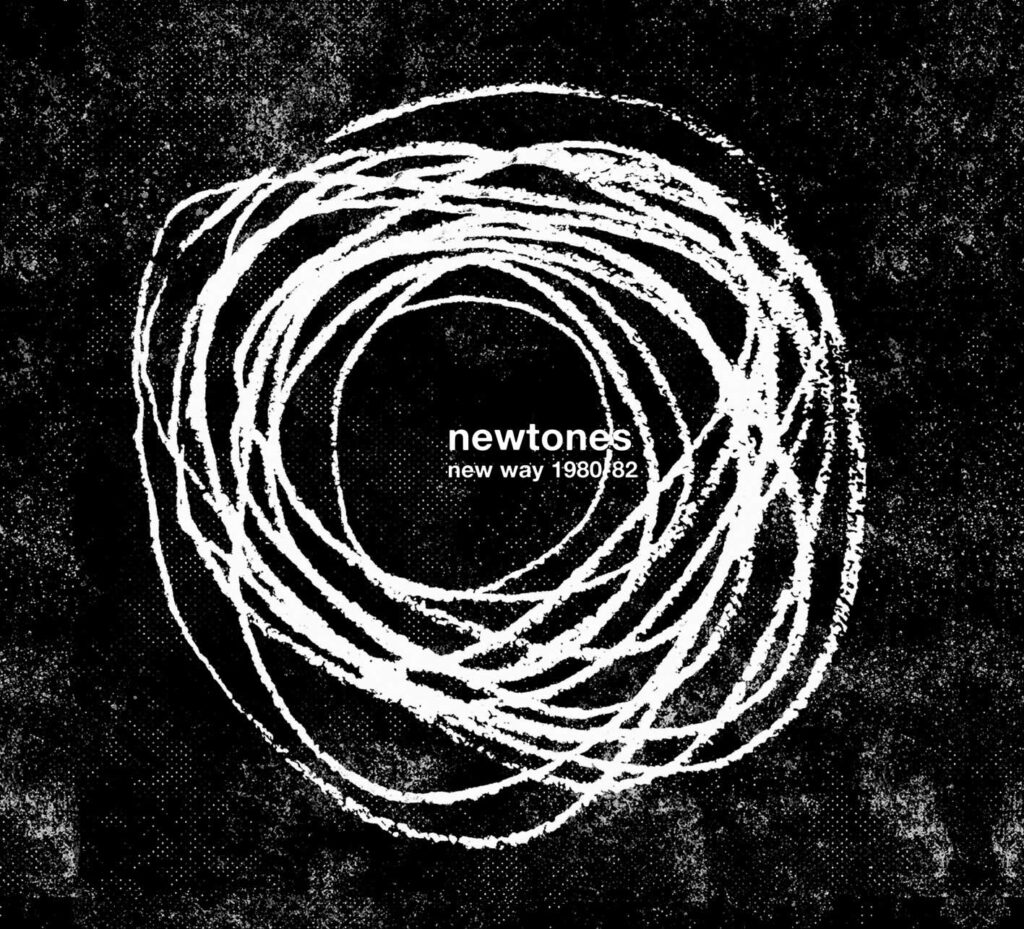
Only readers over the age of about 60 will remember swaggering in their stovepipes and spilling drinks in person at the Gladstone, Christchurch’s classic hotel turned pre-eminent punk music venue of the early 1980’s. They were spitting and shouting their way through international and local gigs for weirdos and the disenfranchised: Nick Cave, Jonathan Richman, the Gordons, Pin Group, The Clean, Verlaines and The Vauxhalls. And among this excellent company was, but only for a short three years from 1980 to 82, Newtones – Christchurch’s frenetic three-piece punk turned New Wave act. Whether you cannot recall, or it’s still as clear as day, it doesn’t matter, because forty-three years later we now have a fresh release of all of the Newtones’ back catalogue in one place, plus a series of unearthed, previously unreleased and newly discovered recordings.
This is New Way, a digital and physical release of Newtones’ eight previously released tracks: Paint The Town Red, New Way, Santa Ana, Christchurch Part 2, China, My World, Incidentally Dreaming and All Over The World. Their re-release as a single document is a fine testament as it is, but what’s remarkable about New Way is the inclusion of seven further previously unreleased tracks recorded by the time of the band’s sudden demise. These include the legendary Four Ships instrumental, which was a mainstay of live performances but thought to be lost forever until it surfaced from singer and guitarist Tony Peake’s archive of recordings. It also includes the epic The Bells, and the physical copy includes 24 pages of liner notes by David Swift and artwork by Robin Neale.
So, a proper retrospective on this influential band.
On initial contact this might look like a story only for hard-core fans, those of us prone to nostalgia, or for amateur historians of southern hemisphere punk. By narrow parameters it has to be a story something like that, but it only takes one listen to realise this record is more than this. This is a short story, yes – a whole career in 16 tracks – but one that shows the band’s rapid development from punk to New Wave. As Simon Coffey on the 13th Floor wrote: “The delight of this approach is rather than trying to create an album, the band have offered an insight into the short burst that Newtones existed for,” transitioning away from punk into the New Wave sound. So we have the band’s whole story right here, and the story of a whole movement, in less than one hour of listening.
Newtones weren’t signed by Flying Nun (a decision the pre-eminent label came to regret), and the band remained unaffected by any of the creative or commercial impulses of anyone else. They were self-funded and self-released (only two EPs were released, and a third completed but unreleased) – in many respects an original indie band. In this context, it seems extraordinary that anything has survived at all.
The achievement that this is, to re-release and newly release this material after more than forty years existing in private archives, reminds me of Steve Albini making the case for the superiority of analogue tape recordings. Analogue tapes avoid proprietary digital formats that are incompatible with others, which go out of date, and machines that can’t read them or software that no longer works. Digital recording, he says, is temporary since recordings on these formats won’t survive for long. For a band to re-release its material many years after it was recorded, say more than 40 years after, a surviving set of master tapes that could be read by any tape machine will ensure longevity of the band’s output in a way that an mp3 on a pen drive simply won’t.
How fortunate we are, then, to be able to look back to this formative Christchurch band and understand what they were up to, whether we were there in person at the Gladstone or not.
If punk is your thing, New Wave is your thing, or anything in between, or you’re a nerd for local music and its history, New Way is to be listened to and understood for the piece of local history that it is.
Related Acts:
More by Michael Durand
EP Review: A Lil Somethin’ Somethin’

EP Review: Pīwakawaka

Album Review: A Perfect Sphere
Album Review: Darren Watson Sings John Hiatt
Album Review: The Opposite of Everything

Gig Review: Pumpkinhead @ Loons, Christchurch – 11/10/2025
Album Review: OMMU

Album Review: The Lord Is My German Shepherd (Time For Walkies)

Album Review: We Lived Our Lives On Top Of This

Album Review: Nickels & Dimes
EP Review: The Third Door
Album Review: One Is Always Heading Somewhere