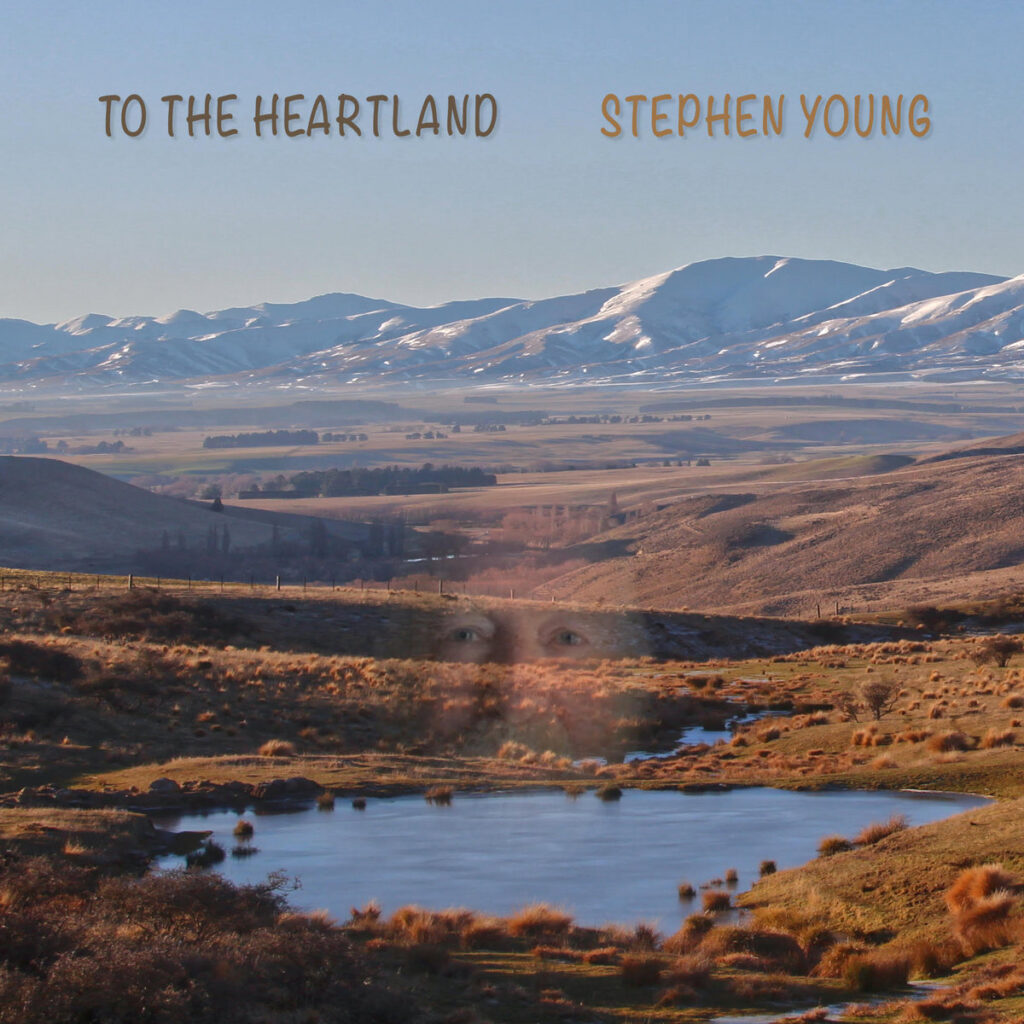
Stephen Young’s To The Heartland unfolds like a slow burning weather system, but it is far from one-note. While the emotional palette leans toward introspection and muted tones, the album’s sense of movement tells a more dynamic story. There is a clear interplay between lighter, more rhythmically buoyant moments and slower, more contemplative passages. That contrast gives the record shape, allowing it to rise and fall rather than sitting deep in one single mood.
A Dunedin-based songwriter with decades of experience, Young approaches this project with quiet confidence. His 1982 APRA Silver Scroll win and early work with theatrical rock band Mother Goose sit in the background, but their presence is felt in the control of his songwriting. Nothing here feels accidental. The arrangements are measured, the pacing intentional, and the emotional tone consistent without becoming careless.
Recorded between 2024 and 2026 with Rob Piggott, Denis Gibbons and John Fielding, the album carries a distinctly southern identity. You can hear it not just in the lyrical focus on relationships and landscape, but in the sonic atmosphere itself. There are shades of Johnny Cash in the grounded vocal delivery and stripped-back instrumentation, particularly in the lower register phrasing and steady rhythmic feel. At the same time, there is a textural restraint that recalls The National, where repetition and space are used to build emotional weight rather than release it.
There are also subtle hints of jazz sensibility woven through the record. It is not overt, but it shows up in the harmonic movement and phrasing, adding a softness that occasionally lifts the material beyond standard folk structures. At times, this gives the album a warmth that offsets its otherwise brooding tone.
This balance is most effective in Joy & Sorrow, one of the album’s more immediate and emotionally accessible tracks. The arrangement carries a gentle forward motion, allowing the message to land without feeling heavy-handed. Lines like “There is no difference ‘tween joy and sorrow, it’s just the same thing on a different day” feel simple but grounded, while “Don’t feed the sadness but at least you know it’s real, it’s all part of living” adds a layer of emotional honesty that is hard to dismiss. The track sits comfortably between light and dark, never fully resolving that tension, which ultimately works in its favour.
Our Wayward Ways shifts the energy again, leaning into a more narrative structure. There is a looseness to the rhythm and phrasing that mirrors the storytelling, giving the song a lived-in quality. It moves through phases of memory, from early touring days to later reflections on ageing and purpose. Lines like “We’d travel round every crappy wee town, driving in my old car” ground the song in something tangible, while the refrain pulls it back into a broader sense of nostalgia. What stands out is the lack of polish in the storytelling. It feels honest rather than curated, which gives it weight.
The title track, To The Heartland, opens into a slightly wider sonic space. The arrangement lifts just enough to create a sense of expansion, giving the song a near hymn-like quality at times. There is a clear emotional duality running through it. Lines like “If this is love, it sure is a strange one, you want a war, I can arrange one” introduce tension, while “And yes it’s true, it’s true that I love you” strips things back to something more vulnerable. That push and pull is echoed in the imagery, particularly in “We break like a wave on the blue tide, we slip, we roll, we ride, we crash,” which reinforces the cyclical nature of the relationship being described.
There is something in this track that gestures toward a more universal sentiment. It carries a softness that feels reminiscent of Lennon’s more reflective writing, not in imitation but in intent. It reaches for connection through simplicity, even when the emotions themselves are complicated.
Across the album, these shifts in tone, tempo and density prevent it from becoming static. The changes are subtle rather than dramatic, but they are enough to create a sense of progression. Songs expand and contract, arrangements open and close, and the listener is guided through that movement without being pulled too abruptly.
That said, the album’s commitment to restraint may create distance for some. Its textures are understated, its hooks are not immediate, and its emotional delivery rarely demands attention. For listeners looking for sharper peaks or more distinct contrast, it may feel elusive, but for others, that restraint will feel intentional.
To The Heartland is not trying to capture attention quickly. It is more interested in holding a mood, in letting its ideas unfold at their own pace. It reflects a songwriter who understands form, tone and emotional continuity, even if that subtlety risks being overlooked.
It may not resonate with everyone, but it does not need to. It sits comfortably in its own atmosphere, moving quietly between joy and sorrow, never fully settling into either.