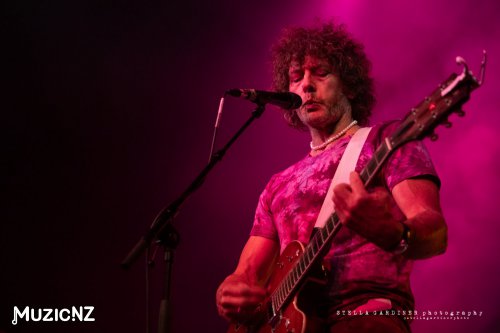
Gig Review: Marlon Willams @ Òran Mór, Glasgow – 12/04/2026

When I first arrived in Scotland, Marlon Williams had just gifted Te Whare Tiwekaweka to the world. An album entirely in te reo, it would become a tether for me to the land I have never been so far away from. Now, over a year later, I’m standing in a crowd at the Òran Mór in Glasgow singing waiata with a packed room of kiwis and Scots. The other side of the world, but feeling like I am holding something that will always be mine, and I’m holding it tighter than I ever have.
Anticipation for this gig has been building within me for a while. While psyching myself up for a Marlon Williams gig is not exactly foreign to me, the circumstance very much is. I could hardly have asked for a better setting of the night’s atmosphere than the one offered by The Maes, a female Australian contemporary folk duo exhibiting mastery of mandolin, fiddle, guitar and banjo, ushering silence over the crowd with their impeccable harmonies and storytelling. Despite showing some signs of nerves, these two girls are well-suited to this folk-laden scene and country. They have tapped in to a timeless sound that transports us with lyrics and melodies that could leave you in tears or in an elated state of deep reflection. It’s the same bittersweet impression that I was always left with listening to Gillian Welch; that stoic, diaphanous drawl clearly present and bringing a familiar, yet refreshing sound to my Scottish gig life, but with a twist of tales of modern yearning, stolen land, and folklore.
The main event strolls in like a mere extension of the crowd trickling onto the stage. Marlon and the Yarra Benders, dressed business casual, aptly smirk through the applause before the crowd falls silent for Marlon’s acapella piece, E Mawehe Ana Au, like a karakia of one feeling the widening division between two worlds. The message and soul of the waiata transcending the need for translation as there is no applause at its conclusion, only the regaining of our collective breath. One of the most poignant moments of the set within the first minutes.
Now with the full band, Ko Tēnā Ua is a gentle segue to introduce the vibe that will shroud much of the night. The upbeat Me Uaua Kē and Easy Does It from 2022’s My Boy feel like dipping into a summer-baked river at home. With the audience gently swaying within the orange glow of stage lights, Rere Mai Ngā Rau and My Boy feel like coming home to an intimate San Fran Bath House gig in Te Whanganui a Tara. The confines of a smaller venue is a benefit of seeing an NZ artist abroad who would otherwise be selling out the Michael Fowler Centre. In the gloomy groove of Don’t Go Back, we’re reminded that Marlon has always incorporated a splattering of te reo in his music, but as his own admissions and his intimate new documentary: Ngā Ao E Rua – Two Worlds reveal, an album entirely in his ancestral language is a wholly different embrace.
So, what about Te Whare Tiwekaweka? The Messy House. A nod to the fact that the translation on the album may not be perfect is a fitting depiction for an effort that Marlon has had in the works for a long time, much of that wading through whakamā of committing to such a project, but also the depth of devoting to something so personal. For myself, the discovery of my own whakapapa coinciding with my departure from Aotearoa added a new layer of conflict. In a way, the distance provided an opportunity to grasp my whenua tighter, especially in the wake of some of the most modern blatant attacks on te reo and rangatiratanga from our government. All of this is a sure-fire way of saying that this gig is beyond significant to me; it’s nurturing identity, and I can tell that many of the kiwis around me are in the same boat.
Marlon and the Yarra’s look entirely at ease. On the streets of Lyttleton, Melbourne, or Glasgow, they would be the most approachable lot to ooze affability and quiet swagger. The long-standing quartet are a powerhouse of tight harmonies, easy-going, cheeky humour, and witty charm. They have a way of engaging with the audience and each other that feel like everyone is in on the joke. Even with the prolonged rambunctiousness of some Scottish audience members who may as well be having a face-to-face to conversation with Marlon, there is no tension or awkwardness in the night. All calls and interjections slide like water to a duck’s back for Marlon, and not without the addition of a witty response or charming anecdote.
The Òran Mór stands as one of Glasgow’s most unique concert venues. Fittingly named in Scottish Gaelic, it translates to ‘big song’ or ‘great melody of life’. Converted into an entertainment venue in 2004, it is held within the belly of Kelvinside Free Church, the foundations of which were laid in 1862. The fact that this doesn’t even crack the oldest of the churches in Glasgow is rather telling of the staggering contrast in the ages and history of the two countries I’ve called home. At the time of the first brick being laid, Māori society was undergoing a period of intense crisis, political consolidation, and active resistance against British colonial expansion. The Native Land Act of that same year aimed to intentionally break down traditional Māori social structures for the ease of settler purchase.
One by one, the waiata come, and each with their own energy and distinctiveness. The quartet rounding out the sound of the album’s grand works to an impressive degree; a testament to their skills. Marlon fills Kommi’s guest verses in Huri Te Whenua with confidence, and the tenderness of Lorde in Kāhore He Manu E. Audience anticipation brings the vibrant Korero Māori, simply ‘Speak Māori’, to life. Whether in Aotearoa or Scotland, the fragility of indigenous language and culture is appreciated far too little, as Marlon says in Ngā Ao E Rua that “It takes one generation to lose a language, and three generations to restore it.”
Going solo for a bit, Marlon delivers a hauntingly beautiful rendition of Dark Child as a fan request, before reaching even further back for another crowd suggestion with The Ballad of Minnie Dean from 2014’s Sad But True with Delaney Davidson. Recruiting the rest of the band, Marlon warns that the song hasn’t been played for over a decade, but to no one’s surprise, they nail it, with each of them beaming with pride in the aftermath. I think they even impressed themselves there.
A faithful cover of Hirini Melbourne’s Rongomai ensues, followed by one of my favourite tracks from Te Whare Tiwekaweka, Kuru Pounamu, a song of endearment, comparing one’s love to a pounamu earring, that crescendos into a fantastic call and response from The Yarra’s. A hell of a love song. The gentle 50’s soul sound of Aua Atu Rā gives way to the fan favourites Thinking of Nina and Nobody Gets What They Want Anymore before the band vacates the stage for the encore.
Returning for another Hirini Melbourne cover with Purea Nei a poignant song of renewal that Hirini wrote in remembrance for one of his late students. It’s a song known to many in the crowd, a little by myself, and just being able to join in on the angelic choir in the Òran Mór singing in te reo elevates the beauty of the piece to a place I haven’t been before. The Maes join Marlon and the Yarra Benders for the final two songs, The Roches Losing True and September Fields by Frazey Ford. Rounding out the show with an encore entirely of covers with friends made along the way seems very on-brand for an artist like Marlon Williams. He is consistently displaying the music, experiences, stories, and culture that makes him who he is. To release and tour an album like Te Whare Tiwekaweka at such a tumultuous time is, according to him, a coincidence as the project has been in the works for such a long time, but perhaps there is something to be said about a celebration of something that comes at just the right time, entirely of its own accord, inspiration, and catharsis.
Related Acts:
More by Tom Langdale-Hunt
Album Review: Water For Gasoline
Gig Review: Yumi Zouma @ The Garage, Glasgow – 23/03/2026
Album Review: No Love Lost To Kindness
Album Review: 200
EP Review: Digital Plastic Surgery

Album Review: Eliana
Gig Review: Crowded House @ TSB Arena, Wellilngton – 09/11/2024
Gig Review: Tami Neilson @ The Opera House, Wellington – 11/10/2024
Album Review: The Lighthouse
Gig Review: Devilskin @ The Hunter Lounge, Wellington – 13/06/2024
Album Review: The Rose of Jericho
Gig Review: Voom, Reb Fountain & Vera Ellen @ The Great Hall, Wellington – 1/06/2024