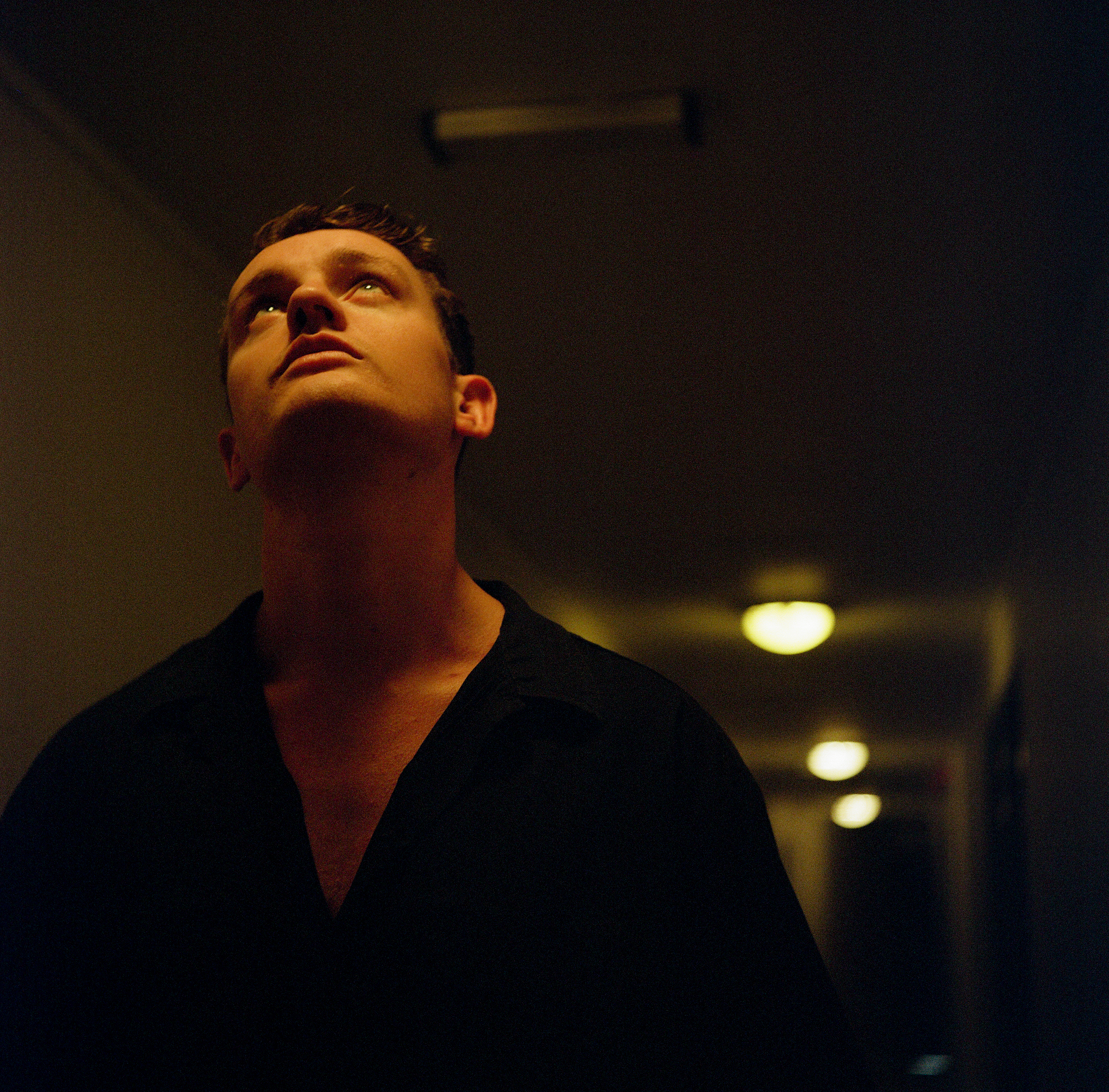
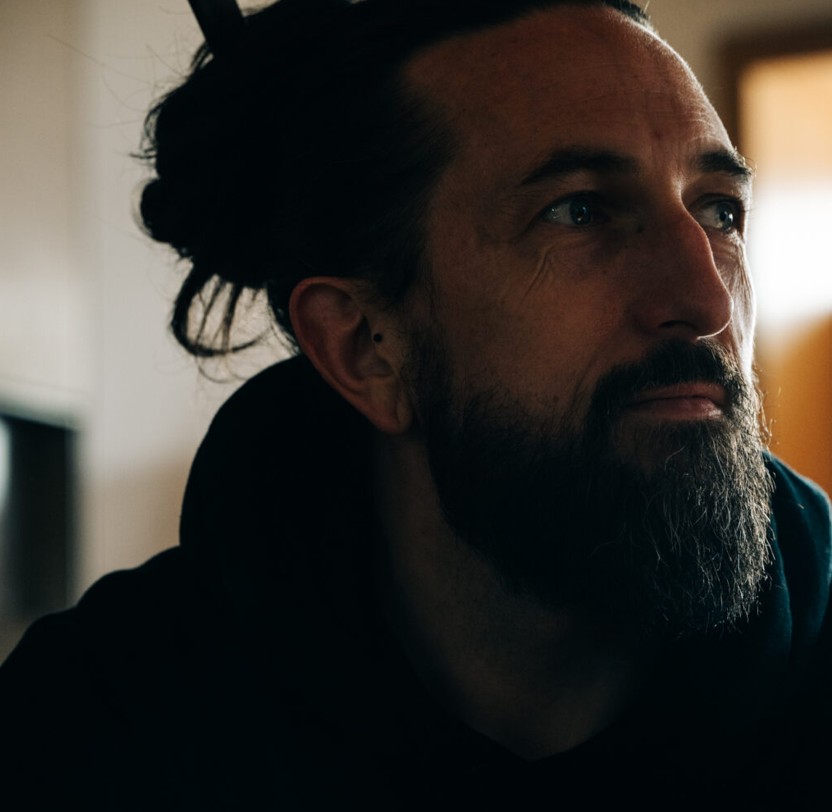
Tom Cosm (or Tom Lewis) originally hails from Ōtautahi (Christchurch). He’s an electronic artist, DJ, educator, and technologist whose work spans international touring, open‑access music education, and the creation of innovative performance systems and production tools. After beginning with classical music training and studying jazz, he threw himself into Christchurch’s underground rave community, drawing early inspiration from Happy Hardcore, Drum’n’Bass, and Breakcore/IDM.
As the electronic landscape shifted toward laptop‑based performance in the early 2000’s, Tom became one of the pioneering and most influential online teachers of Ableton Live, eventually becoming New Zealand’s only Ableton Certified Trainer. In addition to releasing both free and commercial tools aimed at helping producers break out of creative stagnation, he has grown into the co‑founder and Technical Director of Telepathic Instruments – the company he built alongside Kevin Parker (Tame Impala). Their flagship device, Orchid, is a compact, screenless, chord‑focused synthesizer designed to let musicians capture ideas instantly.
Muzic.NZ’s Tim Gruar got his geek on and grabbed some online time with Tom for a bit of a Q&A.
Tom, how do you describe what you do now? What’s the title that feels right?
“I used to call myself an audio mad scientist, but I’m not sure I like that anymore – maybe I’ve grown out of it.” He pauses, then adds “These days I’m more of a sonic tinkerer. A prototyper at heart. I sit in my room and build things. When people bring me very strange ideas, I try not to say no.” He smiles: “I tend to be the end of the line when no one else wants to touch something. People say, ‘Go to Tom, he’ll build it.’ I quite like that – it makes me feel special.”
Where did the music-meets-technology journey begin?
“I’ve always been musical – classical piano, then the Christchurch Jazz School. Jazz is very mathematical, it’s all patterns and moving things around, which I loved.”
“Around the early 2000’s, a first laptop changed everything,” he says. “I realised I could make music using algorithms and numbers. That was the end of studying at a school – I went off making blips and bleeps.” At the same time, the Christchurch rave scene was “really kicking… I was watching Pitch Black, hassling Paddy and Mike at every gig, just standing there watching what they were doing because there were no tutorials.” He charts the arc: “My 20’s were touring as an electronic musician; my 30’s were building tools for musicians; and now in my 40’s I have enough structure to do things like Telepathic.”
How pivotal was Ableton Live to your own journey into this electronic music creator world?
“Ableton Live changed everything.” He started with version 3: “Suddenly you could do on a laptop what used to take racks of hardware – samplers, synths, the machines that told those machines what to do.” Before Live he used Tracker software and Fruity Loops (“I still call it Fruity Loops – people younger than me don’t know what I mean!”). He adds: “I’ve been with Ableton ever since. I’m a Certified Trainer; I still do contract work for them. Wonderful people.”
Before starting Telepathic Instruments, what were you building for creators?
“A big passion was solving audio stagnation – when you’ve heard a loop for three hours and start to hate it.” He built systems that “continuously make variations” on, say, a drum pattern so it stays alive while you work on a bass line. “I released a lot of stuff for free. Usually, I only hear from people when they use it in a totally different way than I intended – or when a software update breaks it and everyone emails me!”
How did Telepathic Instruments start – and how did Kevin Parker (Tame Impala) get involved?
“Kevin followed me on Instagram. I reached out – ‘How are you going?’ – and he said, ‘I’ve got this idea and I think you might be the person who can build it.’” Tom assumed it was a one off: “Usually someone says, ‘Can you make me one?’ and I make one.” Then Kevin said, ‘I want to make thousands of these.’ Tom laughs: “I thought, I don’t know how to do that.” That set off a multi-year scale-up: “We hired engineers and marketers, partnered with a company in China, and suddenly we were a big team.”
What’s Kevin’s role inside Telepathic?
“Kevin is the creative director.” He describes the process: “He’ll have these wonderful moments in his studio and send an amazing TED talk about a new idea.” Tom’s job is translation: “I take that and turn it into something our engineers can build – making sure things go in the right order so we meet release deadlines.” He adds: “He casts a rod out and fishes ideas… then we discuss them and decide if they go into Orchid or become a future product.” And the esteem is clear: “He’s a wonderful man, creatively and as a friend. He’s got a real knack for sound – especially chords and moods. You can’t go wrong having a brain like that behind a company making tools for sound.”
Let’s get into Orchid. What is it – really?
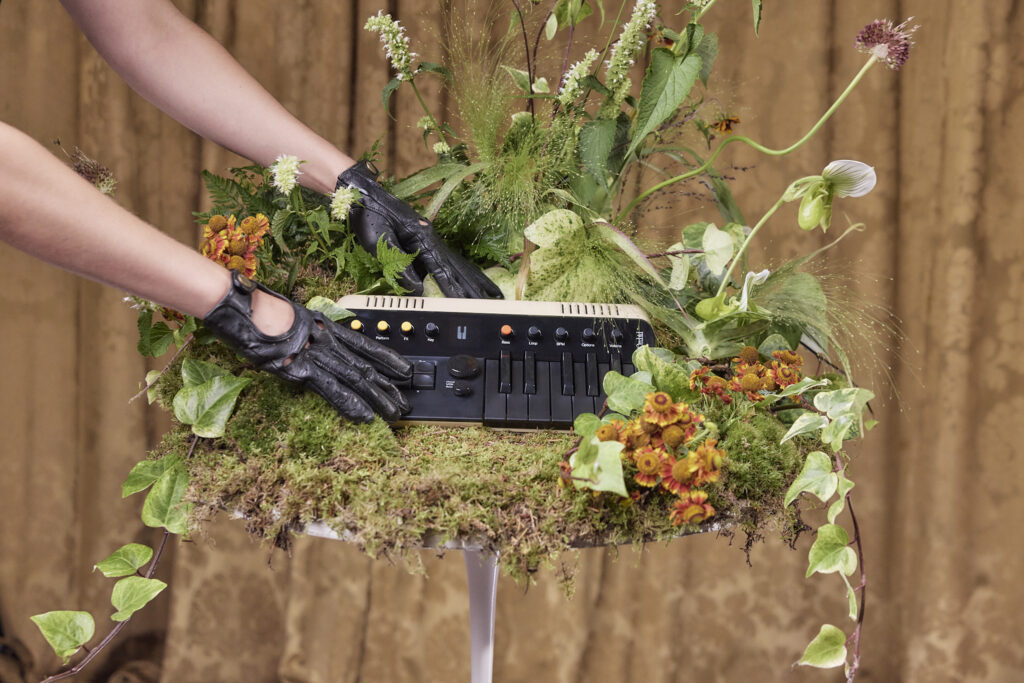
Tom holds up a small rectangular unit, smooth, rounded sides, with a limited keyboard, only a few knobs and a small centre screen that displays notes like ‘G’ or F#’. “We call Orchid an ideas machine.” It’s a portable, battery-powered synthesizer with built-in speakers and a chord button system: “These are your chord buttons – hit major and then press C and boom: C major. You can play complex chords without doing maths in your head.” The point is speed and feel: “We want frictionless capture of musical ideas. You shouldn’t lose an idea while looking for a power cord.” He adds: “Even if you don’t know much theory, you play a chord and go, ‘Oh yeah, that feels right.’ You can find what’s on your mind.”
Who’s using Orchid?
“It’s a really interesting range,” he says and goes on to explain:
“There are DJs and producers who excel at sound design and drums but “theory wasn’t on the radar” Orchid “opens that door” in an accessible way, he reckons. But the product also appeals to hobbyists who “want something on the coffee table to tinker with, like picking up a guitar at a campfire.” Because it’s so flexible, Orchid is also popular with professionals on the move. He says it’s brilliant for impromptu jams or tinkering. “Because it’s battery-powered and has speakers, you can pull it out on a plane, play ideas, save your loop, and finish it when you’re home.”
There’s companion software as well – what does PISTIL (named after another part of the orchid flower) actually do?
“PISTIL opens the hood”. Explaining further, Tom says that when designing, they kept Orchid’s surface “simple” on purpose – “too many options can burden creativity” – but “if you’re a sound nerd, PISTIL lets you design your own sounds from scratch or take Kevin’s sounds and make your own versions.” In other words, the companion software gives users the opportunity to go further, to create deep sound design, without having to contend with an over-cluttered front panel on the Orchid device itself – simplicity for flow, depth when you want it.
Where can people buy Orchid, and how fast do they sell?
“Telepathicinstruments.com.” He’s frank about demand: “Each time we go on sale, we sell out. We’re not trying to do the scarcity thing – it’s just that we can’t make them fast enough.” His advice: “If the store’s closed, sign up to the mailing list – you’ll get an email a few days before we open. … And they sell for about USD $549 (approx. NZD $1112).” He stresses they aimed for “quality materials,” including “recycled plastic where we could,” so Orchid would feel “solid, not cheap,” while still sitting at the lower end of the professional tier.
What’s next for Telepathic Instruments?
“We’re not going anywhere. Orchid has been beyond successful – gratifying to see people love it.” Near term focus is on “new features and updates every few months.” And yes, “There will be future products,” he grins, “but if I say more, our branding team will hunt me down.” He’s energised: “It’s exciting to be back where someone can say, ‘What if it did this?’ – and I can go build something.”
You’ve long turned real world data into sound. Does that still drive you?
“Absolutely. I love taking weather patterns, the stock market, human brainwaves – seeing them move – and asking, how can I translate this into sound? That gives me great satisfaction.”
Final one: how do you feel about AI in music making?
“We’d be silly not to discuss it,” he says of Telepathic’s internal conversations. “Orchid has smart algorithms, but no AI.” His concern is the journey: “If you fire up an AI and say, ‘Here’s a chord – write me the next eight,’ you’ve lost the adventure. Music is about enjoying the journey.” His metaphor lands: “Going straight to the end is like flipping to the last page of the book.” He prefers tools that help you explore: “Sometimes I play Orchid for half an hour before bed – it feels like a meditation. My life’s better because of it.”
Related Acts:
About the interviewer Tim Gruar

Tim Gruar – writer, music journalist and photographer Champion of music Aotearoa! New bands, great bands, everyone of them! I write, review and interview and love meeting new musicians and re-uniting with older friends. I’ve been at this for over 30 years. So, hopefully I’ve picked up a thing or two along the way. Worked with www.ambientlight.com, 13th Floor.co.nz, NZ Musician, Rip It Up, Groove Guide, Salient, Access Radio, Radio Active, groovefm.co.nz, groovebookreport.blogspot.com, audioculture.co.nz Website: www.freshthinking.net.nz / Insta @CoffeeBar_Kid / Email [email protected]
More by Tim Gruar
Album Review: Motoring For Beginners
MNZ Interview: Capital City Big Band
MNZ Interview: Louis TM

MNZ Interview: Tourist
Album Review: Te Ngahere
EP Review: Welcome To The Dance Bunker

MNZ Interview: Ones To Watch: Fables

MNZ Interview: Ones To Watch: Heidi Simpson

MNZ Interview: Ones To Watch: Dawson