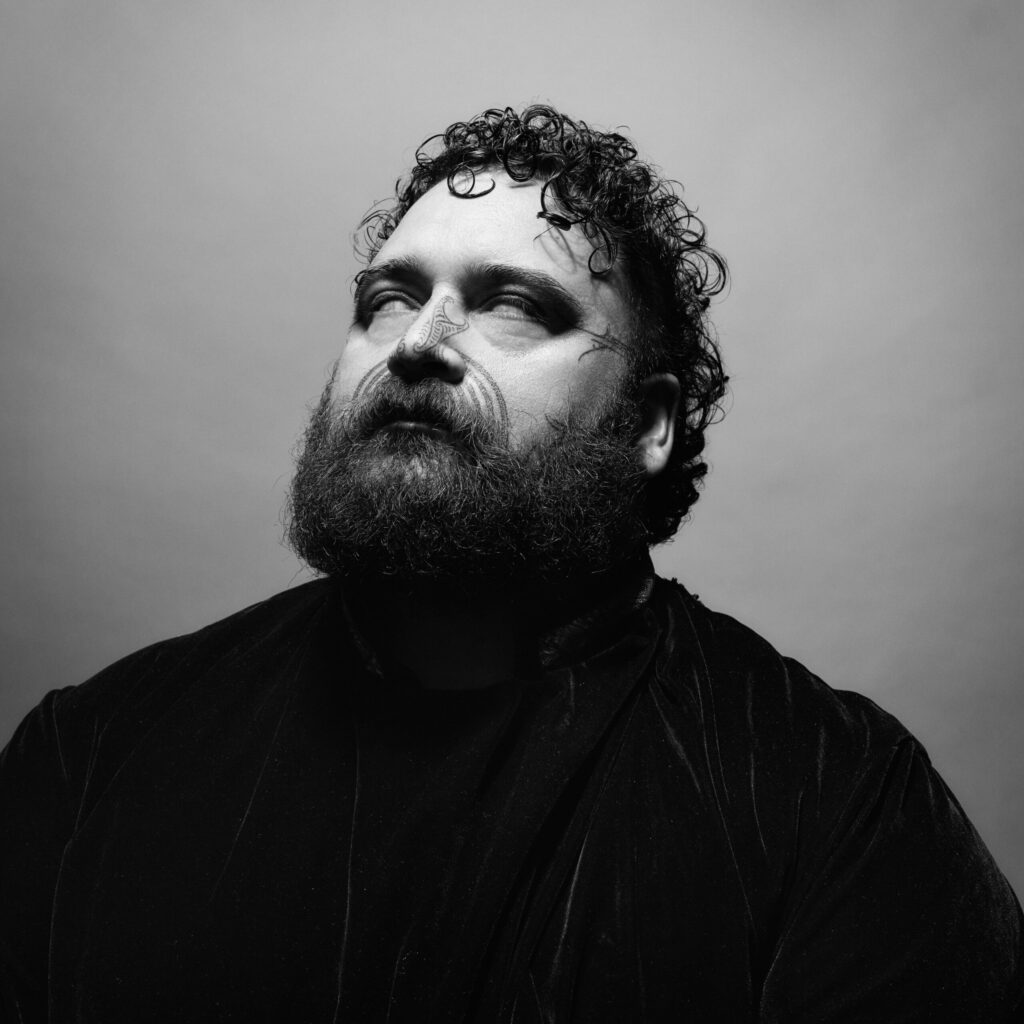
Troy Kingi is bringing his latest project to Pōneke’s Lōemis festival next week, where he’ll be performing live as part of the lineup. In the lead-up, Muzic.NZ’s Tim had a kōrero with him about the making of his ninth album, exploring the creative process and the collaborative buzz of working with some of Aotearoa’s top rappers and rhymesmiths.
Let’s talk about your last album, I suggest. Once we’ve navigated the usual niceties and greetings – weather, kids, travel, Mojave Desert recording sessions – we get down to the real stuff. “Which one?” he asks. Troy Kingi Presents: Night Lords dropped late last year, but he’s already moved on, writing and planning for the last in his 10|10|10 series of albums. “It’s gonna be a ‘James Bond’-inspired 1960’s-70’s big band record,” which will be completed at Abbey Road in London in August. “It’s a nice way to finish off.” And he’s building it with string and horn arrangements, working with orchestrator Ryan Youens. The idea was sparked by his brother’s love of Bond – “Roger Moore, principally. He was initially not a fan of Daniel Craig. It was Roger” (because he was smooth-as). I joke that maybe Shirley Bassey might be free. “Ha. If she was… even if she could pop in and say a couple of words on tape…”
Ok, but let’s back up the bus a bit. Night Lords was released on 28 November 2025 but, to date, Troy says there’s not really been an opportunity to take it on the road ‘properly’. So, he says, the upcoming show at Meow Nui in Pōneke will clearly be something special – and possibly unrepeatable. “We’re getting a lot of flak from our Tāmaki fanbase,” he laughs, because “all the MCs are from there (except MĀ)” and yet Pōneke is getting the big showcase. For Troy, though, the timing was everything: “We tried to make sure we found a date where we could all get together,” and that logistical challenge alone makes the concert feel like a rare thing. He’s blunt about the stakes too, telling anyone on the fence to get a ticket because “this could be the only chance to see us – who knows when all the stars are going to align again.”
From there, we jump into the details of the album. Taking on hip-hop and rap is no small feat. Troy explains that the album came together through a highly collaborative process, with most songs built in a single day in the studio. He wanted to avoid “forcing the genre” and instead let the collaborators lead: “I could still be authentic and true to the music and not feel like a phoney through collaboration,” and “I’m not going to put boundaries on anyone. It’s just, let them feel the music, and see where it takes them.” He also stresses how strongly the record hangs together despite the range of guest voices, saying he is proud that “it all feels cut from the same cloth.” The discussion moves through the songs in sequence, focusing on the stories inside them, the featured artists, and how each track found its shape.
There are a mix of ‘legends’ and newer voices on this record that Troy managed to wrangle by “simply DM-ing everyone. And they all pretty much said ‘yes’.” That included Manu from Mokomokai, who contributes the intense rhymes to Hori on a Hoiho – a sharp meditation on Māori identity and dislocation, told from scatterings of historical perspectives. “That is all them,” Troy stresses, making it clear that he didn’t want to over-direct the writing. But what emerged still surprised him: instead of following a fixed album concept, the song turned toward “1800’s wartime… colonial war and pā war, I felt like I was right in the trenches when I heard it.” He describes the title image as something almost mythic rather than literal: “I just picture a man, almost on top of a mountain, overlooking war going on down in the trenches.” The title is intriguing, too – a metaphor that’s multilayered. He praises the group’s gift for invention: “Manu creates new proverbs, new whakatauaki and people go with that.”
Troy talks about MĀ, who appears on Afters, with obvious admiration, calling her “an enigma”. (After all, she did just snap up an AMA for her album Blame It On The Weather.) “Her voice is very unique. I love her style, her fashion sense. She’s just super cool.” He recalls that the sound of the track was sparked by a 1990’s record he was listening to on the way to the studio, and that the final arrangement came from a very simple source: “All I had was a bongo,” which was then manipulated into the track’s shuffling pulse. For him, it’s one of the album’s highlights: “…probably one of my favourite tracks actually… just energy, really cool energy.”
I scroll down the set list and stop at Yammie Blue (featuring Diggy Dupé). Isn’t that a poetic take on a dangerous relationship? Well, it is – sort of. But Troy insists Diggy’s lyrics are much more literal than that. “It’s read as a female,” he says, “but he’s talking about a bike… A Yamaha Motorcycle ‘Yammie Blue’, it’s a colour.” Even the chorus plays with that double meaning: “When we sing it… so it does sound like a risky relationship, but it’s actually extra literal.” The track’s sensual, slippery feel comes from Diggy turn a motorbike into something emotionally loaded without ever fully leaving the machine behind. So, now you know.
Someone you might not know about is Tāmaki Makaurau/Pacific rapper Brandn Shiraz, who features on No Heaven on Earth. Brandn really locked into the broader spiritual concept Troy initially had for the album. “I wanted the record to reflect your beliefs, God with us… energy, universe… whatever it is.” Brandn’s song tapped directly into that idea by thinking about death and “the next chapter after death and meeting people that have gone before you.”
Troy remembers Isn’t How I Remember (featuring SWIDT) as one of the fastest songs on the album to come together. “They walked into the studio, listened, shaped a few ideas, and by the end the day, we had that full song.” Even the late tempo lift near the end came together almost as an afterthought in the final half hour. He reckons the speed of the process matters here, because it helps explain the song’s immediacy – it sounds like a room full of instinctive decisions captured before anyone could overthink them.
My favourite song on the album is Cold War. It has some classic Tom Scott lyrics: “Shots fired, cold blood, no remorse, cannot keep doing this anymore”. Troy says Scott was the one artist he especially “needed and wanted.” “He’s been at the pinnacle of Aotearoa rap for the last decade”. But the track took a winding route: the original idea did not quite land, and then a bassline Marika Hodgson was playing for something else suddenly became the song. “As soon as he heard that bassline, the raps came,” Troy says of Tom, adding that “in like 10 minutes, he just had the words.” That was the first verse. Then there was a hiatus of about 3 months. “Tom didn’t feel he could finish the 2nd verse ‘cause he wasn’t in the same place mentally”. And so, he recommended Adam Tukiri instead. “When he came in, I realised we’ve actually worked together before 6-7 years ago.” So, it was some kind of continuity and familiarity. Troy was careful about that handover – “I wouldn’t want to just marry anyone onto a Tom Scott song” – but says Adam, “absolutely killed it.” The final product, then, becomes a document of transition as much as tension: one artist setting the mood, another completing the emotional arc.
Troy says MELODOWNZ, who appears on C the Sun, was the first collaborator he invited into the studio because he wanted to begin with someone he already knew well: “I just wanted to work with someone that I was comfortable with.” They’d already made several songs together in the past, which gave the session a relaxed foundation. MELODOWNZ later re-recorded his verse because he had been sick on the day and was unhappy with how low and rough his voice sounded. But Troy liked the original and had encouraged him to “lean into” that darker tone. Ultimately respected his feelings, though: “We’ve got to make sure you’re happy with it.” That detail says a lot about the album’s collaborative ethos – polish mattered, but so did the artist’s own sense of truth.
Another track we discuss is Much Too Late, which Troy says also plays with misdirection: “It sounds like it’s actually talking about a lady… [but it’s] actually talking about creativity.” He wrote it with Charlie BeReal while in the desert recording Leatherman & the Mojave Green, after inviting him over for dinner and then finding a creative connection in the studio. Troy loves the roughness of Charlie’s first vocal take, saying the sampled verse sounds “very crusty” but that he likes that because “it’s not too clean.”
There’s a couple of other awesome tracks that we miss out in this conversation (Sudden Dip with Lucky Lance and River Don’t Change the Flow feat. JessB and Rubi Du) but I do have to ask about the ‘hidden’ tracks. Troy notes that about 60% of his albums have these and “it’s kind of expected now – ha ha”. Money, featuring Tipene, and Damned, with “Legend” Mareko, Rizván and Tyna, are part of what Troy calls the record’s “secret architecture” rather than throwaway extras. He says one grew out of an earlier Tom Scott session idea, while the other almost took a different form entirely, but both still feel strong enough to stand on their own.
He also reveals one of the album’s small tricks here: he left guest names off the streaming credits so listeners would have to “listen for the voices” rather than jump straight to their favourite artist. That also let him “sneak my own rap under the radar.”
So, we’re at number 9 of 10, with one to go. Night Lords could be read as a one-off genre exercise, one more box to tick. But I doubt that. This is, by all accounts, a carefully assembled world of voices, instincts and sly misdirection – and one that should hit even harder on stage. That’s what will make the upcoming show at Meow Nui such a drawcard: a Pōneke premiere of the live set, packed with featured voices from across the album, and a landmark event for this year’s Lōemis midwinter festival, which runs across Te Whanganui-a-Tara from 9 to 21 June. As Troy says – grab yer ticket, quick. Disappointment is the darkest FOMO.
Troy Kingi Presents Night Lords, Meow Nui, Thursday 18 June, 2026.
Go to www.loemis.nz for more information
Related Acts:
About the interviewer Tim Gruar

Tim Gruar – writer, music journalist and photographer Champion of music Aotearoa! New bands, great bands, everyone of them! I write, review and interview and love meeting new musicians and re-uniting with older friends. I’ve been at this for over 30 years. So, hopefully I’ve picked up a thing or two along the way. Worked with www.ambientlight.com, 13th Floor.co.nz, NZ Musician, Rip It Up, Groove Guide, Salient, Access Radio, Radio Active, groovefm.co.nz, groovebookreport.blogspot.com, audioculture.co.nz Website: www.freshthinking.net.nz / Insta @CoffeeBar_Kid / Email [email protected]
More by Tim Gruar
Album Review: Motoring For Beginners
MNZ Interview: Capital City Big Band

MNZ Interview: Louis TM

MNZ Interview: Tourist
Album Review: Te Ngahere
EP Review: Welcome To The Dance Bunker
MNZ Interview: Ones To Watch: Fables

MNZ Interview: Ones To Watch: Heidi Simpson

MNZ Interview: Ones To Watch: Dawson