Gig Review: Shayne P. Carter @ Lōemis Festival, Michael Fowler Centre, Wellington – 19/06/2026
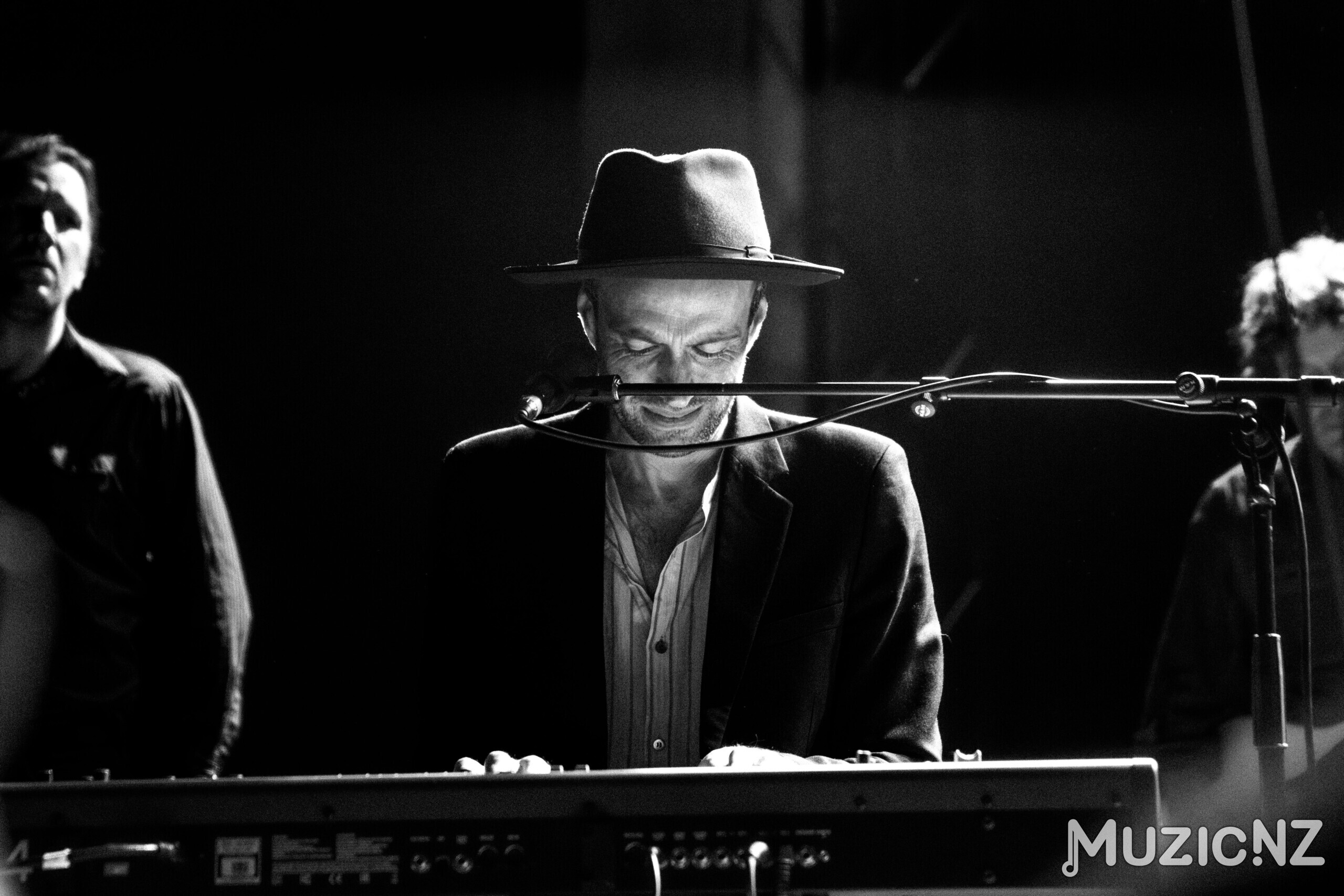
In a collision of Dunedin noir and orchestral grandeur, Shayne P. Carter joined forces with the NZSO to ‘REform’ his iconic songbook – unleashing its world premiere in a bold, one-night debut at Wellington’s Lōemis Festival. Jonny Marks and Isaac Smith didn’t so much open the evening as test the walls of it. Before Carter and company arrived to deliver REforms in full, the Wellington duo took the stage with a set that was incredible, confrontational, and probably a little polarising – which, in this context, felt exactly right.
Marks and Smith are a Pōneke experimental pairing associated with the free-form world of Pyramid Club, and their performance leaned hard into that lineage. It began with Mongolian throat singing processed through synths and pedals, then swerved into Tom Waits-like crooning, possibly in patois, and other genres, enhanced by Indian chants, avant-jazz clarinet impulses, hand percussion, some double bass, bells, bass drum pulses, and a temple-like drone coaxed from an amplified squeeze box. If that sounds overstuffed, it was – gloriously so.
They had promised to “warm up our ears”. For some, it may have felt closer to singeing them. A few audience members made discreet but determined exits, which is no small feat in a near-full seated theatre. But there was real skill beneath the provocation. Throat singing is brutally difficult, and Marks bent and stretched his voice with astonishing control, while Smith’s shifting textures gave the set its strange, ritualistic architecture.
It was niche, no question, and not designed to flatter the room. But as an ear-cleanser before Carter’s orchestral reinvention, it worked. It reminded us that sound can still be unstable, handmade, awkward, ancient, comic, and thrillingly difficult. For some listeners, perhaps, this kind of music is like Lego: fascinating to build, less fun to watch someone else assemble. Personally, I admired the challenge.
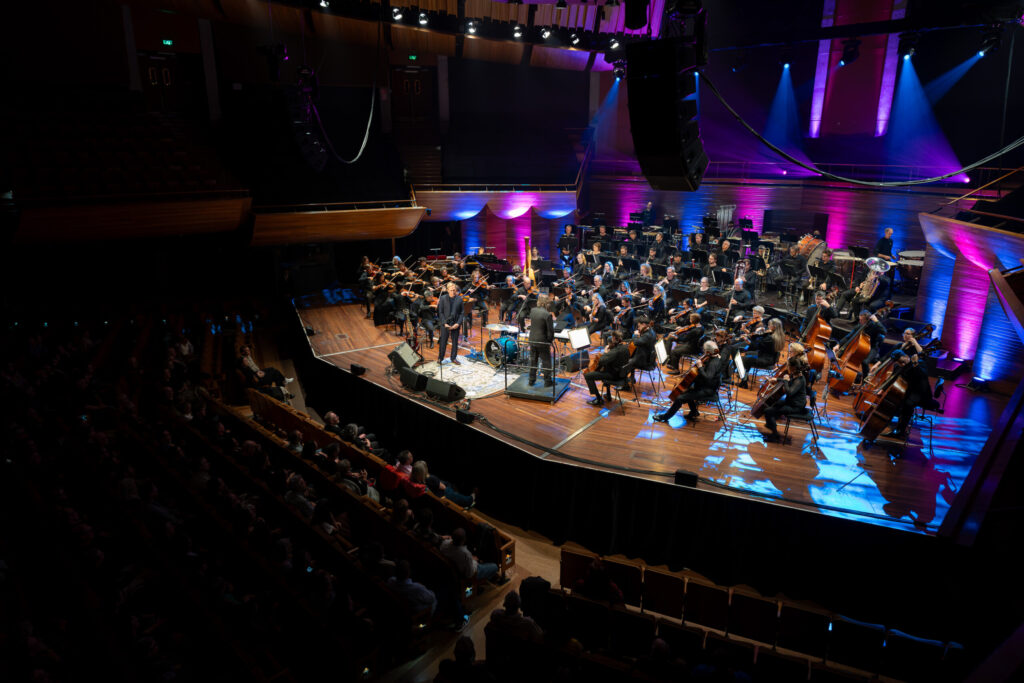
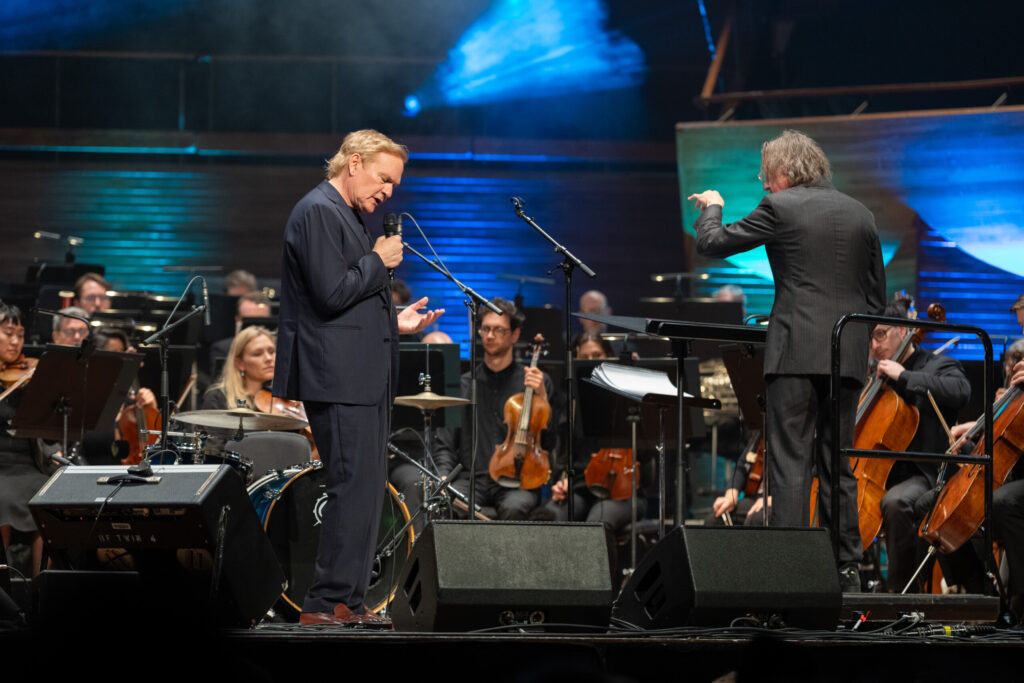
Then came Carter, stepping into a very different kind of risk. REforms is one of Aotearoa’s most ambitious orchestral-rock projects: ten songs from across his catalogue rebuilt from the ground up with the NZSO, arranged by Tane Upjohn Beatson and conducted by Hamish McKeich. This was no polite crossover exercise; no rock songwriter draped in tasteful strings. It was a full-scale collision between Carter’s jagged songbook and the physical might of our national orchestra.
Presented as part of Lōemis, Wellington’s midwinter festival of gloom, ritual, and odd illumination, the concert had the feel of an event before a note was played. This was the very first time the NZSO and Shayne Carter had performed REforms. It was an event to savour. Carter’s songs have always lived in tension: between melody and abrasion, swagger and vulnerability, punk instinct and sculptural sound. With the NZSO behind him, those tensions didn’t dissolve. They exploded.
With Carter, stalking awkwardly about the stage, the orchestra played REforms all the way through, beginning with the brooding lift of We Will Rise Again and moving into a version of Drop You Off stripped of its familiar beat-driven momentum but loaded instead with suspense, shadow and orchestral pressure. These were not cover versions of Carter’s songs. They were excavations. Upjohn Beatson’s arrangements seemed to dig under the tracks, find their darker minerals, and bring them to the surface.
Crystalator became the first real detonation. “This is the only one I play on, and I’m going to enjoy it,” Carter announced, strapping on his guitar before throwing himself into a heavyweight bout with the orchestra. The song bristled and surged, guitar and ensemble trading blows until the air itself seemed charged. It was one of the night’s clearest reminders that Carter has never treated noise as decoration; for him, sound is pressure, shape, resistance.
If I Were You followed with fresh menace, its once-familiar contours made stranger and more cinematic. Then Mat opened out into something almost operatic. Carter explained that it came from a Covid-era piano project, written while he was absorbing classical music and imagining an anti-hero standing amid the destruction he had created. In the hands of the NZSO, that idea grew huge – not bombastic, but inevitable, swelling toward a climax that felt both grand and ruined.
Carter’s between-song commentary was dry, awkward, funny and disarming. On Left to Defend, he brought out old Dimmer collaborator Garry Sullivan on brushes, introducing him with the line, “Giz it a go, Gazza, don’t f*ck it up.” Sullivan didn’t. The result was angular, beautiful, and faintly menacing, with the brushed drums threading a nervous human pulse through the orchestral mass.
The emotional centre of the night arrived with I Know Not Where I Stand. Carter told the audience it would have been his father’s birthday, and that the song was written for him: a Māori child raised by Pākehā parents. Suddenly the concert’s scale narrowed into something intimate and unresolved. The orchestral treatment was full of empathy and restraint, building slowly like water rising under a floor. Its questions of identity, loss, naming and belonging hung in the hall long after the final line.
Just A Moment and Randolph’s Going Home showed how elastic Carter’s writing can be. The songs survived radical treatment because their bones are strong. Randolph’s Going Home, the standard bearer for Carter’s rock legacy, lives a completely different life. With the tribal stomp of the timpani at the beginning and the shrill persistence of the strings, the sonic bulk from the orchestra provided a new weight to it and it changed the mood completely. I could almost imagine this becoming a march track. I never thought I’d say that out loud.
What made the performance succeed was that the NZSO never sounded like a backing band. Under McKeich, the orchestra became an equal creative force: breathing around the songs in one moment, closing in on them the next. The promised “heft and glory” was not marketing language. Live, it had weight. You didn’t simply hear the orchestra; you felt it moving through the room.
For longtime followers of Straitjacket Fits, Dimmer and Carter’s solo work, REforms also made perfect sense. His career has always been about restlessness: bending songs out of shape, chasing texture, refusing the obvious route. Here, that instinct was amplified rather than smoothed over. The orchestra gave the songs grandeur, but it also gave them danger.
By the time Waiting Game brought the cycle to its close, the concert felt less like nostalgia than a curious, career-spanning mutation. Carter’s songbook had not been embalmed for the concert hall. It had been dragged into the hall, shaken awake, and allowed to glower under new light.
And then, with characteristic understatement, Carter undercut the scale of it all. It was, he noted, a short concert: only ten songs. At $95 a ticket, which worked out at $9.50 per song. It was a perfect final shrug from an artist who had just watched his life’s work surge through one of the country’s most powerful musical machines – funny, modest, and entirely aware that, on this night, each song had more than earned its price.
Related Acts:
About the author Tim Gruar

Tim Gruar – writer, music journalist and photographer Champion of music Aotearoa! New bands, great bands, everyone of them! I write, review and interview and love meeting new musicians and re-uniting with older friends. I’ve been at this for over 30 years. So, hopefully I’ve picked up a thing or two along the way. Worked with www.ambientlight.com, 13th Floor.co.nz, NZ Musician, Rip It Up, Groove Guide, Salient, Access Radio, Radio Active, groovefm.co.nz, groovebookreport.blogspot.com, audioculture.co.nz Website: www.freshthinking.net.nz / Insta @CoffeeBar_Kid / Email [email protected]
More by Tim Gruar
Album Review: Leap!

Festival Review: Great Sounds Great Part 1 @ Cuba Street Precinct, Wellington – 5/09/2026
Festival Review: Great Sounds Great: The Night Before @ Newtown Village, Wellington – 4/09/2026
Gig Review: Mel Parsons @ Opera House, Wellington – 05/09/2026

Album Review: Descending Dreams
EP Review: Extended Paranoia
Album Review: Brain Storm
Album Review: Ceiling Waves
Album Review: Castle Hill
Gig Review: Parrotdog Presents @ Parrotdog, Wellington – 1/08/2026

Album Review: 4EPs

Gig Review: The Veils @ Meow Nui, Wellington – 04/07/2026