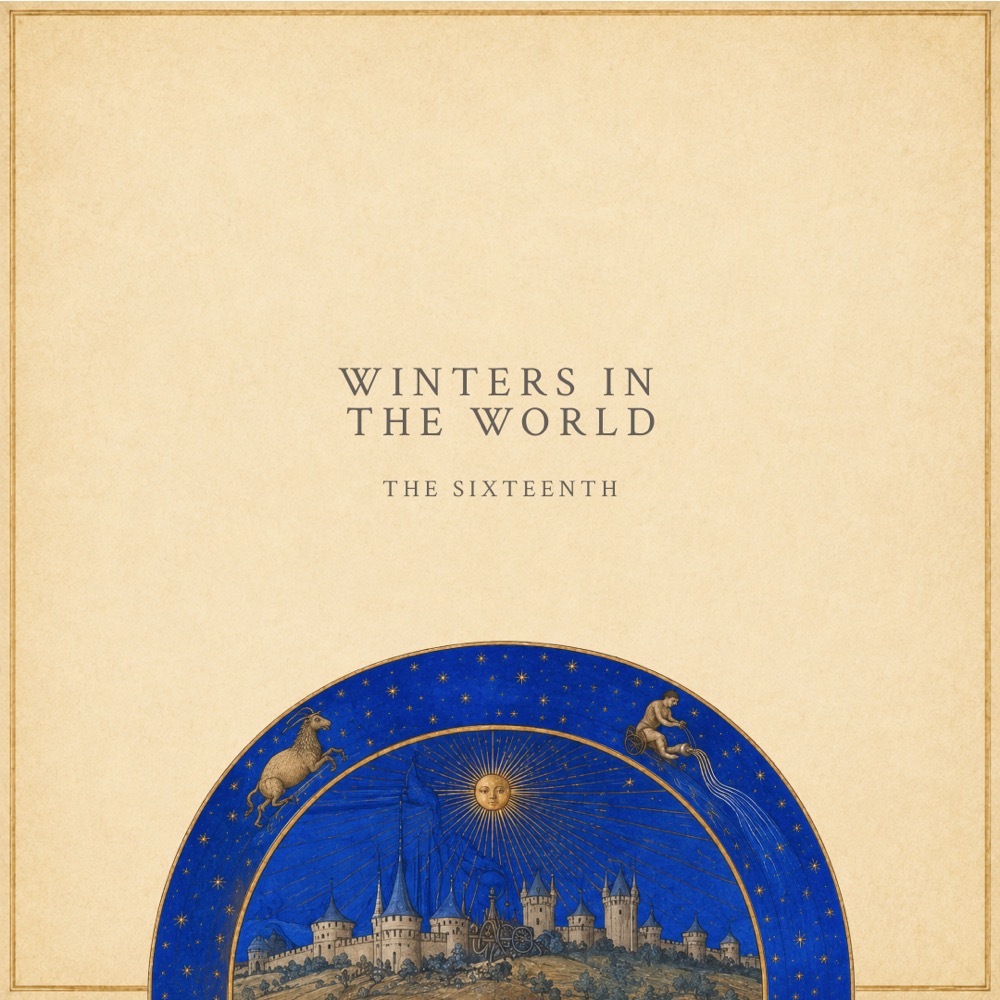
From the first moment Winters in the World began, I had shivers running down my spine. I went into this album with no preconceived ideas and truthfully, it was my first introduction to The Sixteenth, the project of Wellington-based composer Richard Walley. I had no idea what I was about to hear, which perhaps made the slow arrival of the opening track, Winterfylleth, feel even more unsettling.
Inspired by Eleanor Parker’s book Winters in the World: A Journey Through the Anglo-Saxon Year, the album follows twelve seasonal and religious markers from early medieval England. It explores a calendar where pre-Christian customs and the Christian liturgical year existed alongside one another. Advent could sit inside Winterfylleth, Candelmæsse could fall within Lencten and Easter could retain the name Ēastre. One belief system did not completely erase the other. Instead, traditions gathered in layers.
That same sense of layering runs through the music. Orchestral composition, ambient sound design and progressive house are allowed to occupy the same space without being forced into an obvious resolution. The album feels suspended between histories, genres and worlds. It is frequently beautiful, but never entirely comfortable.
The opening Winterfylleth sets the tone with long, sustained notes that rise and disappear before they can offer any real emotional release. There is something deeply eerie about the way Walley allows tension to remain unresolved. The music breathes, but it never completely relaxes. Deeper tones slowly appear beneath the surface, almost as though something ancient is waking under the ground.
Throughout the record, I found myself wondering whether Walley had been influenced by composers and artists such as Gustav Holst, Danny Elfman, Anthony Ritchie or even Aphex Twin. There is some of Holst’s cosmic weight here, particularly in the way the orchestral movement suggests something far larger than the listener. Elsewhere, the music carries the theatrical darkness of Elfman, the dramatic tension of Ritchie and the electronic unease of Aphex Twin.
These comparisons are less about direct imitation and more about the strange musical territory the album inhabits. There is something classical at its core, yet it is constantly disturbed by electronic movement, mechanical textures and moments of genuine sonic unease.
Some tracks are almost entirely acoustic and atmospheric, while others are driven by a clear electronic pulse. Rather than sounding like two separate records stitched together, these contrasting approaches reflect the album’s concept. Just as Christian festivals were placed over older seasonal traditions, electronic rhythms are laid across orchestral foundations without fully concealing what existed before.
Tōcyme introduces the first real sense of propulsion. The suspended shapes of the opening track remain, but a rhythmic pulse begins to give them physical weight. Buzzing tones, circling textures and ticking percussion slowly gather around the music before the beat enters and pulls everything forward.
From there, the album moves between stillness and movement, frequently allowing one to bleed into the other. The music never feels as though it is simply switching genres. It feels more like the seasons changing, with one atmosphere gradually darkening or brightening into the next.
Midsumor was the most intriguing track on the record for me, partly because it feels so different from everything surrounding it. It is the album’s longest and most expansive piece, driven by electronic rhythm, layered synths and distant vocal sounds. There is genuine momentum here, but the music still refuses to offer the kind of clean resolution usually associated with electronic builds and drops.
The track gathers energy, releases part of it and then reforms itself. The beat disappears before returning with greater force, while voices and electronic textures rise through the arrangement. It feels celebratory without ever becoming entirely safe. Even at the brightest point of the album, there is still a shadow passing across the sunlight.
This is followed by Hlāfmæsse, where birdsong appears against a shimmering metallic drone. The natural sound does not feel decorative. It opens the composition outwards, allowing the world beyond the music to briefly enter it.
There is something here that recalls the pastoral stillness of the garden scene in Charles Gounod’s grand opera Faust even though the album itself is nothing similar… perhaps the vibe more than anything. In that part of the opera, Marguerite is surrounded by beauty and apparent calm while something far darker is already beginning to close in around her. Hlāfmæsse carries a similar tension.
The birds suggest openness and peace, but the metallic drone beneath them prevents the moment from ever feeling entirely safe. It is peaceful in the way a clearing can be peaceful just before you realise you are not alone.
Mihhelmæsse feels particularly suited to film or game scoring. Its flickering electronic lines move almost like a digital form of counterpoint, with separate musical ideas circling, interrupting and responding to one another. A restless bass line pulls underneath while higher textures dart across the surface.
At first, the track can feel slightly jarring. There is a lot happening and Walley does not simplify the arrangement for the listener. It requires an open mind and a willingness to sit inside a structure that does not immediately reveal itself.
Once you accept that instability, the piece becomes increasingly fascinating. It feels like movement through an unfamiliar landscape where every sound could be either an invitation or a warning. There is something almost architectural about it, as though separate electronic structures are being built on top of one another while the ground beneath them continues to shift.
One of the album’s most evocative moments arrives with Ealra Hālgena Mæsse. The Old English phrase means “mass of all saints” and eventually evolved into Allhallowmas, Hallowmas and the language surrounding All Hallows’ Eve.
Even the title carries evidence of gradual transformation. Centuries of language, ritual and belief have folded into one another until the original form is still present, but almost ghostlike. The music seems to move in the same way.
It drifts like smoke across a still lake, slowly obscuring the reflection without disturbing the water beneath it. The synths shimmer like dark glitter suspended in the air. Wind moves through unseen branches. Something small and bright flickers between the trees, where mushrooms gather beneath wet leaves and the boundary between the ordinary world and something older feels unusually thin.
There is dark magic here, but it is not loud or theatrical. It sits quietly among the roots and watches. The whole track feels ancient, luminous and slightly feral, like entering a forest where the trees remember every person who has ever passed through them.
Winterfylleth (Reprise) is a beautiful way to finish the album. It returns us close to where we began, but not entirely. Birds, plucked strings, creaking sounds and other pieces of foley gather around the long-held tones of the opening.
The tension steadily builds, yet the expected conclusion never fully arrives. It feels as though something remains unfinished. Not forgotten or abandoned, but deliberately left open.
That lack of completion is one of the album’s greatest strengths. The final track does not close the circle so much as remind us that the circle was never meant to close. The seasons will turn again. The festivals will return under different names. New beliefs will settle over old ones without completely erasing them.
Winters in the World is not an album that asks to be understood immediately. Its movement between orchestral stillness and progressive house can be confronting, particularly when the listener expects one style to eventually triumph over the other. Walley never allows that to happen.
Both remain present, sometimes harmonious and sometimes rubbing against one another. That tension is the record. It exists in the space between tradition and transformation, nature and machinery, ritual and memory.
It is an eerie, patient and highly visual album that feels naturally suited to cinema, theatre and game worlds, though it remains compelling entirely on its own terms. Beneath the historical framework is a meditation on how humans understand time, how traditions mutate and how the past continues to breathe through the present.
By the time the final notes disappear, it feels as though something has been left unresolved. Not because the album has failed to reach its destination, but because winter is already waiting to begin again.
Absolutely well-deserved 5 stars!!!