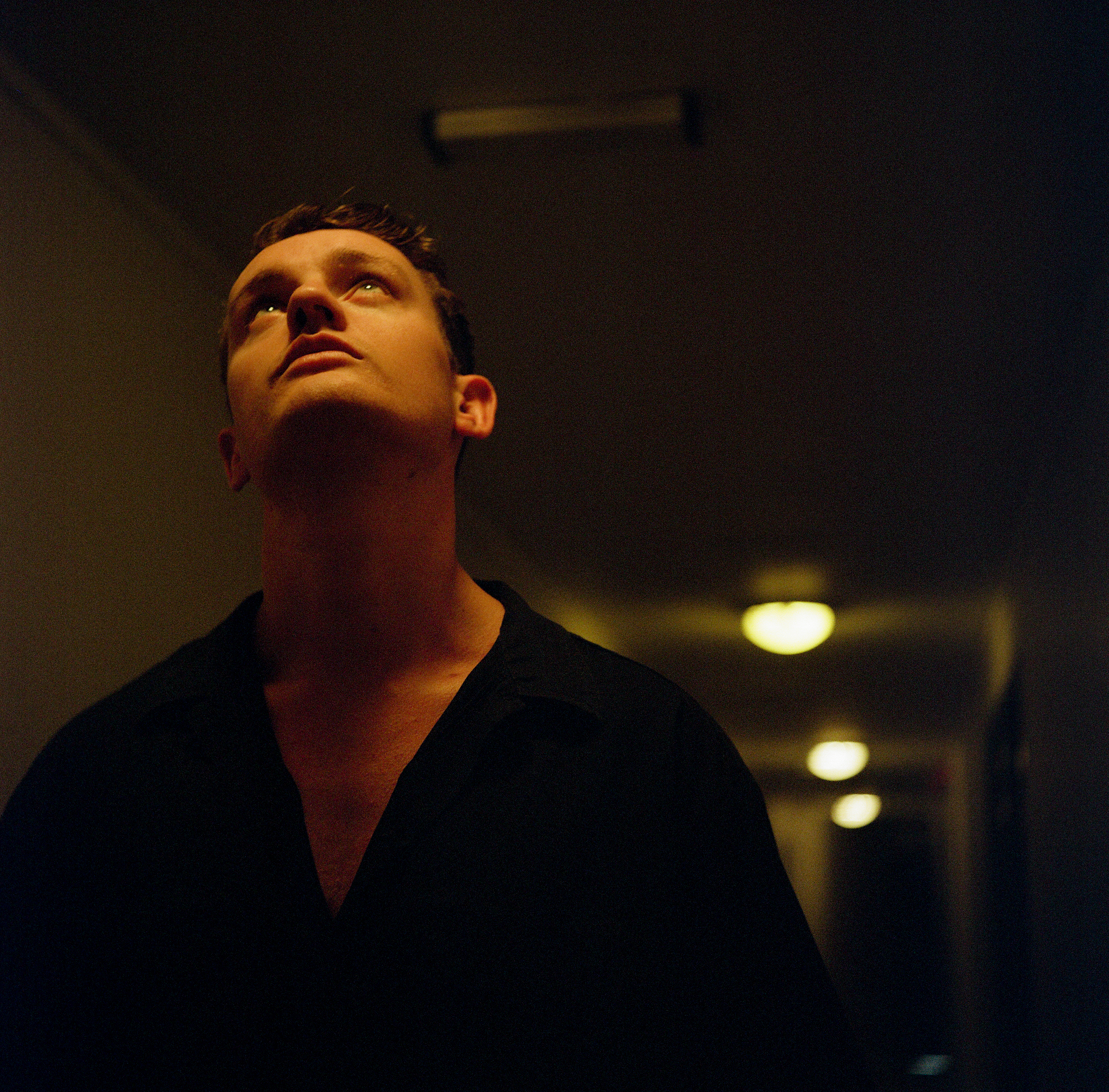
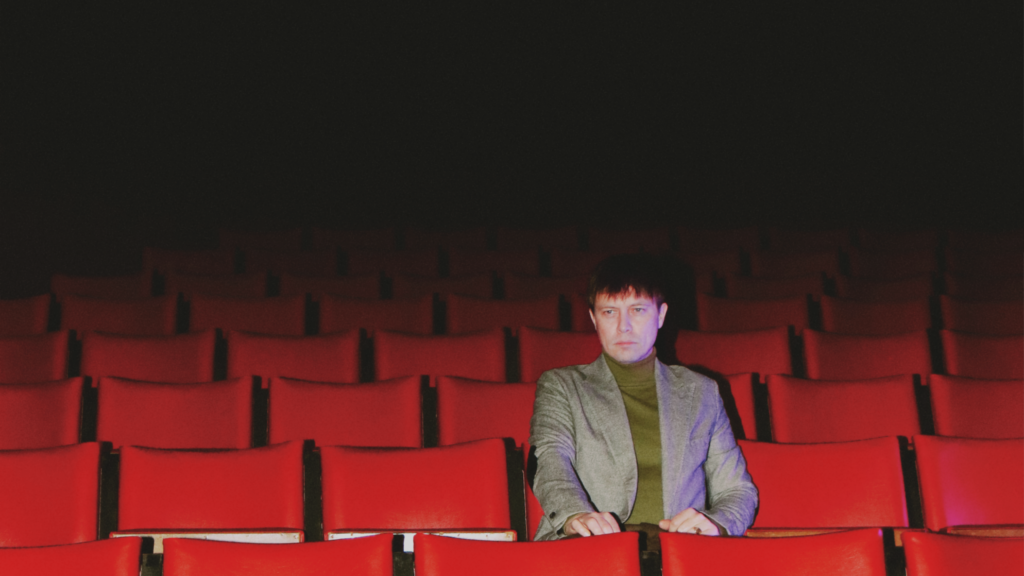
With Cinematographer, the Taite Music Prize-winning songwriter folds documentary, disco, French avant-garde politics and early-2000’s pop memory into a new audio-visual world. The last time I talked to Anthonie Tonnon he’d just been nominated for a Taite Prize. A keen advocate for public transport, he was planning a venture to take his audience in buses to a secret location for a gig. Four plus years on, he’s back on track (pardon the pun) with new plans (and a new album) that blends music, projections and inspiration from the French Situationists and the early 2000’s.
And here it is. The Whanganui-based songwriter and performer has just announced Cinematographer, an ambitious immersive audio-visual show, alongside the single Executive Assistant, which has just been released. Co-produced with Jonathan Pearce (The Beths) and mixed by Bevan Smith, the song introduces a project that moves well beyond a conventional album campaign, combining live electronic music, cinematic storytelling, visual DJing, film, bespoke styling and stage design.
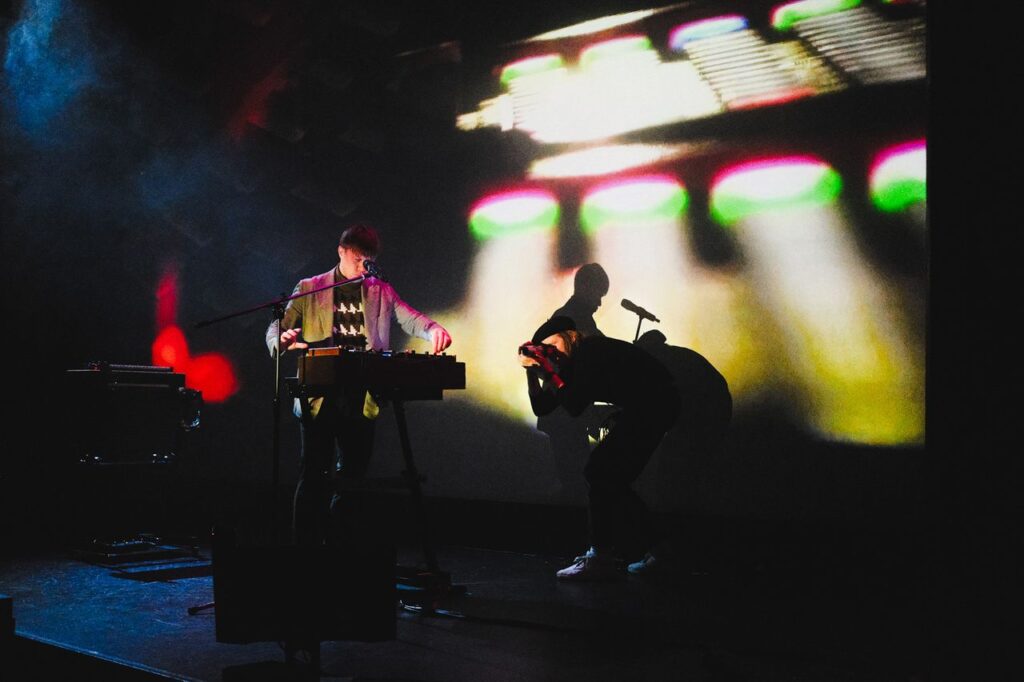
Tonnon catches me up on his work on Cinematographer, three years in the making, exploring “everything from French avant-garde cinema and Situationist politics to turn-of-the-millennium dance music and the landscapes of Whanganui.” Gives it a more vivid shape, he talks personality about the project: “Cinematographer is part documentary, but I am the narrator and I am on stage, playing through the images for you. It’s part performance lecture. It dives from being a music video, with this wall of moving image and music, to me doing a very glamorous slideshow. And it is part disco, so I am performing as if I am a DJ.”
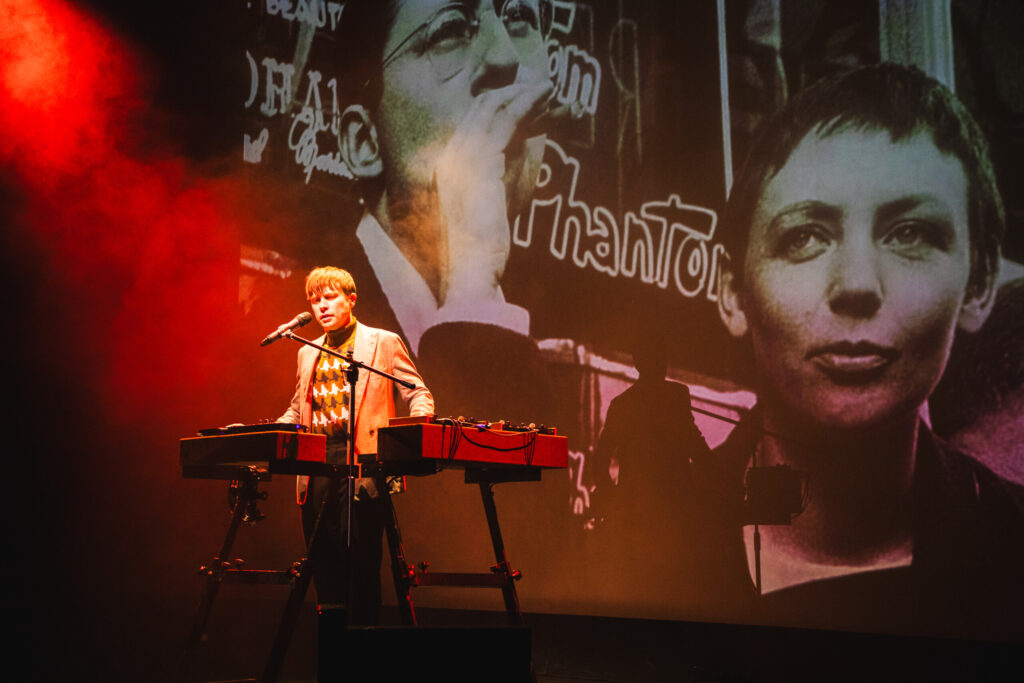
Work, high school, public transport are common themes in his work. The principal theme behind Two Free Hands (2017) centred on a career advisor and the post-high school journey. And we are back there again, sort of: “My last years of high school, around the 2000’s – when high school kids were listening to The Chemical Brothers, Moby or Sophie Ellis-Bextor. It’s a big meld between all of these things, but we’re also telling a story.”
The story at the centre of Cinematographer is the Situationist International, he tells me over a coffee at a downtown capital café recently. They were the European revolutionary art movement associated with the political and cultural upheavals of May 1968 in France. “They nearly overthrew France in 1968 – or at least they would claim it, and some would claim it was them. They were a very mysterious group that sort of melted away.”
But why did they appeal to him? Tonnon goes straight to the mix of comedy, style and genuine intellectual force at the kernel of the movement. “Because they’re just beautiful and funny,” he says. “They come straight out of a Wes Anderson movie: turtlenecks and blazers, trying to save the world from advertising. They were so grandiose to the point of ridiculousness, but they had some incredible ideas that have really lived on – probably the one with the longest life is détournement, a revolutionary technique to save us from what they called the spectacle.”
For Tonnon, the Situationist idea of “the spectacle” is not a museum piece. It connects advertising, film, politics, pop culture and the modern collapse of lived experience into image. “The idea was that when you create big, bold images, particularly in things like advertising or film, you actually steal the underlying reality, and all we’re left with is just the image. And so they claimed that the world had just become one big image, and underlying lived existence was being stolen.”
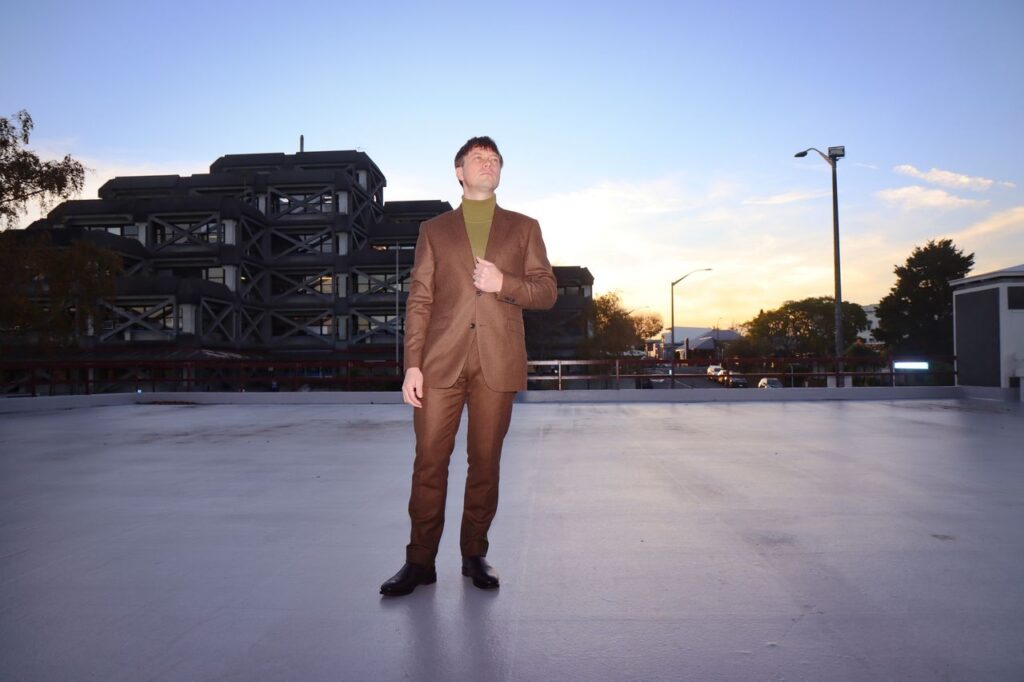
Explaining further, he says the Situationists tried to resist that, taking existing advertising or film images and turning them back against themselves. That idea gives Cinematographer its conceptual charge, but Tonnon is just as interested in the strange loop between the 1960’s and the 2000’s. “It’s funny, the through-line between the 60’s and the 00’s,” he says. “In the 00’s, we were thinking about the 60’s a lot. We were watching Austin Powers, and one influence on me as a teenager was Adbusters.”
That magazine, along with Naomi Klein’s No Logo (her 1999 anti-corporate globalization book about branding, consumer culture and resistance) and the later language of Occupy Wall Street (protest movement), gave him an early sense that “logos were the oppressor.” Years later, while looking for a story that could carry his new music, he traced those ideas back to their source. “We were looking for a story that fit this music,” he says, “and the music is of the 00’s. It’s me finally trying to make dance music. I mean, it’s still pop, but it’s dance-pop music.”
The move into dance music grew out of Tonnon’s earlier experiments with narrative performance. His work on planetarium shows and Rail Land (2018 – his train-based touring project celebrating and exploring our passenger rail network) taught him how to build a “sound bed” beneath ideas and speech, almost like a scored lecture. But after taking audiences on trains to community halls, he wanted a show that could carry the same sense of occasion without depending on railways, buses or unusually specific infrastructure.
“What can you do that is a bit different?” he asks. “For me, songwriting is the main thing. Songwriting is still sacred to me. I don’t write songs thinking, ‘What wild show can I build around these?’ The songs have to lead.”
Executive Assistant became the breakthrough. The song’s narrator is not the assistant but the executive: smug, insulated, in love with delegation and convinced that hierarchy itself is proof of genius. “The executive is pretty chuffed with themselves,” Tonnon says. “If he can just stay still, the interest will compound and the contracts will come in. And of course, he expects the executive assistant will fall in love with him.”
The joke widens into a sharper social observation. For Tonnon, the song catches a particular New Zealand fantasy: the romance of being the ideas person while someone else handles the labour of delivery. “We all want to have the great idea and get the pat on the back,” he says, “but we want someone else to do the pain and hard graft of delivery. In terms of the deeper themes of this show, it’s a picture of New Zealand society – in the 60’s, in the 00’s and now – and it talks a lot about urban form and the way we do or don’t build our world, and how that’s changed over time.”
There is also a contemporary sting. “AI was making it so much worse,” he says of looking for a video concept. “Everyone was just shouting at AI, ‘Free me, free me, because I’m so brilliant with my ideas. Free me of all the hard email and all the stuff that needs to be done to complete it.’”
Musically, Executive Assistant was built by taking live band recordings and cutting them into something stranger and more synthetic. Tonnon brought Jonathan Pearce into the process early, continuing a working relationship that stretches back to 2015 and includes his 2021 album, Leave Love Out of This. He describes their collaboration as a long-term creative trust, one capable of disagreement as much as agreement: “We have got good at just sitting in disagreement, and not running from the disagreement, but finding times to book an appointment to grind it out.”
The sonic direction came from a band session that was never supposed to become the finished record. Tonnon had the musicians play freely, then returned home with “gigabytes and gigabytes” of multitracks. Opening Executive Assistant, he began chopping up drums, rearranging kicks and snares, and sequencing them into something between live energy and programmed propulsion.
That process helped him move away from the cleaner, 808-based architecture of Leave Love Out of This. “I didn’t feel like I wanted that clinical sound this time,” he says. Instead, the bleed, fragments and human traces in the room began to suggest the late-80’s and early-2000’s production world that shaped his ear. “It sounded like my childhood or my teenage years,” he says, naming Sophie Ellis-Bextor and Moby as reference points. “So, I took it, and I added four to the floor.”
When Tonnon sent the track to Pearce, the producer immediately heard a path forward. Pearce suggested acid, pointing Tonnon toward the sound of the Roland 303. Months later, a version arrived with what Tonnon calls “the busiest bassline I think music has ever had.” Bass player David Flyger then learned and doubled the part, while Bevan Smith’s mix balanced the synthetic acid line with live bass and the rest of the arrangement.
Tonnon describes Smith’s mixing in almost culinary terms: finding “something that’s missing in a certain frequency band the way that a chef looks for something that’s missing from the flavour or the acidity, or the umami of a dish.” It is a useful image for Cinematographer itself, which works by layering music, image, theory, humour and personal memory until unlikely ingredients begin to emulsify.
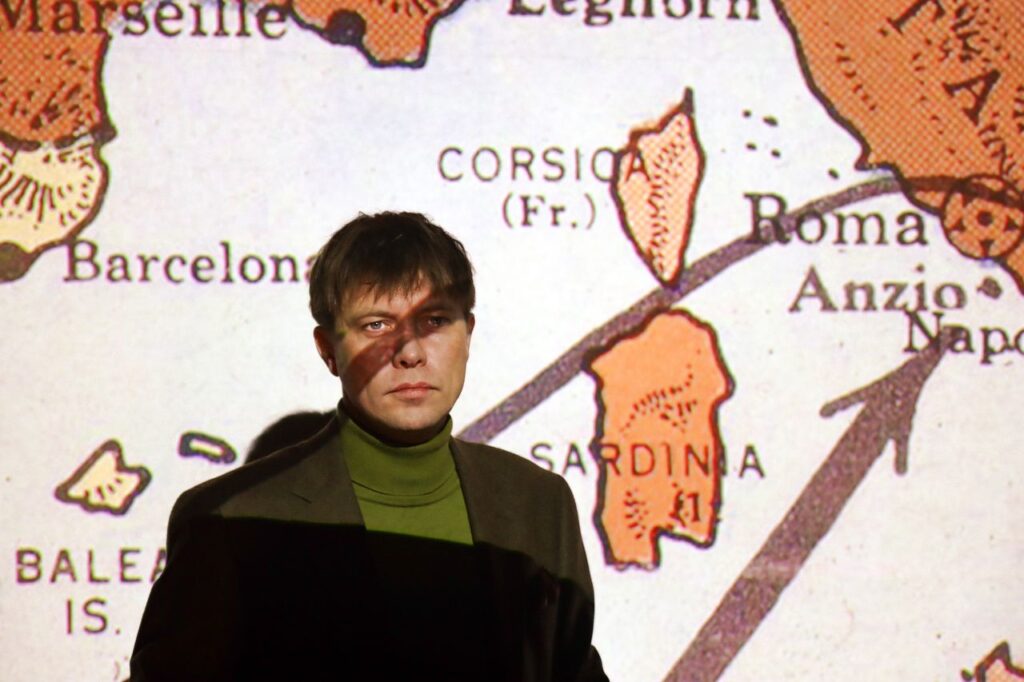
The visual world is just as deliberate. The show features Erica Sklenars as VJ, Theo Taylor on videography, styling by Karlya Smith, and long-time design collaborator Daniel Alexander, also known as Daniel Blackball, on visual design and typography (who also worked on the Executive Assistant video). Tonnon also points to the influence of British documentary filmmaker Adam Curtis, especially the way archive footage, narration and stark text can become an argument in themselves. “It’s not just dance music that the show celebrates,” he says. “It’s also that early-2000’s era of spun archive footage, driven by quirky documentaries.”
That fascination with the 2000’s is not simple nostalgia. Tonnon recalls searching record stores for albums from the era and discovering how strangely hard some of it is to locate physically. “It was just as the internet was taking over,” he says, “so we weren’t as good at making physical mementos.” The same problem, he notes, applies to public transport archives: a Transrail timetable from 2000 can be harder to find than material from earlier decades.
But he is careful to separate reclamation from pastiche. “I’ve never considered myself a nostalgist,” he says. “I never try to make a missing pastiche. I never try to make a covers band. We’re making new sounds. I’m always just trying to rediscover something I think was overlooked, or it’s time for something to come back so that I can say something about the present.”
The live premiere takes that ambition into a full international run. Cinematographer launches across New Zealand, Melbourne and London before further European and UK dates with The Veils. The New Zealand shows are being built around the audience experience, including spaces that allow both standing and seated viewing, while the production team brings together lighting, sound, moving image and performance design.
It is a substantial leap, but not an isolated one. Tonnon’s career has long circled the relationship between songs, systems and places. Mataura Paper Mill examined the social and environmental legacy of a former Southland industrial site. Leave Love Out of This, which reached the New Zealand Top 10 and won the Taite Music Prize, confirmed his ability to turn detailed observation into accessible, literate art-pop. Rail Land turned public transport into both subject and venue.
Cinematographer now pulls those threads together on a larger scale: documentary and disco, lecture and music video, critique and rave, looking back to the Situationists, the 1960’s and the half-remembered texture of the 2000’s while aiming squarely at the present – at the way images, labour, technology and ambition shape the lives people are actually trying to live. Or, as Tonnon puts it, the work is not about dressing up the past for aesthetic comfort, but finding something useful inside it, turning it around, and making it speak again; in Situationist terms, perhaps that is the point: take the image, cut it up, send it back through the system, and see if the dancefloor can still reveal the world underneath.
Anthonie Tonnon presents Cinematographer – Tour
9 October 2026 @ Hollywood Avondale, Auckland
23 October 2026 @ Royal Opera House, Whanganui
30 October 2026 @ Papa Hou, Christchurch
31 October 2026 @ Hannah Playhouse, Wellington
4 November 2026 @ Northcote Social Club, Melbourne
7 November 2026 @ Theatreship, London
Related Acts:
About the interviewer Tim Gruar

Tim Gruar – writer, music journalist and photographer Champion of music Aotearoa! New bands, great bands, everyone of them! I write, review and interview and love meeting new musicians and re-uniting with older friends. I’ve been at this for over 30 years. So, hopefully I’ve picked up a thing or two along the way. Worked with www.ambientlight.com, 13th Floor.co.nz, NZ Musician, Rip It Up, Groove Guide, Salient, Access Radio, Radio Active, groovefm.co.nz, groovebookreport.blogspot.com, audioculture.co.nz Website: www.freshthinking.net.nz / Insta @CoffeeBar_Kid / Email [email protected]
More by Tim Gruar
Album Review: Motoring For Beginners
MNZ Interview: Capital City Big Band

MNZ Interview: Louis TM

MNZ Interview: Tourist
Album Review: Te Ngahere
EP Review: Welcome To The Dance Bunker
MNZ Interview: Ones To Watch: Fables

MNZ Interview: Ones To Watch: Heidi Simpson

MNZ Interview: Ones To Watch: Dawson