
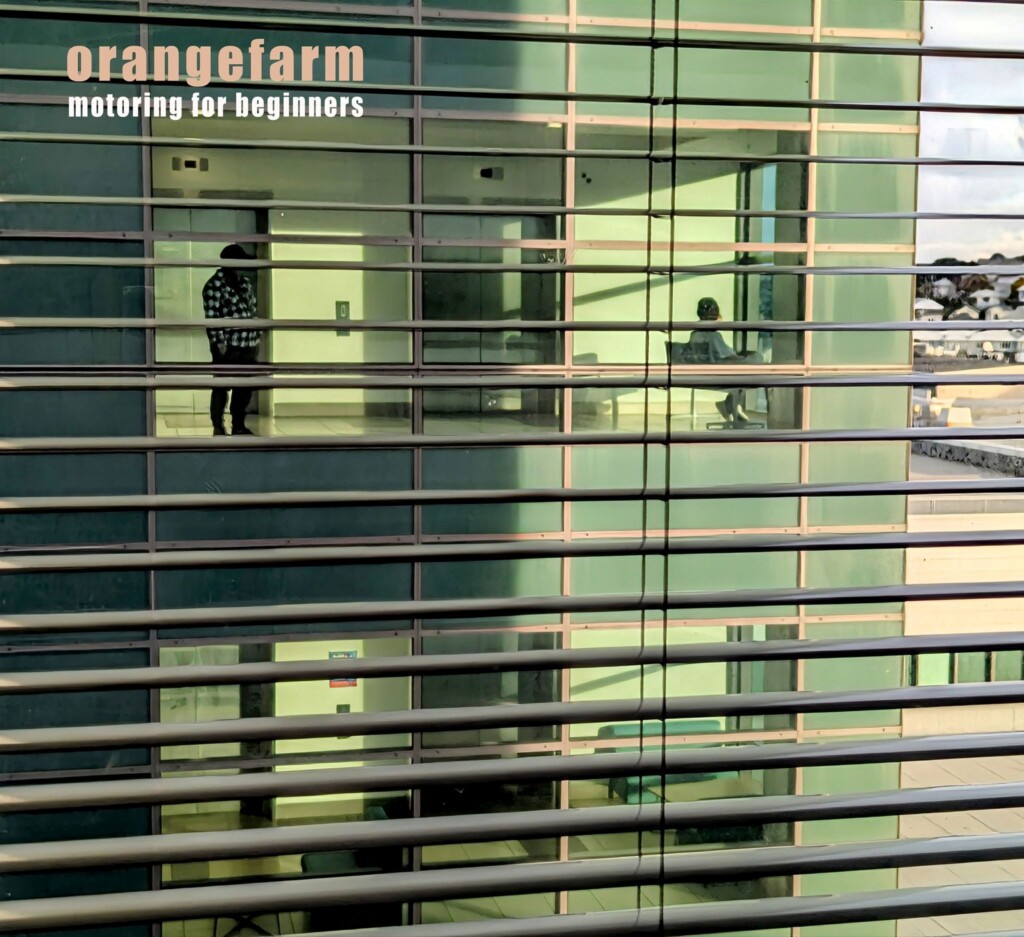
Orangefarm make music for people suspicious of grand gestures. The Wellington band prefers a crooked bass line, a guitar glinting rather than grandstanding, and a French horn arriving like the weather over the Remutakas. Motoring For Beginners initially sounds almost aggressively civilised. Then Nigel Mitchell and Vivien Reid harmonise and the upholstery starts to itch. Beneath the tidy indie-pop sit political nausea, domestic static, grief and the suspicion that self-knowledge is another confidence trick.
Motoring For Beginners, the Te Whanganui-a-Tara quintet’s second modern-era album, turns understatement into a pressure system. Across 15 compact songs – most under four minutes – jangle, dream-pop vapour and post-punk repetition collide with drones, strings, electronics and rhythms that missed the memo about behaving. The warmth is camouflage: hooks smile while lyrics check the exits.
The title is a deadpan joke: after roughly two decades in the capital – and with Mitchell’s musical history stretching back to Ōtautahi Christchurch – Orangefarm are hardly learners. These veteran drivers deliberately mishandle the controls, jolting rhythms, opening strange gaps and letting electronics send the arrangements off-road.
At the wheel are Nigel Mitchell (lead vocals and guitar), Vivien Reid (French horn, bass and vocals), Boyd Dixon (drums), Peter Holm (bass, guitar and vocals) and Clint Meech (keyboards). Mitchell’s dry, compressed writing supplies the chassis; the others tamper with the steering. Holm’s bass stalks, Dixon drags the beat across the guitar pulse, Meech flashes warning lights, and Reid’s horn and voice turn melancholy into climate.
Rob Mayes produces, leaving air between the parts even as the palette expands. Following 2023’s Inheritance, the 2018 EP The Water and 1999’s Joined at the Hip, Motoring For Beginners keeps the earlier record’s bright jangle but dents the bodywork: more rhythmic abrasion, orchestral colour and electronic interference, as if every instrument has been encouraged to argue with the song.
Ok, let’s drop the need and start the engine!
We open with the haunting, gloomy twang of On Reading The Coalition Agreement. Politics enters not as protest chant but psychic residue. The title hints at the agreement formed after the 2023 election, yet the lines claim: “Jesus turned his back on us, ‘cos we closed our eyes. We are on our own again. Sleep now, close your eyes”. It points elsewhere. So, maybe this isn’t entirely political. The sparse lyrics of dread, abandonment and apathy refuse to explain themselves.
More refreshing is Outside Your Car. The pace lifts on a looping bass line, chiming 12-string textures and hazy dream-pop: perfect 90’s rock grooves. Its abstract lyric and widescreen production suggest emotional distance, someone present but beyond reach. The arrangement is beautifully controlled, though the mist can leave the narrative less immediate than the hook.
Affectionate Friction settles into mid-pace. Is this a Shakespearean rip-off? It should be. “Don’t be angry with me” goes the line. Hardly Cupid’s most marketable slogan. “I say what I see”. OK, honest, but brutal – which is why it works. Reid’s autumnal French horn turns long-term love into what it often is: tenderness rubbing against accumulated annoyance. Exquisitely judged, its low pulse can still vanish into the wallpaper.
Nostalgia steers Summer, its fragments of childhood memory set against ringing guitars and overlapping drum cadences. These recollections are fragmented rather than sun-drenched, with enough tension to avoid kitsch. Bright and vibrant, it recalls The House of Love and The Housemartins – my happy-memory late 20th Century soundtrack.
With a nod to another 80’s favourite, Lloyd Cole, Recipe For Loneliness darkens the sky. Uncertainty, separation and isolating habits accumulate rather than follow the method its title promises. Swirling keys, double-time snares and jangling guitars enliven the bridge. Its emotional clarity is a highlight, though the arrangement’s uniform grey may feel overly subdued.
The Choir promises a potent, sumptuous yet lonely journey. “Climb to the top of the hill,” the lyrics suggest; you can see for miles, on and on. French horn and strings widen the frame before an orchestral surge carries the song to its close. It is the clearest evidence of the album’s bigger studio ambition and one of its best dynamic pay-offs. Yet it finishes too soon; I wanted it to evolve, then devolve. Perhaps the meter ran out.
Childhood returns in Burning Hilltop, where a pastoral image is destabilised by danger and distance. Folky double-time drums and twinkling keyboards offset black notes and chords, while the bass rumbles like an accepted irritation. It deepens the album’s unease beneath beauty, though its restraint makes it less distinct than the surrounding set pieces.
Finally, the handbrake’s off. All Your Sister’s Friends rides a psychedelic groove – just a little Sweet Jane – with bright keyboards and a toothy guitar solo driving an uncomplicated romantic proposition. Its 80’s Dunedin jangle won’t define the band, but the wig-out wakes the senses; I can still smell the beer-stained floors of student pubs. Already a live favourite, it is the album’s easiest pleasure and one of the few moments Orangefarm stop second-guessing pleasure long enough to enjoy it.
The title track quotes “Be yourself; everyone else is already taken”, often attributed to Oscar Wilde, over guitars and drums that refuse to settle. The mismatch is clever: selfhood is advice easier given than followed. Compact and witty, it might have carried a larger melodic climax.
Another nod to earlier Flying Nun experimenters, I Wish I Could Think For Myself spins energetic guitars around circling keyboards, recalling Look Blue Go Purple hits from my O-week days. It is self-doubt rendered as forward motion, one of Mitchell’s neatest title-to-arrangement contradictions. The momentum invigorates; the brevity leaves its psychological knot unresolved.
Amplifier returns to 60’s grooves. Loose-hipped polyrhythms alter the album’s gait, foregrounding the band’s rhythmic confidence. Amplification becomes multiplication: parts rub together and generate fresh movement. Flower-child bongos make it adventurous and lively, if less hummable than the straight-ahead pop songs.
My Brother and Me slows down, its exposed guitar and yearning French horn laying bare a meditation on family, loss and an absent presence. It ends too soon: “After the flowers die, after the neighbours stop shaking, no one can heal my heart”. Out of Sight expands that absence and uncertainty into a bigger ballad of shimmering, swarming guitars and full-band force.
The Weather moves gently over a gorgeous undercurrent of distorted guitars, its wind, showers and clouds gathering like a passive but threatening Wellington southerly. Rolling drums, brooding guitar and a vocal duet make the slow build richly atmospheric, though its repetition asks for patience – and leaves you wondering whether this is weather or emotion. Closer B11 then swerves into a nervous electronic sprint, echoed vocals stacked across high and low tones. It feels slightly out of step, almost like an extra pulled from the can, but its melodramatic closing guitar solo still lands.
Inheritance was Orangefarm reappearing in a clean shirt: chiming guitars, compact melodies and reflective lyrics all in place. Motoring For Beginners loosens the collar. Its 1980’s South Island alternative lineage and British and Australian post-punk remain audible, but the record is broader, stranger and less well-behaved. Reid’s horn becomes architecture; Meech colours outside the lines; Dixon distrusts straight time; Mayes leaves room for every small sabotage to register.
The upgrade is obvious: greater variety, deeper colour, more friction. The drawback is that 15 similarly compact songs can become a convoy travelling at one impeccably moderate speed.
Motoring For Beginners makes uncertainty purr. Love, family, childhood, politics, weather and self-doubt flicker past the windscreen, never settling into slogans. Its sharpest trick is sounding settled while dismantling stability: too warm for post-punk, too prickly for dream pop and too suspicious of prettiness for pastoral indie.
If Inheritance found the road again, Motoring For Beginners is Orangefarm ignoring the satnav on principle. Occasionally it drifts towards a bland roadside ditch, and I wanted some journeys fully developed – the promise of epics was right there. The band can conceal a hook so thoroughly it ought to file a missing-person report. But patience reveals the point: this is not cruising music. Jaunty, not jalopy, and far from a car crash, it captures the unease inside motion, made by experienced drivers who know the scenery is never as innocent as it looks.
Related Acts:
About the author Tim Gruar

Tim Gruar – writer, music journalist and photographer Champion of music Aotearoa! New bands, great bands, everyone of them! I write, review and interview and love meeting new musicians and re-uniting with older friends. I’ve been at this for over 30 years. So, hopefully I’ve picked up a thing or two along the way. Worked with www.ambientlight.com, 13th Floor.co.nz, NZ Musician, Rip It Up, Groove Guide, Salient, Access Radio, Radio Active, groovefm.co.nz, groovebookreport.blogspot.com, audioculture.co.nz Website: www.freshthinking.net.nz / Insta @CoffeeBar_Kid / Email [email protected]
More by Tim Gruar
Album Review: Te Ngahere
EP Review: Welcome To The Dance Bunker

Album Review: Leap!

Festival Review: Great Sounds Great Part 1 @ Cuba Street Precinct, Wellington – 5/09/2026
Festival Review: Great Sounds Great: The Night Before @ Newtown Village, Wellington – 4/09/2026

Gig Review: Mel Parsons @ Opera House, Wellington – 05/09/2026

Album Review: Descending Dreams
EP Review: Extended Paranoia
Album Review: Brain Storm

Album Review: Ceiling Waves
Album Review: Castle Hill
Gig Review: Parrotdog Presents @ Parrotdog, Wellington – 1/08/2026