Gig Review: Hikurangi Schaverien-Kaa @ Te Ao Kōhatu Wellington Jazz Festival, Wellington – 18/10/2026
Stones remember. Or perhaps, more accurately, they invite us to imagine that they do.
That proposition drives Hikurangi Schaverien-Kaa’s extraordinary Te Ao Kōhatu, premiered at Tāwhiri Warehouse on the final night of the 2026 Wellington Jazz Festival. Schaverien-Kaa (Ruawaipu and Ngāti Porou) draws on a whakapapa tradition in which the iwi of Te Tairāwhiti, though arriving aboard many waka, are also said to descend from the stones themselves. He treats this not as something to prove, but as a portal into whakapapa, cosmogony, identity and the different ways Māori and Pākehā shape knowledge and history.
In my September Muzic.NZ interview, Schaverien-Kaa recalled actor Eru Potaka-Dewes discussing this idea with his father. Schaverien-Kaa was intrigued by what it reveals about how cultures understand and remake reality. The result could have been forbiddingly intellectual. Instead, Te Ao Kōhatu was visceral, beautiful, abrasive and surprising: loss, reflection, catharsis and whirling colour.
At the heart of the opening piece was Ruby Hinepunui Solly’s Waitaki lithophone: stones arranged like a mineral keyboard. Sitting roughly around a G-major scale, they produce no sanitised concert-hall notes. Each has its own density, attack and decay; their rawness and imperfect tuning are the point. Introducing the piece, Schaverien-Kaa explained that the stones had inspired both its spiritual foundation and its sound.
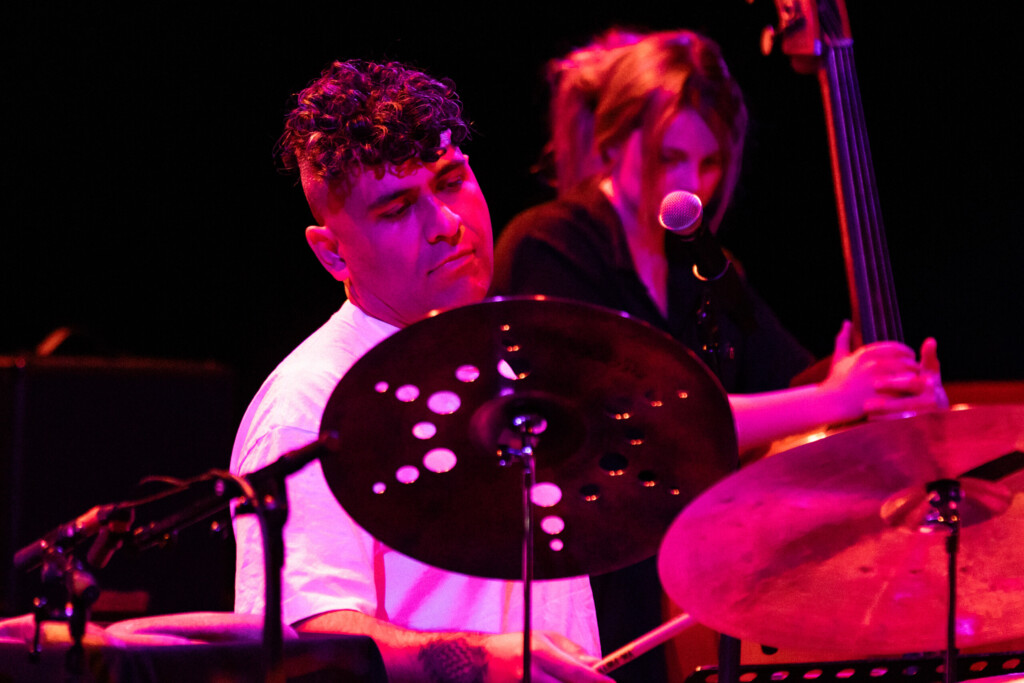
Schaverien-Kaa positioned himself between two ensembles. To his left, The Unknot brought modern improvised jazz: Schaverien-Kaa on drums and lithophone, Emma Hattaway on double bass, Duncan Haynes on piano for all but the final piece, Theo Thompson on guitar and Tyaan Singh on alto saxophone. To his right, with the fabulously provocative name Bub(z) and da Ouncle$, answered with Solly on cello, voice, taonga pūoro and lithophone, Isaac Smith on modular synth and Alistair Fraser on taonga pūoro and ‘electronics’. As Schaverien-Kaa had described it, this ensemble brought “taonga pūoro, modular synth, cello, voice and other textural elements”. Crucially, the groups interlocked rather than took turns: less collision than conversation between ancient and present, te ao Māori and Western musical perspectives.
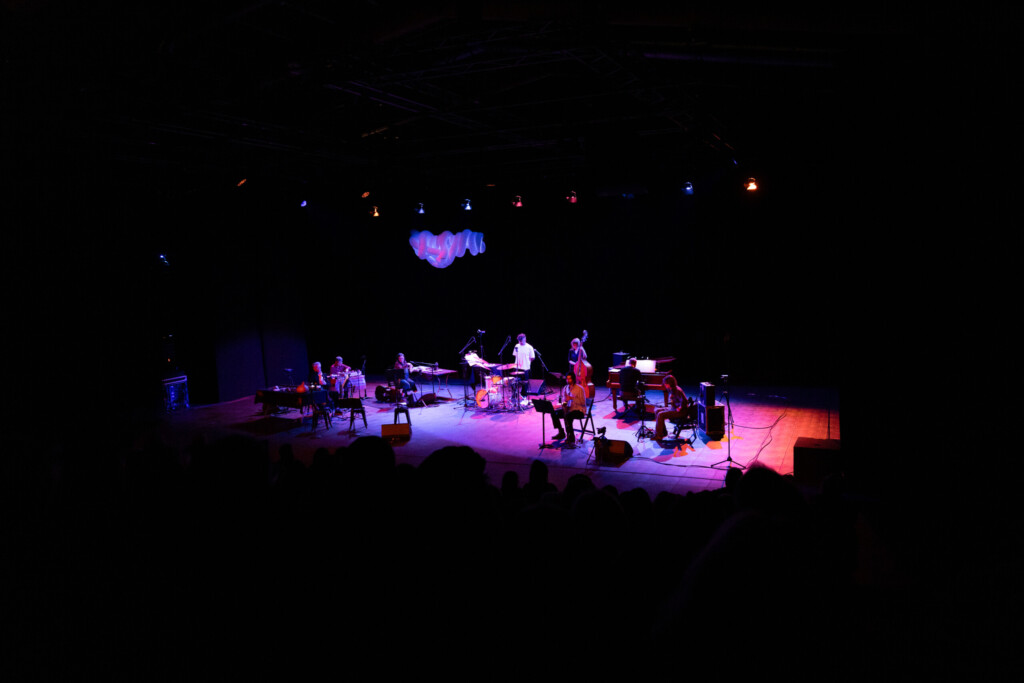
Stage right, Bub(z) and da Ouncle$ worked close to the earth: breath, stone, wood and the textures of te taiao. Solly and Fraser evoked water, air, manu and distant voices without reducing them to effects. Around them, The Unknot spoke in contemporary jazz. The real fascination lay in the territory between.
Smith worked at a table tangled with wires and components, bending simple tones and frequencies into suggestions of forest, river and weather. His modular synth enriched the soundscapes around the taonga pūoro – especially kōauau, pūtātara, pūkāea and nguru. Some of the night’s most organic sounds came from electronics; digital and ancient folded together until the dividing line became irrelevant. At times, it felt as if the forest had entered the room and taken over.
The programme comprised three substantial pieces: the festival commission, Te Ao Kōhatu, followed by two more Schaverien-Kaa compositions. Across the set, the musical vocabulary steadily widened, moving from ritual and elemental texture towards jazz and song without losing the commission’s strange sonic terrain.
Schaverien-Kaa writes more melodically than his reputation as a drummer might suggest. His pieces begin not with rhythm but with a tune, sometimes sung into his phone, then transferred to piano and built out with bass, chords and layered parts. In Te Ao Kōhatu, melody rubbed against texture, improvisation and movement; visual scores mapped intensity over time rather than dictating every note.
That gave the performance its elasticity. A tentative saxophone phrase surfaced; rhythm gathered beneath it; piano offered a harmonic foothold. Then everything dissolved into breath, percussion, electronics and stone. Schaverien-Kaa was not conducting these worlds from the kit. He sat inside both.
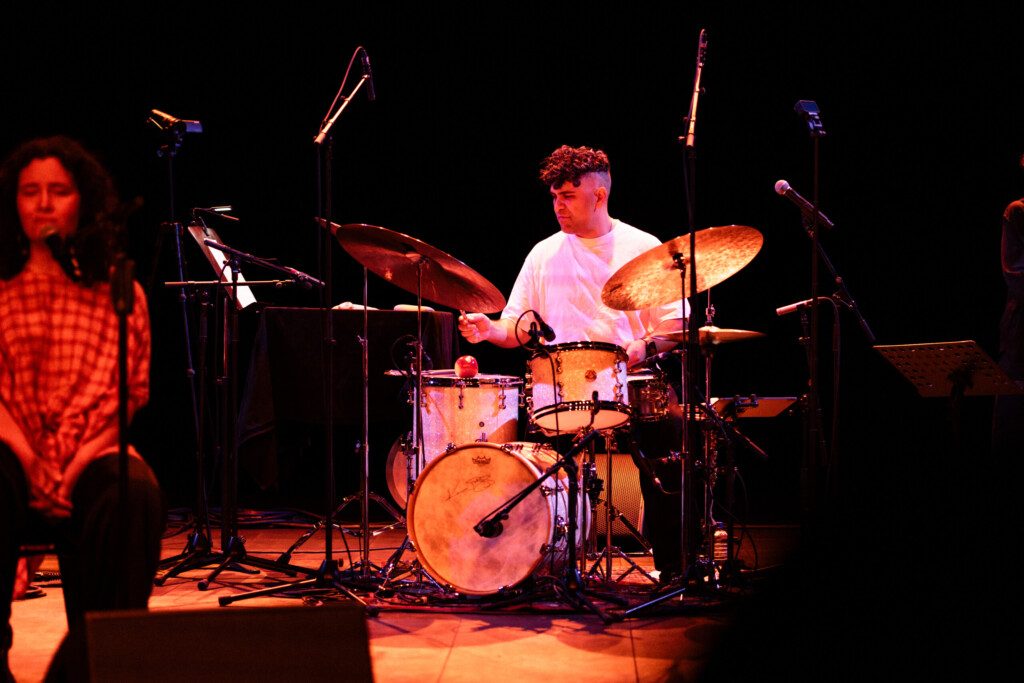
The third piece, Self Portrait of the Artist in a Corner, shifted the emotional temperature with vocalists Ben Lemi, Anna Wooles and Deanne Krieg. Krieg arranged the vocal parts and lyrics – “reflecting my music back on me”, Schaverien-Kaa said. After identity had emerged through instrumental voices and elemental texture, breath became language; language became harmony.
For this final piece, Hector McLachlan, a former student of Schaverien-Kaa’s, took over from Haynes on piano. His solo was beautiful – abstract, meandering, contemplative. Amid so many unusual timbres, this familiar instrument sounded startlingly fresh, gathering threads that had resisted neat resolution.
For all its conceptual heft, this was still jazz – not as a rigid genre, but as attentive listening, improvisation and response from players confident enough to surrender control. Throughout, Singh’s alto saxophone spoke powerfully with the various pūoro.
Solly and Fraser each worked from tables crowded with taonga pūoro, switching quickly between instruments. Every sound helped bind waiata, ngahere and ao wairua. My only grumble: Solly’s lithophone – the commission’s underacknowledged hero – was hard to see. Placing it up front would have made the idea of stones speaking dramatically visible.
Before the premiere, Schaverien-Kaa asked audiences to “listen generously”. He wanted no single prescribed reading, only room for listeners to find their own emotional meanings. That invitation offered a way into the work’s larger questions.
The work never makes us choose between science and pūrākau, Western history and whakapapa. Mātauranga Māori can braid history, cosmology, medicine, myth and allegory, carrying knowledge differently from written Western traditions. Rather than testing the story’s literal truth, Te Ao Kōhatu asks what it reveals about how we construct reality.
Inside Tāwhiri Warehouse, that question became tangible. Metal, concrete, cables and digital technology framed music about stone, whakapapa and the natural world. At the centre sat Schaverien-Kaa: composer, percussionist and bridge-builder.
The most successful thing about Te Ao Kōhatu was that its Māori and jazz elements never felt as though one had been decorated with the other. Neither existed merely to provide exotic colour. Taonga pūoro, cello, modular synthesis, lithophone, drums, bass, guitar, saxophone, piano and voice became different ways of asking the same question: how might sound carry memory?
The stones never answer.
They ring.
And for a moment at Tāwhiri Warehouse, everybody listens.
About the author Tim Gruar

Tim Gruar – writer, music journalist and photographer Champion of music Aotearoa! New bands, great bands, everyone of them! I write, review and interview and love meeting new musicians and re-uniting with older friends. I’ve been at this for over 30 years. So, hopefully I’ve picked up a thing or two along the way. Worked with www.ambientlight.com, 13th Floor.co.nz, NZ Musician, Rip It Up, Groove Guide, Salient, Access Radio, Radio Active, groovefm.co.nz, groovebookreport.blogspot.com, audioculture.co.nz Website: www.freshthinking.net.nz / Insta @CoffeeBar_Kid / Email [email protected]
More by Tim Gruar
Album Review: Motoring For Beginners
Album Review: Te Ngahere
EP Review: Welcome To The Dance Bunker
Album Review: Leap!

Festival Review: Great Sounds Great Part 1 @ Cuba Street Precinct, Wellington – 5/09/2026
Festival Review: Great Sounds Great: The Night Before @ Newtown Village, Wellington – 4/09/2026
Gig Review: Mel Parsons @ Opera House, Wellington – 05/09/2026
Album Review: Descending Dreams
EP Review: Extended Paranoia
Album Review: Brain Storm
Album Review: Ceiling Waves
Album Review: Castle Hill