MNZ Interview: Jo Randerson – Emotion at the Speed of Thought
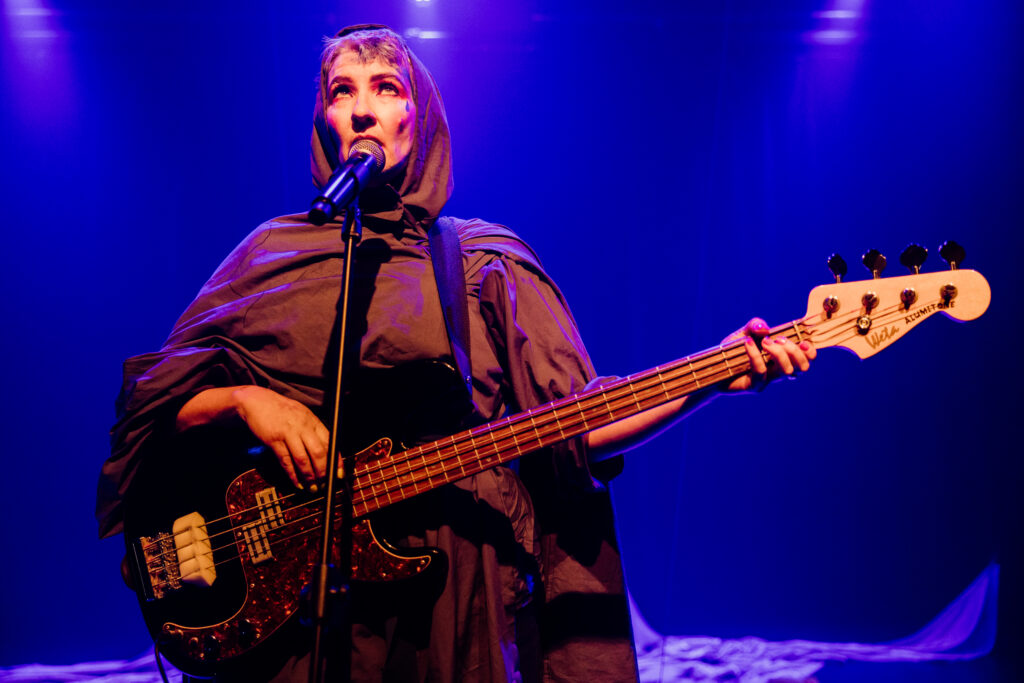
‘ADHD is Hot Right Now!’ claims the advertising for the show Speed is Emotional, coming to the Aotearoa New Zealand Festival in March. It’s a theatre show, described by a reviewer as ‘funny as hell’ by comedian, writer, poet, teacher and sometime musician Jo Randerson ONZM, which ‘unpacks their later-life diagnosis of ADHD, neurodivergent parenting, and dealing with ‘men taking their time’. The work features music, sad songs, comedy, soul-baring dialogue, contributions from their son and husband (on drums) and even a karaoke session all in the service of ‘sharing the exhilaration, exhaustion, joy and absurdity of living and parenting with neurodivergence’.
Jo is a powerhouse of creativity – an award-winning theatre maker, writer, performer, and fearless champion of new talent. In the show Jo dives headfirst into the tough questions we often avoid how society treats psychological disorders, the double standards women face, and the messy, unfiltered realities of parenthood. Along the way, they break down the key symptoms of ADHD in a way that feels real and relatable – mixing up a blend of science and sensitivity, making complex ideas not just understandable, but deeply human.
After being diagnosed with ADHD in their 40’s – shortly after their son was diagnosed—Jo turned that revelation into art. Speed is Emotional, is a bold, unfiltered dive into life with neurodiversity. Expect karaoke. Expect clowning. Expect poetry and stand-up. Most of all, expect a whirlwind of chaos, joy, and raw honesty about navigating ADHD as an adult and a parent. It’s messy. It’s hilarious. It’s emotional. And it’s unforgettable.
When I track down Jo, post-Christmas, they’re calling from their ‘office’ at Barbarian, a theatre production and performance company, which they founded in 2001 – Jo is creative director. Barbarian works out of the very same Vogelmorn Bowling Club that I saw Andrew Fagan play at last month. The former community bowling club is now a revitalised community space with a bar, café, ginger beer brewery, and toy library and a venue and base for Barbarian’s activities.
“We live quite close to the old club”, Jo tells me, “That’s kind of how it all came about, because we were constantly walking past with little kids and pushchairs, and we kept asking about the venue. ‘Why is this massive field abandoned and the building empty so much of the time? We started to think about what we could use it for.”
“People desperately need space and so we started the long journey of trying to negotiate its use, because the bowling club was nearing the end of their life cycle and we could see the opportunity to make it into something else. It’s been an amazing journey to get it where it is today.”
The bowling club transitioned into a community centre around 2014-15 when the Vogelmorn Community Group formed a trust to save it from sale and development. It’s been a community hub for about 10-11 years now and recently celebrated its 10-year milestone.
It’s a common thing – re-use and re-purpose – one that is still strong in the Wellington Arts Community. To look at something that’s decaying, coming to the end of life and identify a new opportunity and repurpose it – whether that be a building, a chattel, or an idea or concept.
One of their missions at Barbarian is the discovery of people’s ‘Creative Superpowers’. Like me, Jo supports the idea of encouraging the arts in education. It’s important, they say to encourage dreaming, thinking, visual, musical and audible skills when possible. Jo knows that some children have skills that are outside the mainstream education templates of reading, writing and arithmetic, which, if identified early can be productively re-directed into meaningful creative pursuits. Their new book, ‘Secret Art Powers’ shows how thinking like an artist could increase one’s resilience, unleash innovative thinking, move away from unhealthy power dynamics, and most importantly help navigate the complex situations we sometimes encounter. This is especially true of people with ADHD, where they don’t always ‘fit’ the mold.
Attention-Deficit/Hyperactivity Disorder (or ADHD) is a neurodevelopmental condition impacting attention, hyperactivity, and impulsivity, with symptoms like poor focus, fidgeting, and difficulty regulating emotions. It affects children and adults by interfering with learning, work, and relationships, often runs in families, and is managed through support and coping strategies and sometimes medication. It is thought that about 5-6% of the total New Zealand population may have ADHD. Ministry of Health Te Whatu Ora recently published data showing 5.3% of children (5-14 years) were diagnosed in 2023/24. However, only a fraction of adults (around 1-2%) have received a formal diagnosis, meaning there is a potentially significant underdiagnosis out there, despite high prevalence.
I ask Jo about their own ADHD diagnosis. Was it a revelation? Did it answer any questions or explain things previously unanswered? They say that was the reason for creating Speed is Emotional, ‘as a way to process that diagnosis’ ADHD certainly explains the rush of creative energy they frequently get: “…sometimes I want to do everything, all at once, the ideas are flowing in all directions, all over the place. And sometimes, you know, it’s beautifully rewarding, but it does take a lot of energy as well. So, I’m hopefully learning how to balance these energies better.”
Jo tells me that ‘finding out’ “helped me to feel ‘seen’ – and to see myself and who I actually am.” More eloquently, they wrote in the Spinoff that they felt like “an archaeologist digging myself up, piece by piece, and slowly stacking my bones together into a skeleton that I recognise.”
In that piece, Jo identifies some of the most common traits – like being unable to sit still for more than 20 minutes, starting multiple tasks that can’t be easily finished, talking too fast, having an overabundance of energy – most of the time.
“People are like: ‘Jo, you shout; you’re so loud! Even the way you walk, you stomp around!’ I’m like: ‘This is just the way that I walk and talk.’ Who determines what is normal? What’s normal energy? Some people are slow. Some people are fast. In fact, I think we’re all kind of slow and fast in different ways at different times and there’s no one right way to be.”
Contemplating career to date, Jo comments: “Maybe if I had known earlier, I might have been able to get a slightly more strategic game plan and not have gone so ‘broad’, stuck at one thing. I guess it’s like I’m a jack-of-all-trades, master of none. Although, someone told me the rest of that quote, it ends with ‘but oftentimes better than a master of one.’ Neither is preferential, generalist or specialist, they’re just different choices. And I’m not into regretting or looking back or going: ‘I wish this. I wish that.’ But I sometimes do look back and feel some sadness for not knowing.”
I asked about the need to identify and be labelled. Has that impacted or changed who they are? “I think of diagnosis as a double-edged sword. It’s helpful to know especially if you don’t understand why you are a certain way. Or if people are always saying to you, ‘you’re too loud and you move too fast’. Then it’s helpful to say: ‘Well, actually, this is a condition, and anyway, maybe you are too quiet, if you want to get judgemental on it.’ I mean, in my dream world, we wouldn’t need labels because everyone would just be able to think: ‘Oh, these people just move at a different pace, and that’s the speed they need to go at to function well.’”
“So, I think labels can help us understand each other better rather than people saying: ‘Oh you’re so fidgety, what’s wrong with you? Why can’t you sit still?’ (For me) I will now say at a conference or lecture: ‘Hey, I’m ADHD. I’m just going to be around the back of the room doing yoga stretches while the keynote speeches are on. And I am really listening; I just can’t sit that long. And that helps because otherwise people have interpreted me as being rude (or thinking) that I’m always lurking at the back like I don’t want to be there. So, it helps other people, and it helps me survive the conference, it’s just about accessibility.’ And a neurodivergent identity is only one part of who you are. We’re all complex. Yes, I have ADHD but also, I was raised in Pōneke, I’m of Danish ancestry, and was raised in a spiritual tradition and then followed a Bohemian path that I chose for myself. My map of identity is going to be different from someone else’s. Right? And so obviously, with my ideas, I’m not going to express them in the same way as another. We need to understand that people work at different tempos and have different needs and if we can communicate around that, and be sensitive and aware, then that’d be great.”
And their new work has been identified as ‘unwaveringly energetic’. That’s probably the best way to describe Jo’s career in the arts in general. “I began my career – although I don’t use that word ‘career’ very often – but I began making work – being on stage, writing my own stuff, being a stand-up comic. And then, as I got older, I started writing. And then also, when I had little kids, I moved more into directing – partly because I was curious. But, also, now I was a parent, I realized that I couldn’t quite get that energy up that I needed to perform on stage, I was too tired at the end of the day. But I really missed that way of expressing myself.”
Jo acknowledges neurodiversity is quite common in the artistic and creative sectors, but acceptance and accessibility is variable. “At this point I want to make sense of all of the meals that I started to cook. You know, it’s like some have been on the back burner or I just chucked some flour in a container and said, ‘that will be bread one day’. But then I’ve turned my attention elsewhere. So, I am wanting to find a way to make sense of all of the things that I have done. Plus, Barbarian, we’re 25 years old now as a company. So, we’re making a book about that. Just to go ‘these were the things we did’. Yeah, and I definitely want to do more making.”
“Just me as an artist expressing, because the last 15 years I’ve been making alongside being a parent. I have been facilitating a lot of other projects which involve a lot of people. You know, making opportunities for other artists as well because I’ve personally felt it’s pretty hard to survive as an independent artist. Why aren’t there supportive structures there? (To answer that) I’ve been trying to help create them. But now I just want to actually express myself a bit more as an artist, and so doing the show has been great for that.”
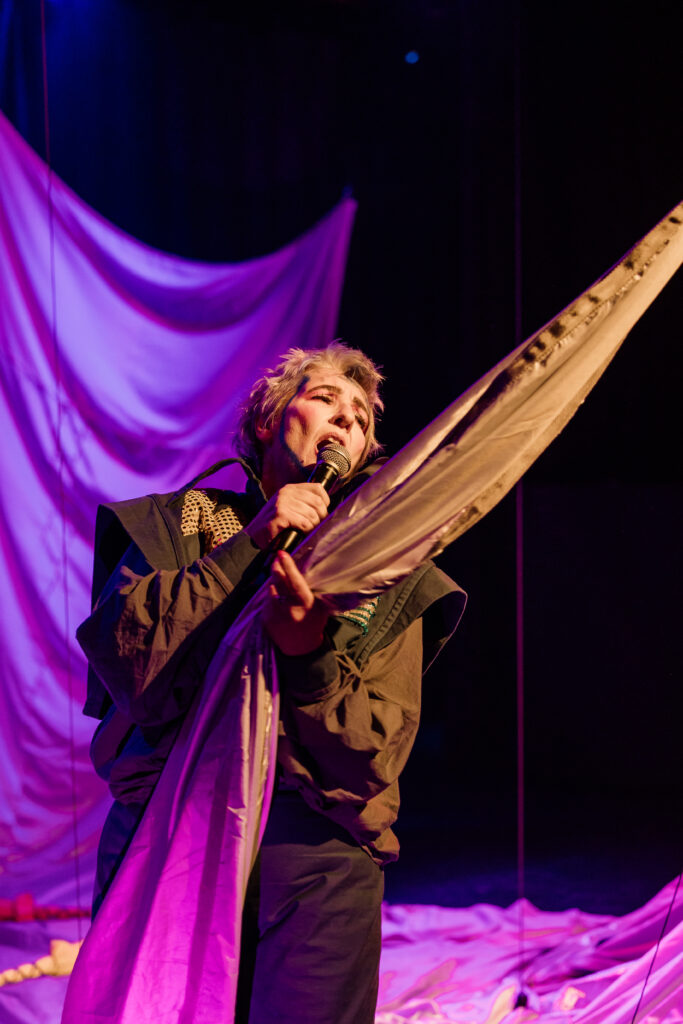
Speaking about creating the work, Jo says, “ADHD diagnosis raised a lot of internal stuff. I felt I needed to make a piece of work around this; it’s kind of just flowed out of me as this new form. I pitched it up at a Performing Arts Network New Zealand (PANNZ) festival and there was a really strong (positive) reaction to the work. Which was great and it just, kind of, went from there. As I say in the show, being on stage is the easiest natural way for me to communicate, the ‘bigness’ of my expression belongs there.”
Speed is Emotional has been performed a number of times previously. I ask how it’s evolved and the importance of the musical elements in the show, which are provided by Elliot Vaughan. Is it like a music gig, where you can try out what speed, style or vibe works best? Does the room or the audience have an impact?
“I love the way that music works, with more of a gig culture. Because sometimes in theatre we can get a little bit locked down. Like ‘This is the show and this is how it’s going to get performed every night from now on.’ And I really love how in music, in that gig world, it’s always evolving. I’ve really loved working with Elliot Vaughan, who’s not only the sound designer but also an onstage support. Like having a buddy, which ADHD people love. That’s different from, say, (earlier days) when I was doing a lot of standup comedy stuff, (which is) solo stuff. I’d be freaking out a bit if it was just me out there. It’s always nice to be in a group.
“(When) Elliot is on stage with me, he’s always open to suggestions. It’s great that I can say to him, ‘Hey, I might be trying new things out on stage tonight’, and he’s up for that. As a standup comedian, you also ride the vibe of the audience, and it’s beautiful to work with operators who are able to busk like that, who can be open to that. Having that quality of being responsive, comedy is definitely very much like that. You’re riffing it …teasing it out every night to get to the best thing that you can. I always want to be evolving like that. For me, it would be a bit boring if I’m always going to do the same thing.”
Jo also notes that the conversation is changing all the time about ADHD, and that they need to change and adapt in response. “You know, maybe there was a time in which people would say it’s a ‘Superpower’. But now, a lot of people don’t like it to be defined like that. Because it can miss the challenging impacts of it. It’s a balance. It shouldn’t be binary in the way you look at it. It’s not one or the other, is it? And you know, we all have our own kind of particular neurodivergent balance.”
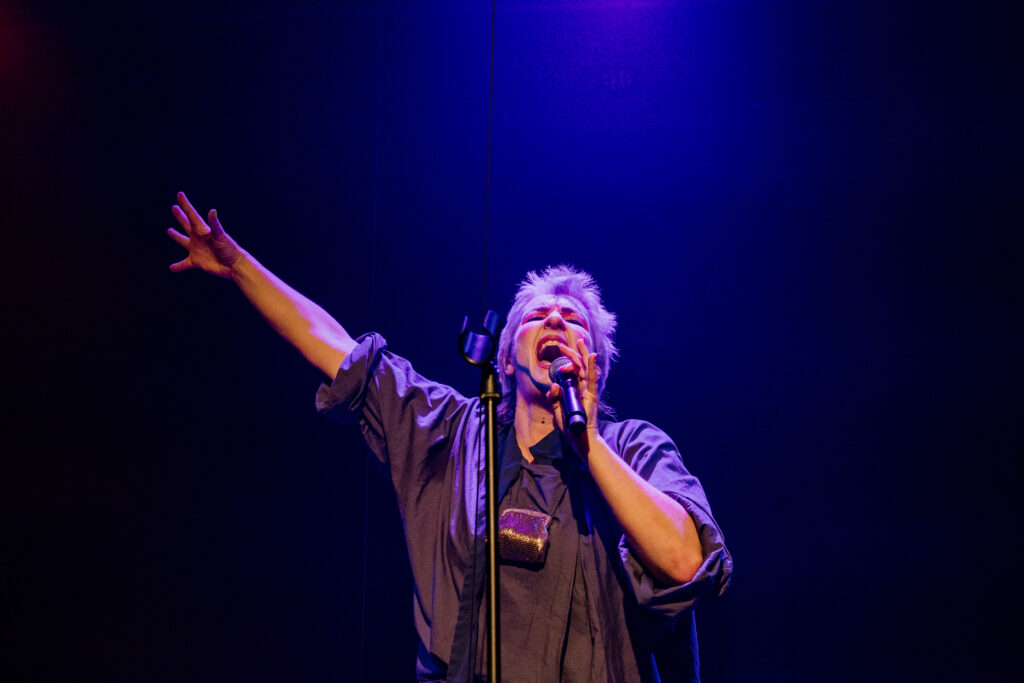
Talking through the show, Jo says it has elements of music throughout, with a highlight at the end being a big audience participation karaoke session. “I’ll try to make you laugh and think, that’s my job. And then the show opens up and I become more vulnerable.” The show has a bit of a back story to their own journey, looks at our attitudes to ADHD. “At first, it’s almost defensive. Like: “So what? I have it.” That is a real way that people can respond to a diagnosis and that is a time when you need to be strong because, you know, people are going to come at you and say ‘it’s BS – not really a thing! You should just toughen up!’ We’ve definitely had that (response) from teachers. I’ve experienced that. But then there are more humane, sympathetic responses, and as the show moves through it evolves into a more poetic expressiveness. I (also) play a keyboard, and nearer and it ends up becoming really like a music gig.”
Jo says that music has been their “most reliable survival tool”. “Music has been one of the things that I have held onto the most, it’s been one of the strongest kind of pō (pillar) to ground me through my life. Yes, people are helpful, but music is very reliable. You know, like I can plug in and listen to that song, and I can listen to it 15 times in a row, until I feel calm. So many different songs have been really important to me over my life and still are.”
Jo tells me that watching the film Amadeus (adapted from Peter Shafer’s play) at age 14 was a “really life-changing movie”, particularly the music and the stories behind the pieces. As was discovering the Eurythmics, Midge Ure, Talking Heads and of course, David Bowie. All heavy influences on the artistic mind. There are particular songs and pieces that are especially calming. “Currently I love Gabriel Garzón-Montano, an instrumental album called Jardín, also, Alice Coltrane’s Kirtan: Turiya Sings, Dimmer’s song Evolution; Mercedes Sosa – Missa Criolla. Fela Kuti. Sometimes it’ll be Gregorian chanting. And historically, (there are) some tracks I return to over and over.” They give a few examples: The Barrel (Aldous Harding), In The Sun (Peter Gabriel), Shamemaker (Ween), Right By Your Side (Eurythmics), or I’m Deranged (from David Bowie, on the Lost Highway soundtrack). “And it’s beautiful, watching my kids also attach to songs as they grow up. I get to know them through the music they like. It feels really right to me that that’s the way Speed Is Emotional expresses itself at the end, through music.”
Regarding the music in the show, Jo says it comes from all places. “Some of the songs that I’ve held onto across the years keep finding new ways to resonate inside me. But they’re not necessarily the ones in the show. Like when I was choosing songs for the show, weirdly, these ones (that I’ve included) surfaced. And working with Elliot, presenting to him my shortlist and watching what he chose, they are songs that I don’t even especially love. But they tend to be songs from the 70’s sung by men. Ha Ha! Why is that? I guess that’s when I was born. And there’s a real kind of a gender conversation going through the show as well. It’s around what we, as women, have to do to present ourselves. You know, think Helen Clark, like so many female politicians, who were taught to lower their voice, speak in a flat sort of monotone, reduce the high pitch in their voice. That kind of thing. And what is wrong with the more expressive or being higher or at the more vulnerable end of things?”
Jo has moved in and out of music, returning as a parent. “My son learns by the Suzuki method for violin. So, I think, I’m re-discovering the classical world, like my mum used to listen to and love. And I never really followed it much; except I knew that I completely loved Chopin. (But) I used to play the piano, but then I feel like I left the music world for theatre. I’ve only just appreciated how big an impact music had on me as I was coming to make this show. I really started to register that music occupies such a huge place in my world, and I couldn’t survive without it. Also, I wanted to sing and not be talking so much. The show moves in that direction, you know, it starts with more classic stand-up comedy, sort of monologue, and then the music becomes more and more present throughout the show.”
Speed is Emotional is a family show, in more ways than one. Their son has also been diagnosed with ADHD. In the show he appears later in the show alongside his father, Jo’s husband, and his older brother. ADHD can be inter-generational. That can be confrontational for some families. “Sometimes parents or grandparents will say, ADHD, that’s not a thing,” Jo notes, “that’s just how our family does it. They might know that their family needs to go for a run every morning, or be constantly active, and struggle to finish things, but see it as just their family culture. And in a way it is. And yeah, families can be full of love but they also can be some of the hardest places to talk about your diagnosis, but I think it’s worth it. In our house, we talk about it, and I’m proud that my son has language around it so that he can talk about anxiety or how he’s feeling. He can say: ‘Oh, this is me getting a bit hyper-focused on this, you know?’ I didn’t really have the tools or language when I was younger and I’m really glad that he has access to that now.”
“My family talked about it (the production) a lot – as we made it, because earlier we’d talked about making a family show. I always felt like I would like my kids to know what my profession is. I saw a ‘doco’ where they talked to lots of kids and asked them what their parents did for work, and then assessed how much children really knew about what their parents do. Children of doctors or lawyers tended to say, “I don’t really know what she does, she’s just at work a lot.” But the people who knew the most about what their parents do were those who grew up on farms. And for me, I always thought, I want my kids to know what this performance world is like.”
The family had talked about making a family show, but “as the ADHD stuff came out more in the story I was like, oh, this is actually my story really, also, it’s really frickin’ hard to make a show with your family. I thought: “It’s not fair to ask my sons to co-author this” but I was determined to involve them still. In the end I asked: “Do you want to be part of it? So, they sort of, a little bit reluctantly, agreed. But then they got into it more and fully joined in. And now, I think they’re really glad for it. I mean, I did push them a little bit because I felt like they were really gonna enjoy it once they got on stage – and they did. Now they’re very proud to be in a festival show.”
I’ve talked to other writers about using family experiences in their writing, like a play or novel. Was there push back from them? “Yeah,” Jo replies, “there’s always some kind, and that’s an important part of the process, the right of reply. But it is a great thing when they’re up there with me as well on stage. Sometimes they roll their eyes (when I say something a bit ‘cringey’) and the audience can see that, you know, they have full autonomy over their response, right? And, also, this process helped me realise that this is not our full ‘family’ story, instead: actually, this is my story that those guys are welcomed into at the end. Like, it’s just clearer and easier, and I’m very careful not to tell their story. But they’re welcome to add their stories into the show as we evolve it. That would be amazing!”
Jo Randerson – Speed is Emotional
OneOneSix, Whangarei, 17 & 18 February 2026
Aotearoa NZ Festival of the Arts, Circa Theatre, Pōneke/Wellington , 11 – 28 March 2026
The Meteor, Kirikiriroa/Hamilton, 21 & 22 February 2026
Tickets:
https://themeteor.co.nz/event/speed-is-emotional/
https://www.circa.co.nz/package/speed-is-emotional/
https://oneonesix.nz/event/speed-is-emotional/
Related Acts:
About the interviewer Tim Gruar

Tim Gruar – writer, music journalist and photographer Champion of music Aotearoa! New bands, great bands, everyone of them! I write, review and interview and love meeting new musicians and re-uniting with older friends. I’ve been at this for over 30 years. So, hopefully I’ve picked up a thing or two along the way. Worked with www.ambientlight.com, 13th Floor.co.nz, NZ Musician, Rip It Up, Groove Guide, Salient, Access Radio, Radio Active, groovefm.co.nz, groovebookreport.blogspot.com, audioculture.co.nz Website: www.freshthinking.net.nz / Insta @CoffeeBar_Kid / Email [email protected]
More by Tim Gruar
MNZ Interview: WOMAD Series: Huia
MNZ Interview: Jean Thoral
Album Review: Sangria
EP Review: Destined for Loneliness
Album Review: Bits
Gig Review: So So Modern @ Newtown Community Centre, Wellington – 7/11/2026
Gig Review: Anthonie Tonnon @ Hannah Playhouse, Wellington – 31/10/2026
Album Review: ¡Blaze!
MNZ Interview: Devin Abrams