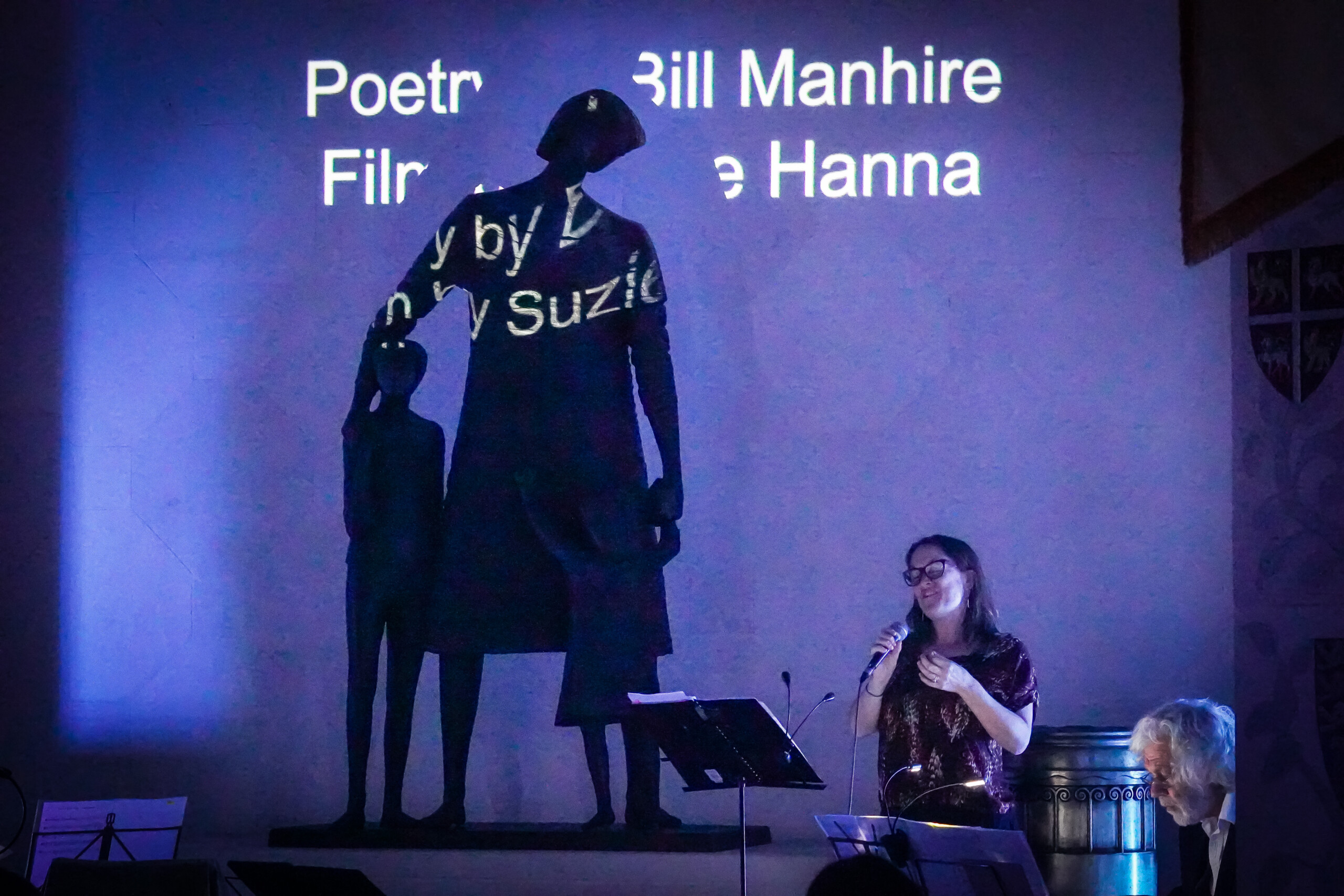

Pōneke’s 2026 Lōemis Festival is about to kick off, with artists including Cate Le Bon, Saint Levant, Chanel Beads, Snapped Ankles, Lydia Lunch, and Acid Mothers Temple, and major locals Shayne Carter (with NZSO), Troy Kingi and avant-garde music experimental outfit Stroma. In the lead-up to their upcoming performance of Different Trains at The Roxy in Miramar, Stroma co-founder Michael Norris reflects on 25 years of adventurous music-making, and the ideas shaping a programme that places Steve Reich, Philip Glass and Terry Riley alongside Dadaist cinema, video art and live digital visuals.
Michael Norris wears several hats in Wellington’s music world. He teaches composition at Te Kōkī New Zealand School of Music and is also one of the founding figures behind Stroma, the ensemble that has spent 25 years creating a space for adventurous contemporary music in Aotearoa. That dual perspective shapes the way he talks about music: as both art-form and living network of ideas, people and collaborations.
Asked what the academic music environment looks like now, Norris answers bluntly: “It’s very open and diverse.” Students arrive from very different backgrounds and work across songwriting, orchestral composition, electronic music, recording, coding and interdisciplinary practice. In New Zealand, he says, “you can’t really assume that everyone comes in with really great music theory,” so the task is to “provide pathways for students” to grow while pursuing the forms that matter to them. That openness helps explain Stroma’s refusal to treat contemporary music as sealed off from the rest of culture.
That philosophy has been there since the beginning. “I was there from the beginning,” Norris says. Stroma was established in 2000 by Michael Norris, Hamish McKeich, Bridget Douglas and Philip Brownlee, bringing together composers and performers who wanted a durable home for adventurous new music in Wellington. For Norris, it began with the feeling that the city already had the players and the appetite, but not yet the framework to bring them together in a sustained way.
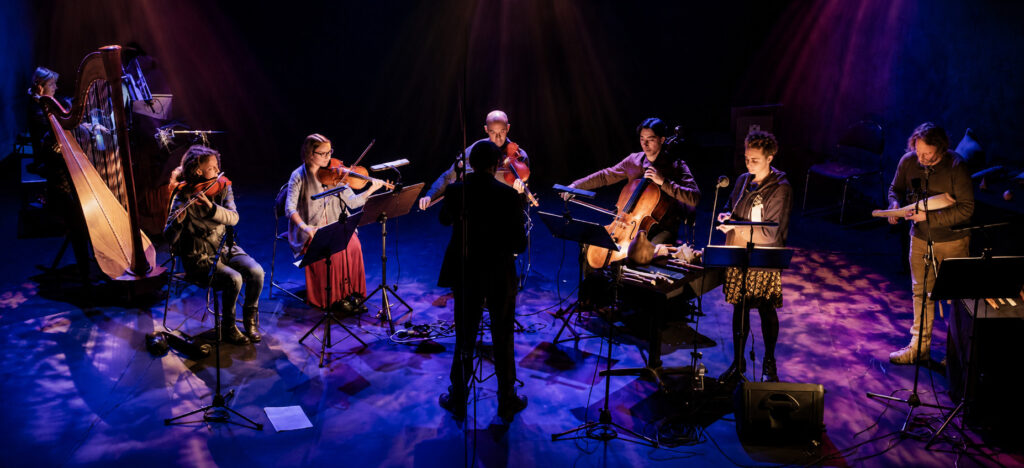
The ensemble emerged after Norris returned from London, where he had completed a master’s in electronic composition. The experience had been stimulating, but it also clarified what he wanted next. “I really want to get back into writing for musicians,” he recalls. Wellington, he felt, had “all the resources, you know, we had all the players, particularly in the NZSO,” but not yet a dedicated structure for new music. There had been earlier ventures in Wellington, and in Auckland, a group called 175 East was blazing trails, but at that time, Wellington was lacking an ensemble that consistently brought together performers willing to champion contemporary repertoire and work closely with composers.
A call to flautist Bridget Douglas helped set things in motion. Norris knew she was open to new music, and she in turn pointed him toward bassoonist and conductor Hamish McKeich, who had recently arrived in New Zealand and would become central to the ensemble’s early shape. At the same time, the NZSO was itself changing, with a younger generation of players coming in, many of them curious about contemporary work. Out of that moment, Stroma quickly built what Norris calls “a good core of sort of 12 to 15 players who were really up for playing new music.”
The kaupapa, then as now, was not simply to present difficult repertoire for specialists, but to build a collaborative, open environment where compelling new music could happen. That appetite for crossing boundaries is central to Stroma’s upcoming concert, Different Trains, which will be presented at the upcoming gig at Miramar’s Roxy Cinema. The programme brings together three landmark works of American minimalism – Steve Reich’s Different Trains, Philip Glass’s String Quartet No. 3 “Mishima”, and Terry Riley’s In C – and places them in dialogue with moving image works that span nearly a century, from early avant-garde film to contemporary real-time digital visuals.
For Norris, the choice of Reich, Glass and Riley is not a greatest-hits survey of minimalism but three different ways repetition can work: Reich as memory and testimony, Glass as inward flow and formal control, and Riley as collective pulse and emergence. Together they create a journey through experimental image-making, united by rhythm, repetition, abstraction and transformation.
The concert begins with Reich’s 1988 masterpiece Different Trains, written for string quartet and tape. Inspired by his childhood rail journeys between New York and Los Angeles after his parents’ separation, Reich later realised that, as a Jewish child in wartime Europe, he might have been travelling on very different trains. The piece unfolds across three movements –America – Before the War, Europe – During the War and After the War – using recorded voices, train sounds and layered quartets to set that counterfactual idea in motion.
The music is paired with Beatriz Caravaggio’s 2016 film Different Trains, first shown at the Museo de Bellas Artes de Bilbao, synchronised to the Kronos Quartet recording. Drawing on archival wartime footage, the triptych moves from American landscapes to deportations, extermination camps, liberation and the survivors’ journey to America, deepening the work’s themes of Holocaust memory, genocide and the anxieties that linger after catastrophe. Norris is careful not to reduce Reich’s piece to one message: “It’s not specifically about the Holocaust so much as this idea of a sort of counterfactual in a time of war, something many people can relate to at this point in history” he says. Yet he also stresses its beauty: “The music is very beautiful and hypnotic which elevates its poignancy.”
Stroma’s performance ‘uses’ the Kronos Quartet version: one live string quartet playing alongside pre-recorded quartet tracks from the ensemble’s canonical 1989 recording. That is, they’ll play alongside the recording and the film. Norris jokingly calls it “karaoke style,” but the demands are exacting, especially when image is involved. “There’s definitely some logistics that we always have to work through,” he says.
The second work is Philip Glass’s String Quartet No. 3 “Mishima”, drawn from the score to Paul Schrader’s 1985 film Mishima: A Life in Four Chapters. Here Stroma pairs it not with Schrader’s film but with Man Ray’s 1926 surrealist silent film Emak-Bakia, a Dada-Surrealist “cinépoème” of rayographs, distortions, reflections and visual non sequiturs. Norris calls it “a forced marriage, where you take an audio work and a visual work that have nothing to do with each other and sort of throw them together and see what happens.”
That openness is precisely the point. Rather than illustrate the music, Emak-Bakia (Basque for “leave me alone”) meets Glass through motion, texture, visual rhythm and surreal instability. Norris is not looking for a tidy thesis here, only what he calls “just a beautiful piece of music and really interesting visuals.”
The final work, Terry Riley’s In C, pushes the concert toward another kind of openness. Composed in 1964, it consists of 53 short patterns played in sequence, with performers repeating each figure as often as they choose before moving on. The result can vary dramatically in length, instrumentation and texture, which is exactly what makes the piece so enduring.
Norris notes that Riley is now in his nineties and still looms large in minimalist history, but In C remains the key work here because it is so flexible, social and alive. It can be performed by a small group or a large one, and each version reveals different colours.
He also mentions Riley’s unexpected pop-culture life, pointing to the album A Rainbow in Curved Air, and recalling that its music was used in the original BBC adaptation of The Hitchhiker’s Guide to the Galaxy.
Norris also singles out an especially inspiring performance of In C at the Tate Modern with percussionists from Mali, describing it as a version that showed how naturally Riley’s open, modular score could connect with very different rhythmic traditions.
Stroma’s version of In C will be a ‘medium-sized one’, around eight players, and Norris is keen to stress that the piece is anything but ambient wallpaper. “It’s very funky, you know, it’s really rhythmic and pulse-driven,” he says. For him, one of the fascinations of In C is that “it’s just basically one page of music,” yet because players loop and move on at different moments, “you end up with these really complex textures.” What can look simple on paper becomes, in performance, a living system. Norris hears the patterns as “almost like little cells,” gradually mutating, morphing and combining into larger organisms. That sense of musical morphology – of small units becoming larger forms – is exactly what leads into the concert’s final visual collaboration.
For In C, Stroma is joined by Wellington artist, Zoë Bell, who is creating real-time visuals that respond to sound. Norris says Bell’s work has “this really beautiful cellular vibe,” and that audiences can “almost see cells dividing and splitting apart, filling up the space with more and more little organisms.” It is a contemporary counterpart to the concert’s earlier films – algorithmic rather than mechanical, digital rather than optical, yet still tied to the same underlying fascination with motion, abstraction and transformation. As Norris puts it, the programme traces “a sort of trajectory there which looks back across time,” from early black-and-white experimental cinema to present-day digital image-making.
The setting helps. The concert takes place at the Roxy Cinema in Miramar, a venue Norris praises for its generous screen, strong atmosphere and unusually practical stage area, which can accommodate a small orchestra beneath the image. That matters because Stroma does not want this kind of programme to feel forbidding. “It’s a very relaxed setting,” Norris says. “You go and get your drink and your ice cream and you can come up to the cinema and just be entertained.” The expected runtime is a little over an hour, and he promises “a real treat for both the ears and eyes.” At a time when contemporary classical music is still too often framed as worthy but austere, that emphasis on pleasure feels important.
What emerges most strongly from talking with Norris is that Stroma’s 26th anniversary is not being marked with nostalgia. Different Trains honours three canonical minimalists while keeping the music in motion: Reich as memory and testimony, Glass as surreal collision, Riley as collective emergence. Threaded through all of it is Norris’s belief that contemporary music should stay porous – open to other artforms, new audiences and surprise.
As part of the Lōemis festival Different Trains is presented by Stroma at the Roxy Cinema, 5 Park Road, Miramar, Wellington, on Wednesday 17 June 2026.
For the performance Stroma are: Anna van der Zee (violin); Julia Broom (violin); Andrew Thomson (viola), Ken Ichinose (violin cello); Thomas Guldborg (percussion); Sam Rich (percussion): Bridget Douglas (flute); Oscar Laven (saxophone)
The programme features Steve Reich’s Different Trains with film by Beatriz Caravaggio, Philip Glass’s String Quartet No. 3 “Mishima” alongside Man Ray’s Emak-Bakia, and Terry Riley’s In C with live visuals by Zoë Bell.
Related Acts:
About the interviewer Tim Gruar

Tim Gruar – writer, music journalist and photographer Champion of music Aotearoa! New bands, great bands, everyone of them! I write, review and interview and love meeting new musicians and re-uniting with older friends. I’ve been at this for over 30 years. So, hopefully I’ve picked up a thing or two along the way. Worked with www.ambientlight.com, 13th Floor.co.nz, NZ Musician, Rip It Up, Groove Guide, Salient, Access Radio, Radio Active, groovefm.co.nz, groovebookreport.blogspot.com, audioculture.co.nz Website: www.freshthinking.net.nz / Insta @CoffeeBar_Kid / Email [email protected]
More by Tim Gruar
MNZ Interview: A.R.T.

Album Review: 4EPs
MNZ Interview: Carnivorous Plant Society
Gig Review: The Veils @ Meow Nui, Wellington – 04/07/2026
Gig Review: Shayne P. Carter @ Lōemis Festival, Michael Fowler Centre, Wellington – 19/06/2026
Gig Review: Troy Kingi @ Lōemis Festival, Meow Nui, Wellington – 18/06/2026
Album Review: Fragile World
Album Review: This Wasn’t Planned

Gig Review: Little Prayers @ Lōemis Festival, Hall of Memories, Wellington – 13/06/2026