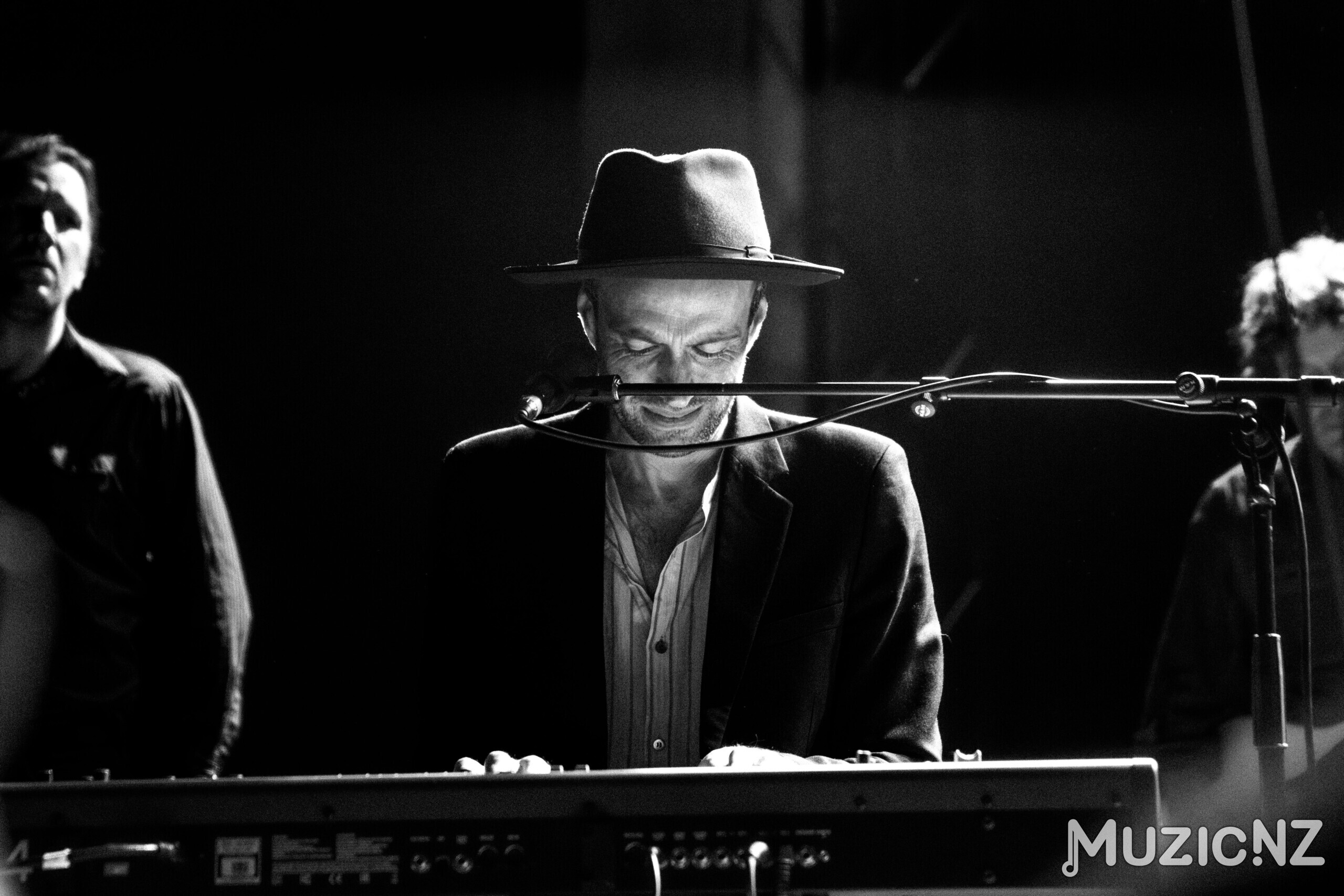
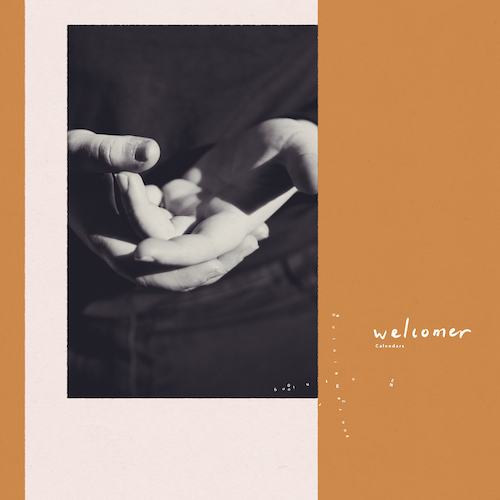
When this one dropped into my inbox, I was none the wiser. But I should have been. Turns out Welcomer are actually some of my locals, hailing as I do, from Wellington / Te Whanganui-a-Tara. I don’t know where I’ve been; somehow I missed them. Shame on me, because Welcomer are a band whose music and style have been shaped less by sudden arrival than by patience, distance, and quiet accumulation. It’s beautifully honed, confidently played, and as comforting as a decades old sofa. Every tune on this new release sounds, and more importantly feels, like you’ve always had it with you. And that takes skill.
Enthused by what I’m hearing, I cranked up the search engine. Formed in the late 2010’s and led by songwriter, vocalist and guitarist Miles Sutton, Welcomer first came to attention with a self‑titled EP that already revealed Sutton’s gift for precise observation, emotional restraint, and wry humour. But rather than leaping into the fray, the band took time to refine their songs, build community, and allowed life to naturally intrude into the work. That slow burn doesn’t just inform their sound – it defines it. Their long‑awaited debut album, Calendars, my people, is finally done.
From the first notes, it’s clear Sutton is the band’s gravitational centre. His voice carries a smoky, comforting maturity, sometimes breathy, sometimes contemplative, even casually distant. Whatever he does, it feels lived‑in rather than performative. There’s a calm assurance to his delivery, a conversational dryness that invites comparison to Lloyd Cole, especially in the way lyrics unfold as quietly devastating observations rather than dramatic declarations. At times, too, his cadence recalls Steve Kilbey of Australian band The Church, particularly in moments where understatement deepens rather than dulls emotional impact.
Crucially, Sutton is surrounded by collaborators who enhance – never overwrite – his songwriting. Welcomer operate as a band, not a vehicle, and Calendars reflects a collective sensibility shaped through years of shared work. Across ten tracks, they dissect the pieces of a life and reassemble them into a record that is intentional, ornate, and quietly affecting, while Miles Sutton has spent the intervening years since the group’s self‑titled EP honing his songwriting craft, the raw vulnerability at its core remains intact.
Frequently described as a “Saturn return” album, Calendars feels like a coming‑of‑age moment not rooted in youth but in the unsettling realisation that things can begin slipping away unless they’re actively held on to – a soft reckoning that lives in the uneasy middle ground between growth and loss, where friendships shift, identities loosen, and meaning must be gathered before it fades.
Writing had been unfolding for some time before recording formally began, with sessions officially starting in January 2024 and the bulk of tracking taking place through Autumn 2025, a season Sutton has repeatedly identified as central to the album’s emotional tone; recording wrapped in November 2025, making Calendars the result of nearly two years of sessions layered onto several years of song development. Most of the album was recorded in Pōneke, engineered by Sutton himself, alongside producer and close collaborator Jesse Austin‑Stewart, who also co‑produced the record, before work continued remotely when Sutton relocated to Paris in August 2024, with files moving back and forth between Europe and Aotearoa. Additional recordings took place in Sutton’s hometown of Kawerau, as well as at Daniel McBride’s studio in London, giving the album a sense of geographic sprawl without emotional dilution. Throughout, Sutton’s songs are brought fully to life by his band and collaborators – Eddie Crawshaw (Lake South), Ox Lennon, and Shannen Georgia Petersen (Sports Dreams) – resulting in a record that feels dispersed across places and time, yet emotionally cohesive, shaped between routines, relationships, and evolving versions of the self.
There’s a phrase that best sums up this record: small worlds, held carefully.
Opal opens the album, setting a deliberate tone, introducing the album’s central themes – memory, humour, ageing – with restraint and clarity. Dry, husky vocals and Sutton’s guitar phrasing here, as well as on later tracks like Rafters, recall the elegant, understated melodic sensibility of artists like Sérgio Mendes, especially in its willingness to let rhythm and harmony breathe rather than push forward.
Impossible is built from nocturnal vignettes. It follows Opal’s moon‑lit opening naturally. Its title coming from a cut lyric – “hurting each other in these impossible ways” – and in many ways the song embodies that idea: emotional damage that lingers even after the words are gone. It’s a study in residual feeling.
Magazine Clippings feat. Lontalius is quite simply a fully formed marvel, and to my ears it stands as Calendars’ emotional axis. Arranged to feel “as warm as possible” – described by Sutton as “like a darker gentle hour” – the song layers Rhodes, strings, pedalled organ and steady drums beneath a devastatingly specific lyric. There’s a generosity to both the sound and the writing: literate, socially grounded pop that trusts detail over abstraction, suggesting a clear lineage back to early Lloyd Cole & the Commotions. Sutton’s eye for observation shines throughout, and the song’s emotional scope subtly widens on each listen, revealing itself less as a single moment and more as a carefully balanced exchange.
“Things got heavy in the summer,” sings Sutton, “but they got heavier after / We were thinning out, you were basically skeletal.” Like many of the songs in the world of Calendars, Magazine Clippings unfolds on the brink, with characters working hard to keep things intact even as friendships begin to fray. Over the lilting instrumentation, Sutton writes candidly about relationships in disrepair, threading humour through the heaviness with wry, sharply local observations – “you went to like four festivals in a town without festivals / Whatever it’s flexible, the definition is flexible” – sketching a recognisable New Zealand landscape beyond the centres. Eddie Johnston (Lontalius) enters as the voice for the friend, his verse lifts the song and completes the conversation rather than interrupting it. Sutton has spoken about his comfort with ambiguity – “I’ve had people interpret the narrative differently and I like that. I never felt that details weigh a song down” – and while the track alludes to emotional strain, it ultimately centres on faith in community. As Sutton himself puts it, it’s “a heavy but hopeful exchange,” one made whole by Lontalius’ contribution.
Scam is super clever. Its dense, word‑heavy verses give way to big, open choruses – according to Sutton, at least. The song starts in a place of angst before flowering out to the chorus, with the lines: “You could feel it in your body when you couldn’t see it coming / It’s never stopped you believing before / You say you’re doing fine well everybody lies / It’s just this time no one believed in yours.” The music thrives on contrast, its energy contained and released in carefully timed waves. It’s a song of trust. What really counts? Who means what they say, anyway?
For Rafters they settled on a version that’s stripped back to its essentials, with just Sutton on voice and guitar, Elliot Vaughan with some achingly beautiful strings, and the subtle ambient textures from Asher Lee (Skymning). “I’m sure you heard our old room burnt down / Hansen street, front of the house, / In Asher’s car I drove around to watch the rain fall through the rafters.” A very personal story. A release from a relationship, with the destruction of an old flat where the couple lived, but not everything can be razed by fire, as observed. Again, Sutton’s guitar phrasing feels subtly Latin‑inflected, relaxed and melodic in a way that recalls Mendes’ most lyrical moments.
Like Scam and Magazine Clippings, Nothing of You Remaining is another friendship narrative, balancing heartbreak with unexpected humour. There are references to toxic relationships in lines like “You wanted a family / He didn’t want kids / And sure, he’s a liar who didn’t know how to leave it / But you just thought it’d be longer before he got someone pregnant.” It plays out like a little kitchen sink drama. The arguments behind doors revealed for the street to learn. That’s revealed in the brilliant drapery twitcher: “Oh, Crack in the curtain / Oh, shining like a blade.” Love and betrayal, domestic bliss smashed like crockery on the walls – all subtly referenced. The power of this songwriting: “Giving out every secret you gave him / Giving ’til he has nothing of you remaining / Like that.” The accompanying video, directed by Taylor Galmiche, mirrors the song’s quiet motion. Projector‑style visual effects are especially poignant, a handy cam and jerky images like a home movie made in better times, reinforcing the theme of memory as something simultaneously vivid and dissolving.
To me, Aisle has one of the album’s most affecting lyrical moments, mixing the mundane with the profound: “Deodorant can in a faded black backpack / A cellphone your friends came to clear out ASAP / I guess you had plans for when there were no longer plans. You went so hard until you just couldn’t bear it / Thrashing that body like it was something to wear in.” A song about grief, displacement, and a partner or close friend leaving, Aisle finds meaning in abandoned objects. Its dry delivery again recalls Steve Kilbey, where emotional weight lands precisely because it is understated. Musically, the song is lush, with a sweeping orchestral 80’s synth-bed to carry it along.
Beginning with the tractor‑whirl of an old projector, the album’s longest track, Sister City, fires up the memories as the pictures roll. But this doesn’t take place in a city at all. Instead, it returns to Sutton’s small‑town upbringing, destabilising the album’s narrative briefly before re‑cohering. It becomes a geographical description, detailing the ordinary landscapes as we go “Past the miniature train tracks that lay around the playground / We’re swimming out into the rubbish of the river mouth.” This is Sutton at his observational best. But is this real, or just a faded slide show in the mind? “There is a story I can’t shake / There is a feeling that I keep / I’m not sure anything actually happens if you’re not there to see it.” This kind of detailed narrative would do Anthony Tonnon proud, I think. The delivery contrasts beautifully with the sweeping trombone and string finale – perhaps the album’s most expansive moment.
Positioned deliberately as a ‘regional gothic’ penultimate track, Crescents looms large, holding tension without offering resolution before Daniel Song closes the album quietly. Built on muted nylon‑string guitar and pizzicato phrasing, it’s intimate and unresolved. Inspired by Sutton’s love for its namesake, it references Two Minds by Sheep, Dog & Wolf – affection rather than quotation. Perfectly placed, the song lets the album fade off, like a half-completed sentence, rather than conclude with a dramatic crescendo. The effect, however, was affecting because it made me jump back again to re-listen, as if I’d missed something. I actually had, and I found myself replaying it over and over, discovering more each time. That’s the best compliment I can give. First impressions are not enough with this collection.
Calendars never rushes forward or demands attention. Its strength comes from restraint – emotional, musical, and narrative alike. Miles Sutton’s smoky, quietly seasoned vocal delivery, and the band’s measured elegance carry that well. The album’s gradual layering of detail creates a listening experience that unfolds with time rather than immediacy. True to its title, significance emerges not from singular moments, but through steady accumulation. Long after the final notes fade, Calendars lingers, subtly reshaping how memory, distance, and becoming are felt, considered, and experienced.
Related Acts:
About the author Tim Gruar

Tim Gruar – writer, music journalist and photographer Champion of music Aotearoa! New bands, great bands, everyone of them! I write, review and interview and love meeting new musicians and re-uniting with older friends. I’ve been at this for over 30 years. So, hopefully I’ve picked up a thing or two along the way. Worked with www.ambientlight.com, 13th Floor.co.nz, NZ Musician, Rip It Up, Groove Guide, Salient, Access Radio, Radio Active, groovefm.co.nz, groovebookreport.blogspot.com, audioculture.co.nz Website: www.freshthinking.net.nz / Insta @CoffeeBar_Kid / Email [email protected]
More by Tim Gruar
Album Review: Leap!

Festival Review: Great Sounds Great Part 1 @ Cuba Street Precinct, Wellington – 5/09/2026
Festival Review: Great Sounds Great: The Night Before @ Newtown Village, Wellington – 4/09/2026
Gig Review: Mel Parsons @ Opera House, Wellington – 05/09/2026
Album Review: Descending Dreams
EP Review: Extended Paranoia
Album Review: Brain Storm

Album Review: Ceiling Waves
Album Review: Castle Hill
Gig Review: Parrotdog Presents @ Parrotdog, Wellington – 1/08/2026

Album Review: 4EPs
Gig Review: The Veils @ Meow Nui, Wellington – 04/07/2026