
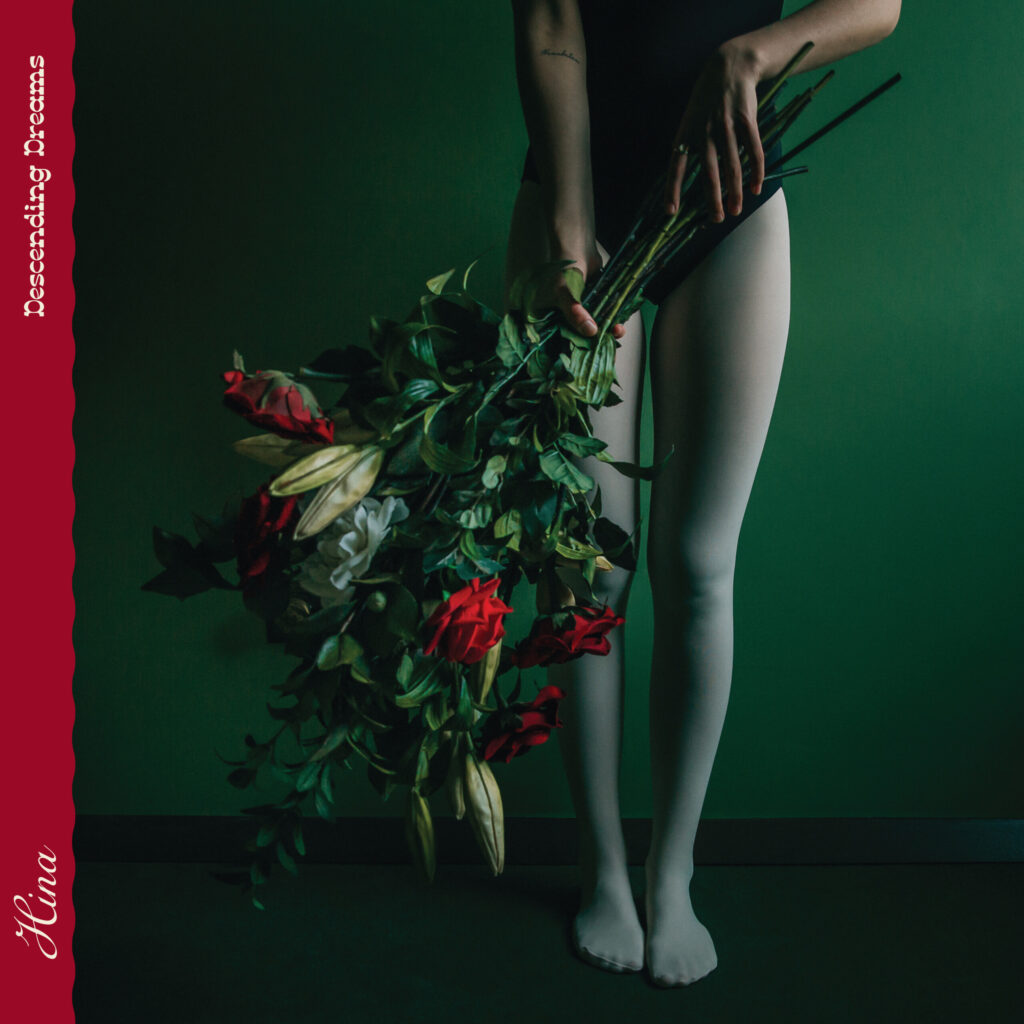
When Hina (Amy Boroevich – Te Rarawa, Ngāti Raukawa) talks about this album, she speaks of contraction: the emotional rooms she occupied too long, and the slow, deliberate work of returning to herself. You can hear it in the songs – the tightening, the release, the breath held underwater, then finally taken. Her stage name is no ornament. In Polynesian cosmology, Hina is the moon goddess: traveller, tide-keeper, shapeshifter, the woman who moves between worlds and refuses to be diminished.
Boroevich has always sounded as if she was writing from the threshold. Early releases Muse (2020) and Omen (2023) were quiet revelations: genre-fluid, atmospheric, and emotionally exact. Her connection to reo Māori songwriting deepened through co-writing the APRA Maioha Award-winning waiata Me Pēhea Rā, and through her own luminous single Hinātore – a small lantern held up in a dark room.
But Descending Dreams goes further. It is not a sketchbook or a set of experiments; it is a descent, a reckoning. Recorded across a year at Neil Finn’s Roundhead Studios in Tāmaki Makaurau, the album has room to breathe: analogue warmth, close-mic intimacy, and arrangements that glow rather than glitter.
Producer Navakatoa Tekela-Pule (Noa Records) gives the record its gravitational pull. His touch is patient and textural: tape-warm mixes, soft distortion, and space enough for Hina’s voice to sit like a candle in the centre of the room. James Milne (Lawrence Arabia) helps refine the album’s emotional architecture, while Dave Khan’s slide guitar lends a dust-road shimmer and Finn Scholes’ brass brings bright, cinematic lift. Engineer Paddy Hill’s tape mix deepens that glow before Josh Llewellyn’s mastering gives it final shape. The result is polished but never plastic. I hate that. This, people, is music with grain under the fingernail.
South Pacific Sun opens with oceanic breath – childhood beach, restless memory, tide pulling gently backward. I first heard it on a frantic commuter trip and felt the song slow the carriage around me, tugging me back toward the warm sands of a recent Samoan holiday. Strings rise like dawn light; Hina’s voice arrives soft as saltwater. It feels less like an opener than a prayer whispered into a shell. No ukulele strums, though.
Coucou! arrives with a wink and a wound. The informal French greeting – playful, affectionate, almost conspiratorial – is dressed in 1960’s French-pop sparkle, but something uneasy flickers beneath the rouge. Released as a single in 2026 and later named in APRA’s Silver Scroll Top 20, it turns Blond Monroe flirtation into glam theatre: “Too much, too much, too much / Oh will you hold me like you / Do love, do love, do love, please do.”
Finn Scholes’ trumpet adds a Calexico-style desert flare; Dave Khan’s slide guitar flickers at the edge like heat haze. The song laughs as it breaks, braiding coyness, frustration and vulnerability into one glittering ache.
River To Mouth swells where awa meets moana – triumphant in sound, disillusioned in text. Piano moves like current, strings gather like undertow, and Hina sings identity as something fluid, contested, and tied to reclaimed whenua. Her line “Gang land, heartbeat on a stick / Sad land, come mortar and brick” lands like a flare against the dark.
Against today’s assaults on Te Tiriti principles, te reo and cultural memory, the song cuts deeper: “New blood, we’re the promised land / Become one in the hand / Who would’ve thought we’d find home / Under the tongue of foe.” The images of ‘bleached victory’ and an ocean still mysterious leave the track unresolved – and all the stronger for it.
The Fountain begins, “I’ve been drinking / From the fountain with no name” and immediately feels like a reckoning. The lyrics circle self-delusion, blame, and the sickly comfort of avoidance: “So maybe I’ll pull up, pull up / Pull up my socks and I’ll bow the knee.” Then comes the sting: “My baby told me / Yeah my baby told me / I’m the only one to blame.” Musically it feels almost ceremonial, lifted by gospel-tinged Rhodes keys and a lose 70’s country roll that gathers heat toward the end. It is one of the album’s strongest cuts.
House Within A Room turns domestic space into an emotional maze. A chattering bassline threads through the track, with violin flashes opening out the image of ‘a room inside a room inside a room’. Hina makes the ordinary uncanny: “Somewhere inside / There’s a house within a room / Houdini could be fooled / They’re never leaving.”
Underneath sits a darker current – unsettled, claustrophobic, emotionally airless. Lines like “When’s my turn again to dive in the river?” suggest someone trapped inside architecture they helped build, then slowly learning how to make room for themselves again. The ‘dive,’ though, worries me. Is this a call of desperation?
The folky Hope Has Teeth is a smile with bite marks. Hope is not soft here; it is feral, stubborn, a creature gnawing its way through the wall. “My hope a violent lover, I’m blue / I’m biting down my tongue in two” gives the song its bruised centre, while the folk-pop surface keeps it light enough to sting.
Take Apart Me is built on a small lyrical trick that opens into something raw: “You take apart me, I put back / Piece by piece, I like that.” Later, Hina reverses the frame – “I take apart you“ – and the song becomes a study of intimacy as dismantling and repair. Strings curl around her voice like hands rebuilding what has been broken. Her harmonies give goosebumps.
India catches the ache of someone leaving on their OE: “Oh London is calling again,” she sings, while the narrator sits in Chancery Square with a “Heart in a big disarray.” It is delicate and cinematic, soft-focus but never vague – a goodbye song that knows the suitcase is already packed.
Back To The Fire lifts the tempo into a slightly jazzy heat, all altar-light and temptation. Whether read as returning to a relationship, a fight, or the self you tried to leave behind, it has the thrill of stepping back toward the flame. “I’m lighting up the altar / I’m buying one more minute of you” is gorgeous – devotional and dangerous at once.
Closer Hollywood Graves is haunting, atmospheric and strangely tender. Lush strings place glamour and decay side by side; the song feels like a long exhale, a burial of old selves, and a quiet acceptance of what remains. The vinyl album has an alternative version of this song.
Across Descending Dreams, Hina turns contraction into motion. The album is a reclamation of whakapapa, voice and emotional agency – music that moves like the moon goddess she is named for: disappearing, returning, glowing harder each time. It is one of the most assured debuts Aotearoa has produced in years – not the arrival of an artist to watch, but the emergence of one already fully formed. Flirty, poignant, harmonising, brash, and more – I truly enjoyed having Hina’s voice in my ears.
Related Acts:
About the author Tim Gruar

Tim Gruar – writer, music journalist and photographer Champion of music Aotearoa! New bands, great bands, everyone of them! I write, review and interview and love meeting new musicians and re-uniting with older friends. I’ve been at this for over 30 years. So, hopefully I’ve picked up a thing or two along the way. Worked with www.ambientlight.com, 13th Floor.co.nz, NZ Musician, Rip It Up, Groove Guide, Salient, Access Radio, Radio Active, groovefm.co.nz, groovebookreport.blogspot.com, audioculture.co.nz Website: www.freshthinking.net.nz / Insta @CoffeeBar_Kid / Email [email protected]
More by Tim Gruar
Album Review: Motoring For Beginners
Album Review: Te Ngahere
EP Review: Welcome To The Dance Bunker

Album Review: Leap!

Festival Review: Great Sounds Great Part 1 @ Cuba Street Precinct, Wellington – 5/09/2026
Festival Review: Great Sounds Great: The Night Before @ Newtown Village, Wellington – 4/09/2026

Gig Review: Mel Parsons @ Opera House, Wellington – 05/09/2026

EP Review: Extended Paranoia

Album Review: Brain Storm

Album Review: Ceiling Waves
Album Review: Castle Hill
Gig Review: Parrotdog Presents @ Parrotdog, Wellington – 1/08/2026