
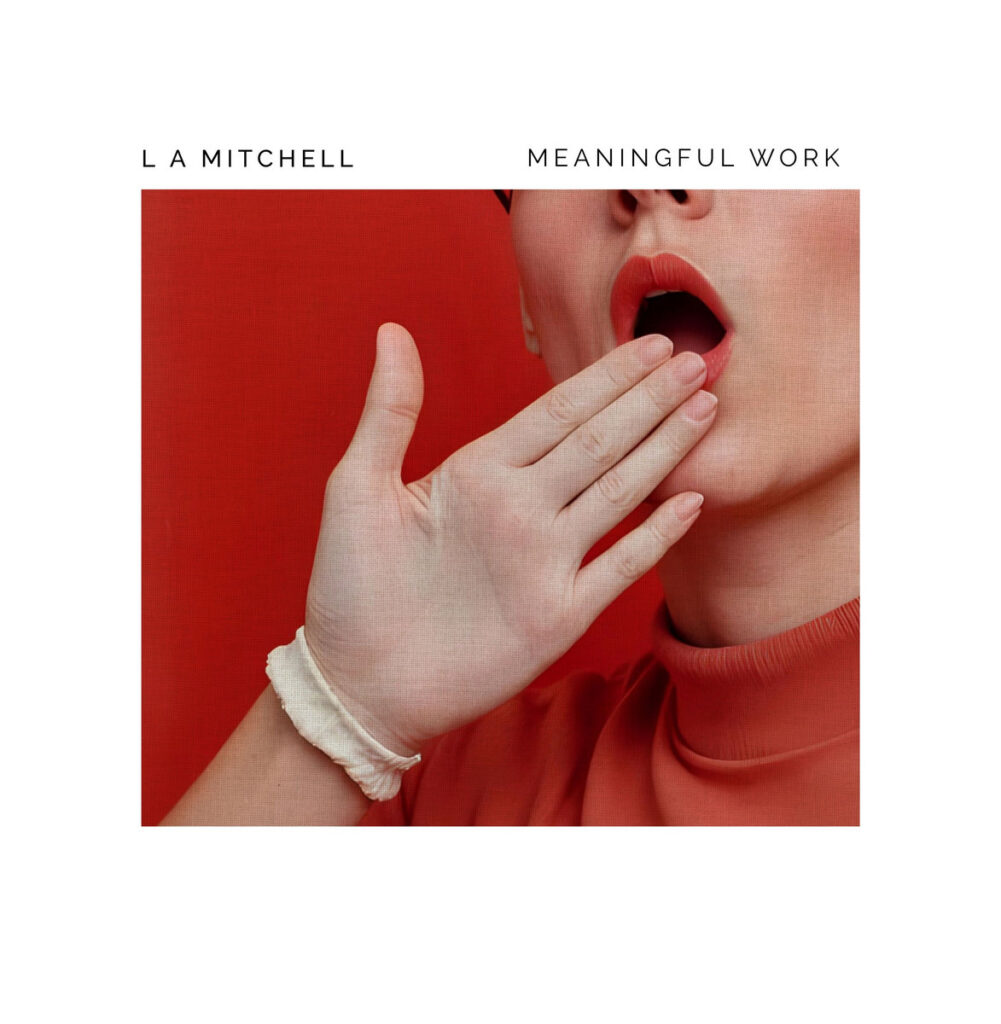
It seems we’ve already fallen down the rabbit hole. Deepfake imagery has become so pervasive that distinguishing reality from ‘un‑reality’ is increasingly difficult. While AI can be an incredibly useful tool with genuine benefits and practical applications, it also carries real and present dangers in the wrong hands, with the potential to fundamentally distort our shared sense of reality. And who owns reality – and which version?
Look closely at the cover of LA Mitchell’s latest release. What do you see? At first glance, it appears familiar – even benign. But look again. The distorted hand feels anatomically wrong, and that unease is precisely the point. And to be very clear, the album artwork is AI-generated. That’s because, along with the album’s title, it’s attempting to dive deep into the complex experience of creating art and music in the current moment.
Mitchell explains this further in her press: “I have generated this image through the I.P of prompts. I decided to use it as a statement because it is twisted, it’s both a little sickening and also hard to look away… What exactly do we value as a meaningful contribution to the world and to the human condition?”
After a long hiatus, Mitchell returns with her third full‑length album Meaningful Work, a response to our widening landscape of altered states. Twelve years in the making, the record is both an integrative work and a statement piece, pairing her bold, unguarded songwriting with lush experimental alt‑pop and unmistakably raw, powerful vocals – closing one chapter and opening a new creative trajectory.
If you’re a bit fuzzy on the name, here’s a quick profile. L.A. Mitchell (Lauren Anne Mitchell, now Lauren Barus) is one of Aotearoa New Zealand’s most respected yet understated musical voices. A singer, composer, and vocal coach, she works across solo performance, collaboration, and community music‑making. Emerging in the late 2000’s with a background in jazz vocal performance and a Bachelor of Music from the University of Canterbury, she built a career performing with artists such as Dave Dobbyn, Bic Runga, Tim Finn, Anna Coddington, Sola Rosa, Dukes, Troy Kingi, and Dallas Tamaira (Fat Freddy’s Drop), and toured in support of Stevie Wonder, Lionel Richie, and Guy Sebastian. Many will also recognise her from her long‑standing involvement with Fly My Pretties and the Bill Withers Social Club.
Alongside this work, Mitchell co‑founded the acoustic folk duo Terrible Sons with her husband Matt Barus, earning an AMA Best Folk Artist finalist nomination in 2024. Across all these contexts, her style is defined by embodied vocal expression, lyrical intimacy, and a deliberate refusal to over‑produce emotion.
If you follow the awards, then you’ll already know that her song Apple Heart was a Top 20 finalist for the Silver Scrolls and was on Fly My Pretties’ recordings and a fast favourite at their live shows.
Her first album, Debut (2006) offered a range of piano-driven jazz-pop, with a thoughtful light touch. That was followed up by a wonderful live album recorded in 2008 at the fabulous Matterhorn bar and club in Pōneke (Live at The Matterhorn). Home of the early Fat Freddy’s gigs, amongst many others. Since then, she’s been working on many collaborations, as illustrated above. But Meaningful Work is all about Mitchell again. Written across twelve years and completed between 2021-2023 with producer Mark Perkins, the album was conceived as an experiment in presence: remaining in the body through writing, recording, mixing, releasing, and even promotion. Mitchell has described the record as an attempt to “reconnect to my physical experience of the world” and to “return and collect the parts of me that were stuck” in earlier life stages. She says the process of making this album “was about reconnecting to my physical experience of the world and reconciling the history within myself. To return and collect the parts of me that were stuck there.” And, musically, the styles and shape of these songs vary greatly, incorporating experimental alt pop, piano and 80’s synths, 70’s balladry, and using rhythm as emotional cues rather than the typical hooks and earworms, you’d expect from modern music. Fittingly, this album will resist the algorithms and formulas that preside over our usual digital curations.
If you were expecting a big bang to get this album started, then you’re out of luck. That’s for other artists to contend with. Instead, it opens with constraint as motif. Almost a disturbing lullaby – “I have been holding a weight / I carry it / Between my teeth / It sets my jaw askew.” What exactly it remains undefined. But, I suspect this entity relates to our acceptance of living in a digital hegemony. Glove frames vocation as something both fitted and inescapable – “Fits you like a glove” – introducing the album’s central tension between obligation and embodiment. My first listen, and subsequent re-listens confirmed that whilst sonically restrained, there is a lot going on here. The song starts with one melody, then breaks to a second and even a third with a developing bridge line that seems to construct itself on the fly. I was reminded of Annie Clark (St Vincent), especially her early work. It establishes the album’s refusal to rush catharsis, foregrounding jaw, teeth, and bones as sites of tension rather than metaphor alone.
Beginning in the style of Laurie Anderson, there’s an anthem of steadiness amid chaos as Slow Dancing applies a repetitious 80’s-tinged electronic element and soft circular harmonies Mitchell’s voice effortlessly floats across the track – she remains present in sensation rather than create a driving narrative force of momentum.
The line “Money doesn’t grow on trees / I got people to please” could have been plucked out of any kitchen table conversation up and down the ages. They all said it at one time or other. That tension between obligation and mitigation of our children’s wants and desires. Mitchell has identified her position in life – as a parent and a performer. She sits on the fence, observing, but also on both sides, arguing. This track, Mother, is clearly one of the album’s emotional centrepieces. Lyrically, it speaks from both child and parent perspectives, critiquing economic systems that devalue care and innate maternal love. In her own press, Mitchell describes the song as “a protest against the insufficiency of our current worldview on parenting,” while also acknowledging her own complicity within the system she critiques.
The song that made me stop in my tracks was Better. It’s a beautiful tragedy. It’s a masterclass in songwriting, too. Perfect phrasing, a mid-tempo ballad, the lyrics crystal clear and so very ready to be transposed onto many realities. But it’s a quiet song. This is witness to depression without solutions or answers. The lyric “I’m the only witness / To the little things you do / To get your body through / Another day” exemplifies the album’s ethic: attention as care. AI is no solution for love or empathy.
And Mitchell is in her element here. Her vocals are near perfect – you can ‘feel’ the emotion. It’s not big or blustering like Adele, etc. And I’m not saying they aren’t genuine. But on this song, Mitchell, to me, is so much more authentic. This is so deeply personal. I may be projecting my own experiences, but isn’t that the intention? I really did want to make her ‘better’.
Perhaps the album’s most unsettling track is Cover Your Mouth. It’s advice and a warning, not to be ignored. Whether it’s about what we say, we type or we record and post. What is free about speech and when are we free to speak without consequence? “There’s a price to every word you let go”, Mitchell concludes. Our meme-based digital selves are shackled to unwritten rules, laws and unintended consequences. With crystal clarity this song navigates shame, gaze, power, and consequences of incessant commentary. “You don’t know what it is to live in my skin / All the desire (shame) in those eyes, I ignore / Cover your mouth / Cover your mouth, son.”
Relationships can be messy. What do we do after? When it’s all broken down. What do we make with the fractured pieces? “This is a story / How a man who came before you made a mess / Left the table a wreck.” Look At Me Now is one of several ‘reclamation’ songs in the set that reframes survival. But it’s not a ‘fight song’. The music is warm, upbeat. It gestures toward healing without grand declarations of victory – “weathered and worldly mended with gold.” That’s a very clever phrase – and a metaphor. It’s a solid nod towards Kintsukuroi (金繕い), or kintsugi, the Japanese repair practice that restores broken pottery with lacquer infused with powdered gold, silver, or platinum. And there’s a practical line, too. The ‘golden repair’ or ‘golden joining’, is the careful mending technique, which, instead of hiding, draws attention to the fractures, treating damage as part of an object’s story. In the song, as with the philosophy, there’s an expressed value in our imperfections, our resilience, and our accumulated histories.
And then there’s Shake – It’s upbeat, a little bit funky even. With a bit of a cool kabuki-tinged keyboard part. It reminded me of Sparks (especially songs on Kimono My House), but there’s also a disturbing undercurrent. Shake dives straight into the knots of unspoken conflict, with Mitchell confronting her younger self’s fear of confrontation and reclaiming her voice through relentless rhythm. “I am not in awe of your youth.” This is a cathartic song, too. “Shake my heart free”.
“For the last ten years,” Mitchell says, “I had made a conscious decision to stop making and releasing music under the name L.A. Mitchell. It’s not simple to explain.” In 2021 she began again, right in the middle of the pandemic. “I felt like I had been given a sense of motivation and a sense of inclination to complete all the pieces to a piano and voice stage…I shared these with some producers, one of whom was Mark Perkins. We did Eagle. I felt excited again, Joyful!” And indeed, this is a joyful reclamation. Of a singer, a writer and her spirit.
The message in Eagle seems clear. “Am I not an eagle / Flying over my domain / Is the span of my wings / Not enough to prove / That I can fly, alone!” The challenge of self-determination. Can a woman not fly her own path? Is the idea of independence so mythologised that it’s beyond true usefulness? “Nobody is ever meant to fly alone!”. This may also be about confidence. “In the back of my mind / I’m hopelessly waiting / Quietly sedating / The need to Love.”
“How can you hold grief like this / In skin as thin as linen / How can you hold grief like this / While your heart keeps beating.” The most poignant song on the album is Grief. “In Christchurch, March 15 2019,” writes Mitchell, “My eldest daughter turned 5, and a shooter ran into a mosque.” As mentioned in the opening liner notes to this delicate, quiet song. It offers hope, understanding, but also mourns the loss of whānau, of innocence and once again, for all women, sovereignty over their own lives. That is something of a theme on the album – being able to move freely, without fear, constraints or judgement. The song is minimalist and devastating, Grief refuses resolution. Repetition mirrors endurance rather than healing, aligning with Mitchell’s insistence that some states are meant to be carried, not solved. Grief, Mitchell says, is for the women who lost and lost and lost again but who became our friends, who made us lunch and who taught us to drive, who we laughed and cried with, who I daily marvelled at how they carried on”.
“Don’t be afraid / Like I am now / I feel it move under my skin like a tiny shiver / I don’t feel brave / In fact, I cower / I know that there is a beginning, I’m too scared to start.” These are the opening lines to Wish. The liner notes simply label the song ‘Cowardice’. But who, exactly, is the coward here – and who is doing the cowering? The voice that emerges is heavy with fear yet strikingly gentle, caught between paralysis and tenderness. Lines like “You know, I notice when I stop talking to you / Yet I make so much rubble I fall over trying to push on through / Now I’m stuck here in the silence, and I wish you knew” suggest an interior pressure that has nowhere to go.
Across the song, images of scarring surface again, and again, underscoring the album’s broader assertion that harm does not invalidate experience, but instead carries knowledge. “Now there’s a scar / I feel hesitant to show you in case you hate the mark”. Still, unsettling questions linger. Is this a portrait of domestic abuse, or something more internal? Who is speaking – the one afraid, or the one inducing fear? The song refuses to clarify, and instead closes on a fragile, unresolved plea: “I wish you knew I love you.”
In The Beginning offers a moment of lightness. “Just when I thought that I was / Done and dusted / The heart was rusted shut / It’s not.” This reads as the moment of discovering love after a long period of emotional stillness, capturing late‑arriving affection with a sense of awe and tentative curiosity rather than confidence or resolve.
The album closes unresolved, with Red On Red. Red, the colour of pain, of caution, of rage, of blood. Fatigue, shame, and desire coexist without synthesis, underscoring the record’s refusal to package growth as redemption. This is the end of an album Mitchell describes as built around “body states, as well as emotional states”.
“I am thinking of my skin, my mouth, the sensations of my muscles. I’m thinking about movement and fear, and the sensations associated with them that make me physically aware of their presence. This project has caused me to make subtle adjustments towards necessary bodily discomfort. It has helped me discover a journey I once sought for comfort and consolation – now I need to adjust to accommodate discomfort & pressure. That I may move out of the cocoon of comfort and back out into the wild of the world.”
And so, lyrically, the song layers colour, repetition, and bodily weight. And there are references to heartache – whether personal, or global. “It’s just like yours / Is just like theirs / The origin of my tears / Yellow on yellow / Red on red.” This is an emotional saturation rather than transformation. The lyrics centre on inertia, heaviness, and restrained desire, and a rejection of being numb, despite the onslaught from the world’s endless chaos. “Maybe I’m lazy / I’ve eaten apathy / Full on the feeling, change is misery / This heckling pride / Prowls around / Chewing on the anger I hold down.”
Within the wider framing of Meaningful Work, Mitchell has spoken about resisting catharsis and allowing discomfort to remain unresolved, describing the project as an experiment in staying present to the body through uncertainty and pressure. Read in this context, Red On Red functions as a quiet reckoning rather than a release – an acknowledgement that intimacy can intensify sensation, and that some emotional states do not seek closure. This aligns with her stated aim to “return and collect the parts of me that were stuck,” without forcing resolution or triumph.
I started this review observing the album’s critique of AI and the potential un-reality of art in the modern world. What is authentic today? Who and what can we trust? Why can’t we accept imperfection and discomfort? Is that not legitimate, too?
Meaningful Work is not designed for scale or speed. It’s a record that insists on attention as an ethical act, positioning discomfort as a legitimate site of meaning. Stepping away from platform‑driven visibility L.A. Mitchell has made an album that feels quietly radical. It doesn’t shout, it accepts age, change, difficulty and discomfort as part of real life, un-curated or repackaged. And it marks a return to the surface, leaving ‘the cocoon’ ready to be vulnerable in public as an artist again. The record marks “the end of a season, and the beginning of a new way of being”.
Related Acts:
About the author Tim Gruar

Tim Gruar – writer, music journalist and photographer Champion of music Aotearoa! New bands, great bands, everyone of them! I write, review and interview and love meeting new musicians and re-uniting with older friends. I’ve been at this for over 30 years. So, hopefully I’ve picked up a thing or two along the way. Worked with www.ambientlight.com, 13th Floor.co.nz, NZ Musician, Rip It Up, Groove Guide, Salient, Access Radio, Radio Active, groovefm.co.nz, groovebookreport.blogspot.com, audioculture.co.nz Website: www.freshthinking.net.nz / Insta @CoffeeBar_Kid / Email [email protected]
More by Tim Gruar
Album Review: Motoring For Beginners
Album Review: Te Ngahere
EP Review: Welcome To The Dance Bunker

Album Review: Leap!

Festival Review: Great Sounds Great Part 1 @ Cuba Street Precinct, Wellington – 5/09/2026
Festival Review: Great Sounds Great: The Night Before @ Newtown Village, Wellington – 4/09/2026

Gig Review: Mel Parsons @ Opera House, Wellington – 05/09/2026

Album Review: Descending Dreams
EP Review: Extended Paranoia

Album Review: Brain Storm

Album Review: Ceiling Waves
Album Review: Castle Hill