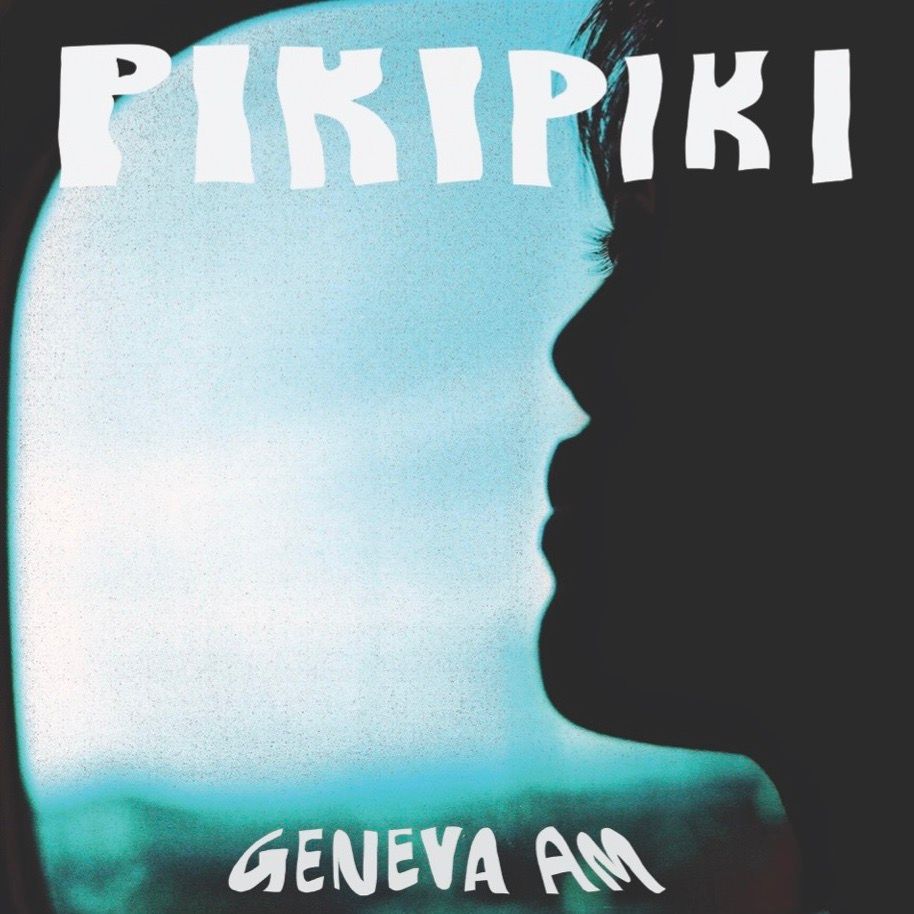
Geneva AM’s debut album Pikipiki arrives like a beam of light through the banal fog of current music – with bold arrangements, bilingual lyrics, grounded in whakapapa, history, brimming with mana. Tāmaki Makaurau-based producer, beatmaker, and vocalist (Ngāti Ruapani mai Waikaremoana, Ngāti Kahungunu ki Wairoa, Aitutaki, Palmerston) has crafted waiata that are both sonically innovative and spiritually uplifting. You can’t help feeling all the more better after listening.
Geneva AM – formerly of Electronica crew SoccerPractise (2012-2018) – has long championed te reo Māori in their music. Their ‘23 hit IHO scored a Te Tohu Puoro o te reo Māori at that year’s Student Radio Network Awards. The bilingual drop T(M)²I (Tangaroa Made Me Ill) further proved she could easily ride the waves in both worlds. Already a seasoned live performer, she’s shared the stage alongside Che Fu, Anna Coddington, Ladi6 and Suzi Cato.
However, her first full album, Pikipiki is more than that. It’s a full-length statement to the here and now, in Aotearoa. Part homage to the past, part rebellion, all aroha.
“I feel optimistic about the future and one day joining [my ancestors] in the next realm to spiritually serve the next generation,” Geneva says. It’s that feeling that runs through the entire album.
The title track, Pikipiki, actually closes the album. It features the gorgeous harmonies of Hawkins, Mara TK, Rewl McLay and Samara Alofa. I had goose pimples listening to this. Production chops are definitely on display with lush layers creating an undeniable spine-tingling emotional resonance. Far from sterile, the classic DnB architecture that drives these beats are meticulous but have an urgent sense of dance-floor euphoria. It’ll take all your will not to break out in a spontaneous song at the top of your lungs when the chorus comes in.
Waiata like Toitū Te Tiriti and Urban Planning are politically charged, but not ‘preachy’. The former has an undercurrent of a classical quartet – violins, violas, cello, thanks to the Ngā Whetu Ensemble. Somehow that adds an element of old-world colonialism. The lyrics implore weaving kaupapa Māori into the fabric of the music.
Geneva’s voice – in both a literal and metaphorical sense – is the anchor of this waka, guiding us through the themes of resistance, resilience, reconnection. Because this is a call to action – honour Te Tiriti o Waitangi – and an invitation to everyone – katoa ki te korero te reo Māori.
“I wanna believe you’re never alone/How does it fell when you’re finally home? The motor way is an awa/The museum they put my waka/I feel at home in the city” Geneva sings on Urban Planning as they reclaim the actions of past town planners and officials. Whilst commercial progress and modern real estate have pushed out across ancestral lands, Geneva does not feel aggrieved. “I got my Tīpuna with me.” I take that to mean, there’s always a layer of home and settlement that sits over the city despite the concrete and glass. The awa of whakapapa still flows across the whenua that lies underneath. “We’ll all be stars, in the end.” There’s a comfort in that.
One of the album’s most striking achievements is her reinterpretations of iconic waiata that she grew up with. Geneva breathes new life and energy into classic waiata such as Purea Nei by Hirini Melbourne, Pokarekare Ana by the returning soldiers of WWI, and Tutira Mai Ngā Iwi by Wiremu Te Tau Huata.
The modernisations are not just for the sake of being hip or trendy. I think there’s a genuine attempt to honour each song’s emotional heart.
For Pokarekare Ana Fiona Campbell and Lani Purkis are enlisted to provide a grungy, almost punky version. They really rock it out. Whatever the case it’s light years from the sanitised renditions often heard or schmaltzy renditions employed by ad agencies and tourism boards.
Far from nostalgic these covers are radical, treated a living being, as all good songs should be, capable of change, evolution, reinvention and defiant of commercial appropriation. To me it shows that tradition does not remain static – it’s open to redevelopment, as long as the core sentiment and meaning remains honoured and respected.
If you could only pick one track, one gem amongst these many, then it would be Tīpuna Rākau – this is full on nu-disco. Elements of 80’s Depeche Mode styled synth pop but Messrs Gore, Fletcher and Gahan could never pull of this trick. Geneva’s te reo lyrics and joyful vocals are inspiring, the music expansive, both grounded and appropriately cosmic. After all, our ancestor will ascend to the stars to watch over and guide us.
“This waiata speaks to the cycle of our lineage as descendants,” explains Geneva AM. “It is so beautiful to be part of a legacy and even though we may not know every single name of our ancestors I feel optimistic about the future and one day joining them in the next realm to spiritually serve the next generation.”
Check out the video, made by Louis Olsen and artist Kahurangiariki Smith. It explores and contemplates Te Kore – the primordial realm of nothingness. A void. Unrealised potential. And it is from here that all things are created. Not unlike the big band, in that sense. In the beginning is a state of ‘potential being”, where there is darkness, chaos, and, also, the seeds of all things possible. Everything before the emergence of Te Pō (night) and Te Ao Mārama (the world of light).
To lighten, Geneva channels her inner ‘Leia’, complete with the iconic hairdo. A bit of a nod in the direction of sci-fi feminism along the way. And those familiar with Moana and the Moa Hunters or Dee Lite may see a bit of similarity to their videos, too – funny, a bit camp, cheeky.
Pikipiki is rich with collaboration whānau energy. Producer and songwriter Mara TK, Hawkins, Rewi McLay (Kiko), Samara Alofa all bring their own fabulous flavours to the mix. In addition the Nga Whetu Ensemble (arranged by Eric Scholes) provide a cinematic quality to Toitū Te Tiriti. On the album you’ll hear the contributions of puoro player Tyson Campbell (Pikipiki); Ruby Walsh (Na Noise, Lips); Fiona Campbell (Guardian Singles, Coolies) and Lani Purkis (Elemeno P) on Pokarekare Ana.
Also to be credited are costume designer Steven Junil Park and makeup artist Levonne Scott who have beautifully transformed Geneva’s vision for video and live stage work. That gives the album more air and presence. The waiata are now four-dimensional – aural, visual, spatial, and spiritual.
Pikipiki is more than just a debut. When culture is expressed so bravely, with such artistic fearlessness, it should be celebrated. At no time does Geneva accept compromise. This music does not ask for permission to exist. It doesn’t need to.
Reinterpreting classic waiata is not brave, it’s innovative. Confronting cultural close downs is necessary, vital. It’s a defiance of our current, who wish to homogenise us, flush out what makes Aotearoa special, expunge our identity and tikanga. In an audio landscape so dominated by safe, formulaic pop, Pikipiki is a real breath of life.
Me titiro whakamuri kia anga whakamua. Ko te tangi o to tatou wa kei te heke mai – i whai pakiaka ki roto i nga wa o mua, tuwhena, kua rite mo nga mea kei te heke mai.
Related Acts:
About the author Tim Gruar

Tim Gruar – writer, music journalist and photographer Champion of music Aotearoa! New bands, great bands, everyone of them! I write, review and interview and love meeting new musicians and re-uniting with older friends. I’ve been at this for over 30 years. So, hopefully I’ve picked up a thing or two along the way. Worked with www.ambientlight.com, 13th Floor.co.nz, NZ Musician, Rip It Up, Groove Guide, Salient, Access Radio, Radio Active, groovefm.co.nz, groovebookreport.blogspot.com, audioculture.co.nz Website: www.freshthinking.net.nz / Insta @CoffeeBar_Kid / Email [email protected]
More by Tim Gruar
Album Review: Leap!

Festival Review: Great Sounds Great Part 1 @ Cuba Street Precinct, Wellington – 5/09/2026
Festival Review: Great Sounds Great: The Night Before @ Newtown Village, Wellington – 4/09/2026
Gig Review: Mel Parsons @ Opera House, Wellington – 05/09/2026
Album Review: Descending Dreams
EP Review: Extended Paranoia
Album Review: Brain Storm
Album Review: Ceiling Waves
Album Review: Castle Hill
Gig Review: Parrotdog Presents @ Parrotdog, Wellington – 1/08/2026
Album Review: 4EPs
Gig Review: The Veils @ Meow Nui, Wellington – 04/07/2026