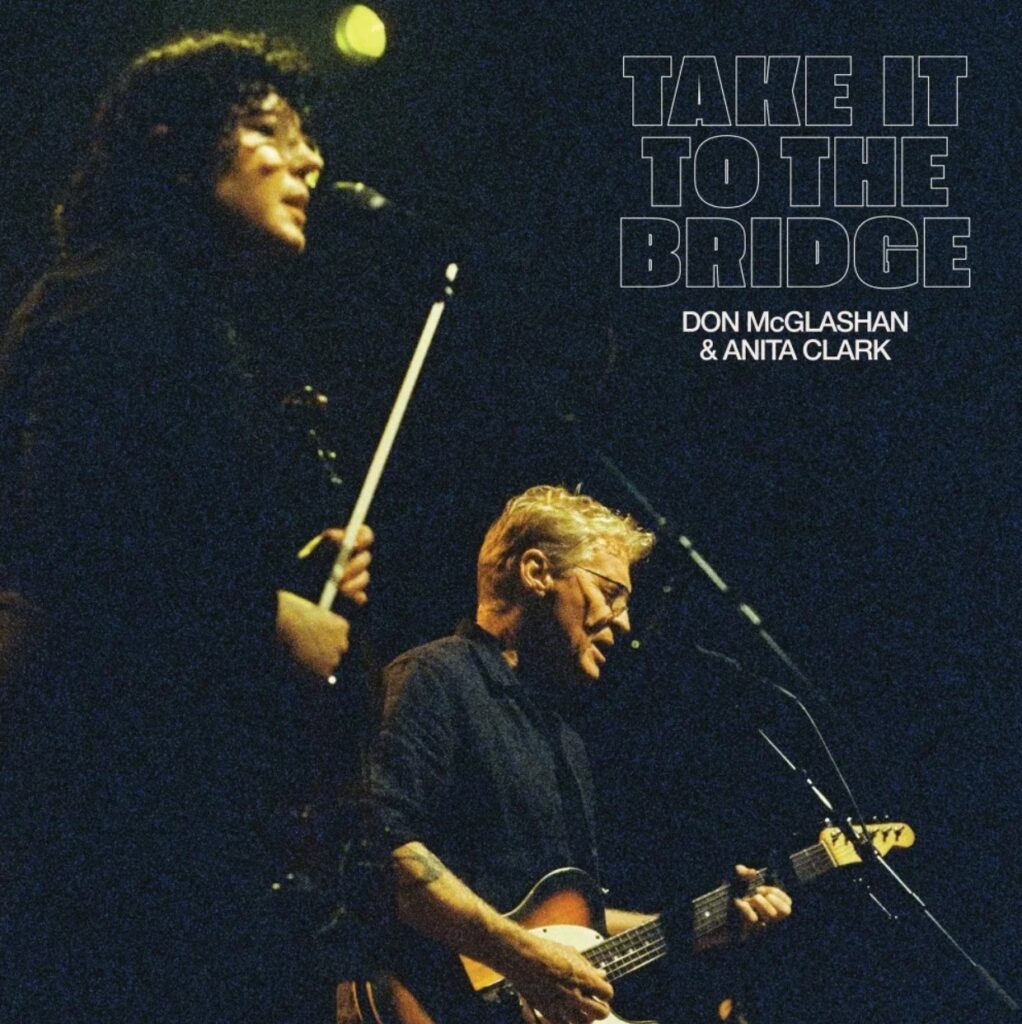
Take It To The Bridge is a very welcome, first live album from peerless troubadour Don McGlashan. It documents the 23-date nationwide tour he undertook with Anita Clark (aka Motte) in 2023. Thirteen tracks are drawn from four venues across five nights, and sourced from McGlashan’s Blam Blam Blam, The Muttonbirds, and solo ventures (with The Front Lawn also remembered, as an evolutionary touchstone).
Drawn from a 40-year time span that belies its creator’s seemingly undimmable light, these representative slices of uniformly excellent songwriting take us from Don’t Fight It, Marsha, It’s Bigger Than Both of Us (1982), to Go Back In and Nothing On The Windows (from 2022’s Number 1 album Bright November Morning). All are masterfully delivered by a songwriter displaying the kind of confidence on stage his assured songwriting skills surely entitle him to. He uses his mic’ time to exhort the crowd to vote, to give away trade secrets (apparently Clark could not play the mandolin before it became a requirement of this tour – there’s no question she can play it now), and is flexible enough to let the audience run rogue on the odd vocal interlude.
They may not be the tunes everyone sings along to, but Harbour Bridge and Miracle Sun – both from 2006 solo album Warm Hand – are the revelations on this album, for me. The latter – recognising the near deification of Opo the dolphin (from 1955-56) – is incredibly moving in its capture of nostalgia, and its marriage to miracles. Clark’s backing vocals lend this version a delicacy that illuminates it in bright relief to its album version. With its warmhearted nostalgia for childhood, it delivers an irresistible attack on the heart strings. Violin and keys propel us ascendant, and you can feel the light breaking through the windscreen, even as you mourn its passing. Things didn’t end well for Opo outside of the lyric, but – if only for the duration of this song – we’re innocent anew.
Harbour Bridge is a fine example of the way McGlashan can find metaphor and character in apparently any inanimate object, no matter how imposing or unyielding. “Why’d you have to be so grey?,” he beseeches the iconic “tonnes of Japanese steel”. “Why’d you have to be so long… Why’d you have to be so high? There’s as much structure to the song – almost geometric in its arrangement – as there is to its subject.
The Heater – to which a blazingly enthusiastic crowd chant back the “Frank, Frank, Frankincense” harmony – is a great example of the potential for personification to warp into anthropomorphism. “Come on and plug me in…” McGlashan’s fans know these songs like they know to follow “the crowd walking down the fenceline” (from a transcendent White Valiant).
McGlashan is the king of goodbye songs, and Charles Kingsford Smith – from 2015’s Lucky Stars – shows how sublimely he can harness the universal or epic to the personal and unique. Airport observation deck minutiae casts a spell that makes it easy to envisage the familiar setting of the song, and to slip on one’s own similar memories.
Another grand adventurer is the titular subject of the haunting Shackleton. Clark’s theremin wails like icy wind, amping up this devastatingly haunting song’s eerie vibes… “Who’s that walks beside you…?” This story’s no metaphor – weaving a mixture of history and McGlashan’s own spell in Antarctica – so cinematic in its execution, it drops the temperature, as it sneaks up and down your spine.
Bathe In The River – made iconic by Hollie Smith/Mt Raskil Preservation Society, in the hit version from the film No. 2 – sees an audience in Carterton turn a small venue into a church, and every hair on your body will feel the combined spiritual force. I’ve heard McGlashan and Clark play this in an actual church before too – at Old St Paul’s in Wellington (playing with The Others) on the Bright November Morning tour. It’s great to be able to revisit that exultant feeling with this new recording, its first verse and chorus delivered in Te Reo Māori as they were then too – incorporating the translation drawn from the NZ On Screen Waiata Anthems project version, Kōrukutia. It’s deeply moving to hear in action McGlashan’s belief that Pākehā have a unique opportunity, to learn and speak the language spoken by the first people to describe the whenua we share.
McGlashan’s ability to imbue a chest-cleaving yearning for home – and the ability to centre that home in people he sees as all-consuming places – is easily passed on to the audience at Auckland’s Q Theatre, on a closing Anchor Me. The crowd take the main harmony line, leaving McGlashan and Clark to tread new ground. The result transforms the classic belter into something more intimate, providing a stirringly delicate version that’s pure shivers.
About the author Bee Trudgeon
Bee Trudgeon (she/her) is a writer, rocker, stroller, strummer, mama, children’s librarian, and perpetual student. Her journalism has been published in Rip It Up, Audioculture Iwi Waiata, Capital Times, The Sapling, The Spinoff, and NZ Poetry Shelf; her poetry in A Fine Line, NZ Poetry Box, and NZ Poetry Shelf, and the New Zealand Poetry Society Anthology paint me. She lives in Cannons Creek, and on the Patreon page of her alter ego, Grace Beaster.
More by Bee Trudgeon
Gig Review: Jon Toogood @ The Hannah, Wellington – 26/09/2026
Festival Review: Great Sounds Great Part 2 @ Cuba Street Precinct, Wellington – 5/09/2026
Album Review: The Nights
Gig Review: Delaney Davidson @ Meow, Wellington – 18/07/2026
Album Review: Tāwauwau
Gig Review: Andrew Fagan @ St Peter’s Village Hall, Paekākāriki – 16/11/2025
Album Review: Dream, Believe, Achieve
Gig Review: Kaylee Bell @ Michael Fowler Centre, Wellington – 04/11/2025
Album Review: Echomatica
Gig Review: Tami Neilson @ Opera House, Wellington – 3/10/2025
Festival Review: Great Sounds Great Part 1 @ Cuba Street Precinct, Wellington – 6/09/2025

Gig Review: Jazmine Mary @ Meow, Wellington – 31/07/2025