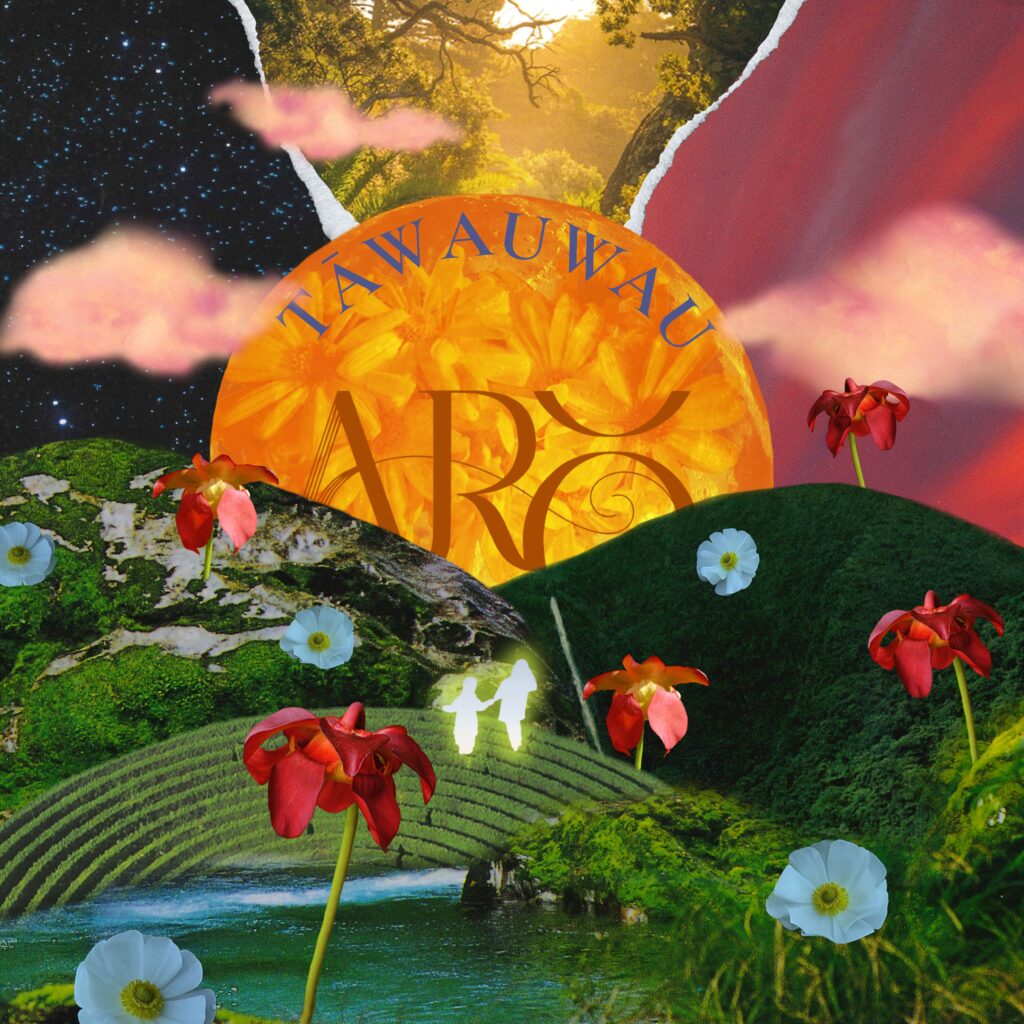
Award-winning māmā-pāpā duo Aro – Charles Looker (Ngāpuhi, Te Rarawa, Ngāti Te Ata, Te Ati Awa) and Emily Looker (née Rice) – have been living on the road with their two young children in a mobile home, laying down the bones of their new album in the precious hours after the little ones’ bedtimes. Following the nature-focused themes of their previous albums and EPs – Manu, He Manu Anō, He Wai, and He Rākau, He Ngārara – their concept for Tāwauwau sees them turning inwards together, setting gently introspective duets like Pretend beside more pop-rock fusions like OYH and Burnt.
Title track Tāwauwau is a sublime a cappella invitation into the liminal world of the album, which Aro have described as “that thin place where hope feels close enough to touch”. First single Puna Ora is another vocal-driven piece, with Emily’s lead accompanied by woodwind, guitar, horns, drums, and haka chants, in celebration of the interconnectedness of whakapapa. It’s a waiata about awakening the living spring within, and feeling its connection to our tūpuna, our tamariki, and to something beyond what we can see. Whakataratara and the mesmerising Hīraruau are two more examples of tracks where brave and delicate sentiments are punctuated by powerful infusions of haka.
Stand-out track Fly High is a jazzy number, which sets its course in Te Reo Pākehā, although – like the majority of the album – its destination will be reached in Te Reo Māori. The inclusion of one of beloved poet Mary Oliver’s most famous lines – “What is it you plan to do with your one wild and precious life?” (a refrain sung by Emily) – underscores the suggestion that to fly (however one might) is an invitation worth accepting.
The upbeat and catchy melody of second single Mundane belies the thanks-but-no-thanks lyric – “It’s just mundane” [echoed in a buoyant repeated catch cry] / “It’s all the same!” – calling out boring timewasters and repetitive narratives. It starts with a catchy strum that eventually gives way to a fiery guitar solo, driving home the latent strength in a firmly implied, no excuses necessary “kāo”. It’s a great example of the general mood of the album – subject-wise – with its eye on both challenges and solutions. Perhaps it mirrors the necessary life skills and genesis of its peripatetic creation.
Tāwauwau is an album that masterfully showcases Aro’s honourable commitment to uplifting Te Ao Māori through waiata, kaupapa, and affirmative action. Its spacious feels boogie confidently through the kete of musical styles at its vastly talented makers’ disposal. Secured by the combined values of kaitiakitanga and manaakitanga as its punga, Tāwauwau is a brave and beautiful response to uncertain times. Turn down those narratives, noises, and paces that don’t serve you best, and turn up the most expansive Aro album to date.
“Ka wehiwehi,” indeed.
Related Acts:
About the author Bee Trudgeon
Bee Trudgeon (she/her) is a writer, rocker, stroller, strummer, mama, children’s librarian, and perpetual student. Her journalism has been published in Rip It Up, Audioculture Iwi Waiata, Capital Times, The Sapling, The Spinoff, and NZ Poetry Shelf; her poetry in A Fine Line, NZ Poetry Box, and NZ Poetry Shelf, and the New Zealand Poetry Society Anthology paint me. She lives in Cannons Creek, and on the Patreon page of her alter ego, Grace Beaster.
More by Bee Trudgeon
Gig Review: Jon Toogood @ The Hannah, Wellington – 26/09/2026
Festival Review: Great Sounds Great Part 2 @ Cuba Street Precinct, Wellington – 5/09/2026
Album Review: The Nights
Gig Review: Delaney Davidson @ Meow, Wellington – 18/07/2026
Gig Review: Andrew Fagan @ St Peter’s Village Hall, Paekākāriki – 16/11/2025
Album Review: Dream, Believe, Achieve
Gig Review: Kaylee Bell @ Michael Fowler Centre, Wellington – 04/11/2025
Album Review: Echomatica
Gig Review: Tami Neilson @ Opera House, Wellington – 3/10/2025
Festival Review: Great Sounds Great Part 1 @ Cuba Street Precinct, Wellington – 6/09/2025

Album Review: Take It To The Bridge
Gig Review: Jazmine Mary @ Meow, Wellington – 31/07/2025