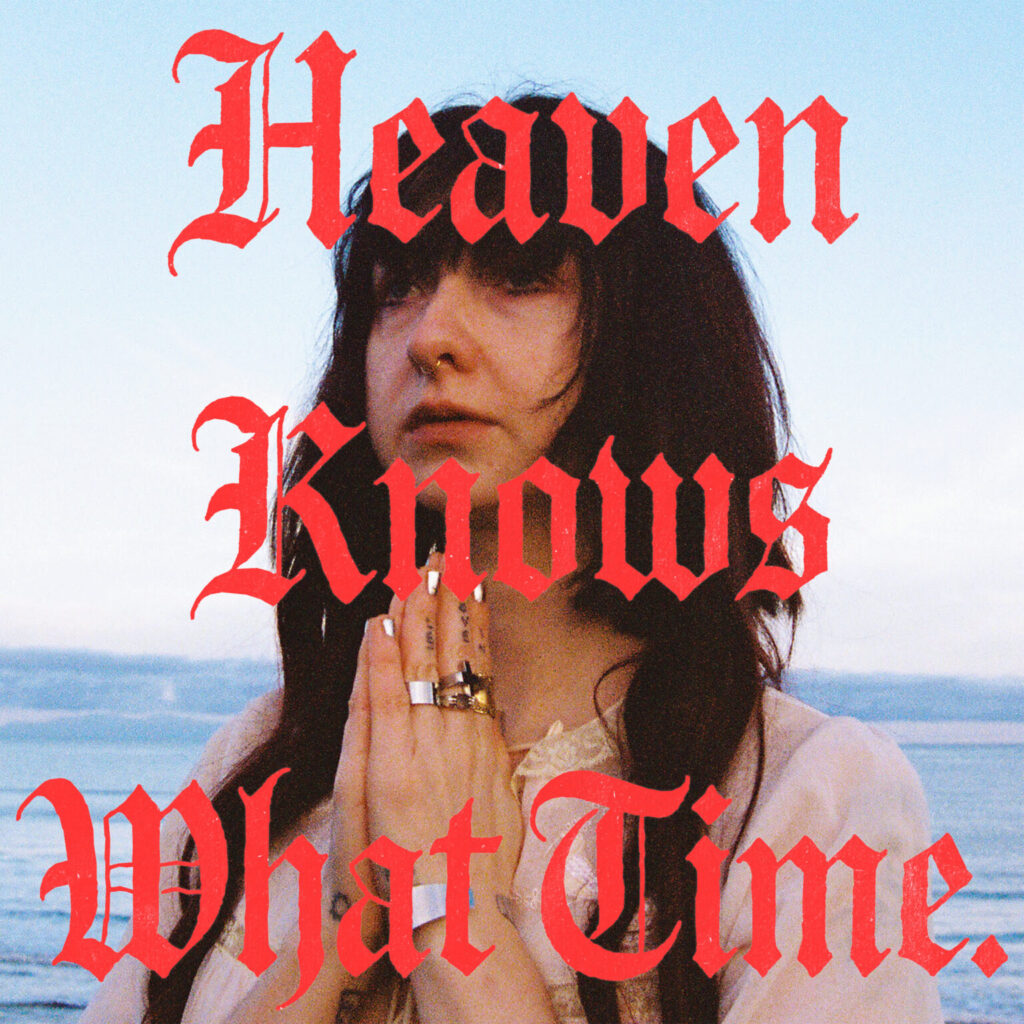
I love dropping into my local Flying Nun store. Behind the counter are musicians and music obsessives I’ve come to know, on and off, over the years – people whose careers I’ve watched grow, photographed, written about, and interviewed. With Vera Ellen, I’ve seen that growth up close: from tentative opening slots at San Fran and Meow to major stages like SXSW and Laneway Auckland, and plenty of points in between. I’ve met her mum at a fundraiser (she served me Polish sausages). We pass each other on Cuba Street. I’ve seen her on YouTube, in music videos, heard her on the radio. She’s everywhere, really – but to us Wellingtonians, she’s still one of us. That local connection runs deep, so when files for her new album landed in my inbox, I was genuinely elated. I had a strong sense this one would be special.
Putting on my headphones, I shut out the world and leaned in. What quickly became clear is that Heaven Knows What Time isn’t searching for neat conclusions. Instead, it finds grace in staying present with uncertainty, in waiting things out. That alone marks a shift from the emotional terrain of Ellen’s earlier work. Her raucous, bratty Flying Nun debut It’s Your Birthday (2021) kicked hard against the pricks – bristling with post‑punk nervous energy, sharp self‑awareness, and a fabulous surge of feminine strength. No surprise it earned Best Alternative Artist at the Aotearoa Music Awards (2022). It’s still on high rotation in my car, whether I’m heading to gigs or road‑tripping with the whānau.
The follow‑up, Ideal Home Noise (2023), turned further inward. More fractured, heavier, and unflinchingly honest, it showed an artist unafraid to document vulnerability in real time. That courage was deservedly recognised with the Taite Music Prize (2024). Tracks like Carpenter, which wraps big, catchy melodies around creeping self‑doubt, and Broadway Junction, which stares despair in the face and somehow opens it up, capture how the record moves deftly between humour, darkness, and contrast without losing its heart.
Heaven Knows What Time doesn’t abandon the honesty that’s always defined Vera Ellen’s songwriting – it widens the lens. Where Ideal Home Noise wrestled with conflict within the self, this album turns outward, allowing love, joy, exhaustion, humour, doubt, and exuberance to coexist, unresolved and deeply human. There’s no pressure to define, fix, or neatly conclude – because life isn’t a tightly edited TV episode that wraps before the credits roll. That embrace of messiness is exactly what makes Ellen’s music feel so real.
Born and raised in Naenae, Te Whanganui a Tara/Wellington, Ellen began writing songs at eight, coming up through local bands like Maple Syrup and Sweater before moving to Los Angeles in her early twenties. There, she co‑founded Girl Friday and released music via Sub Pop’s Hardly Art, gaining her first international footing. When the pandemic brought her back to Aotearoa in 2020, that interruption proved pivotal, sharpening a solo voice that’s now instantly recognisable – and fearless.
On that continuum, the songs that became Heaven Knows What Time emerged after years of relentless touring and self‑sustained work. Several were written during a two‑week songwriting residency at Carterton Cottage in Greytown, Wairarapa, awarded through the NZ Pacific Studio Artist Residency Programme, an experience that offered two crucial elements she had been missing. The first was space and solitude – largely alone in the cottage, she slowed down, walked the land, and reconnected with her thoughts and body, allowing fragmented ideas to settle into songs again. The second was accountability: a final performance at Studio 73 created a gentle but necessary deadline, reaffirming her commitment to songwriting and her desire, as she wrote in her application, to make an uplifting record after the weight of Ideal Home Noise. That balance of stillness and responsibility runs through the finished album, which feels lighter and more assured while still embracing contradiction, humour, and unresolved emotion rather than forcing neat conclusions.
Produced and mixed by longtime collaborator Ben Lemi (Trinity Roots, French For Rabbits, Dawn Diver), the album features his multiple talents on drums, cello, percussion, glockenspiel, backing vocals, and includes some welcome contributions from Hemi Hemingway, Audrey May, and Bella Guerra. Audibly, I think, the fact it was recorded in Aotearoa gives it an ‘at‑home’ warmth and looseness, which is so important to forming the emotional glue that holds everything together.
As I said above, I think Heaven Knows What Time is less interested in wrestling with pain than learning to live alongside it. Jangle, glockenspiel, conversational melodies, and gently crooked rhythms give many songs an understated buoyancy, even as they carry sharp emotional weight. Ellen has spoken about wanting to write something “uplifting” after the heaviness of Ideal Home Noise, but the album never tips into forced optimism. Instead, it embraces contradiction – joy that contains fear, humour edged with ache, desire shadowed by doubt.
The album lunges in on an upbeat, jangly melody, but first there’s a breath – literally. “Three, two, one,” Vera Ellen says softly, in her unmistakable Hutt‑girl drawl, opening Spit @ The Sky not with a hook but a moment of grounding. Shortly after comes the spoken mantra: “I wrote a note to myself, said “it’s not me, it’s you” / I’m renouncing it all, gonna paint a bedroom / That isn’t my own and call it my home / And let go of every pain that I’ve known.” It’s brilliant, bright, hook‑heavy indie pop, but it also feels like an announcement – a clear shift away from urgency and emotional strain and toward instinct, patience, and something lighter that’s genuinely earned. With its gentle twang and lopsided jangle, Spit @ The Sky works as a grounding breath, not a grand statement; when Ellen offers “…the darkest part of me,” it’s neither dramatic nor apologetic. It’s not a confession so much as acceptance – and in that quiet certainty, the tone for everything that follows is set.
“Big shot Jerry, running around in New York / You’ve come a long way since high school, yeah.” Is this a compliment? I don’t think so. Irony is fully locked and loaded for Big Shot Jr. Children’s voices and jangly pop collide in a reflection on distance from former selves. Nostalgia flickers but never settles comfortably. The song arrives and disappears like memory itself. Why do I think this song reminds me of Talking Heads? I dunno, but I like it.
How We Say Goodnight is beautifully built on an insistent rhythm and conversational vocals; this is less about break‑ups than habits. The tension hums beneath Ellen’s restraint. It’s quiet, but deeply unsettling. The humour is so dry, you could mistake it for sincerity. Watch your words.
One of the record’s most talked‑about moments comes with Gayfever, a joyful anthem of infatuation that allows itself sweetness without irony. While the song openly celebrates queer desire, I’ve not seen confirmation of her own sexual orientation, and I love that intention, deliberately choosing to let the work stand on its own terms. As with much of her songwriting, identity is present but never boxed in. The lyrics are gushing: “To give me that Gayfever (Gay!) / You poetic creature, I just wanna please ya / Gayfever! (Gay!) / Yeah, I’m a believer in everything we were. / To give me that Gayfever (Gay!) / I’m getting bad fever.
And also vulnerable, in that way we all are when we’re totally smitten: “Look at how you learned your lesson, never keep a woman guessing / Careful with the words you’re choosing, never bite an apple bruising / You’re making all the worst places fun, like the mall and the DMV / Thinking about the ending, but we just keep pretending. / I’m giving you.
It’s the album at its most playful and unguarded, revelling in feeling before reflection kicks in. The video that goes with the song is directed by former bandmate Jerry Ramirez and starring Zipporah Norton. It leans into that same spirit, balancing warmth with flashes of off‑kilter absurdity.
Remember Walking In Memphis – That Marc Cohn classic about discovering the real American music dream? Well, this is might just be Ellen’s ‘darker’ take. Walking in Vegas begins delicately but soon unravels into shrill guitars and nervous energy. This is the liquor-soaked sin city, the place of vice and degradation. The American dream appears as a promise that never stabilises. Discomfort is the point. It’s a song that appears to be so relevant for so many people right now. I love the references to barfly life, especially the lines: “Waiter, waiter, pour me a drink / I’ve got my wetsuit on and I’m ready to sink. / Waiter, waiter, like my cigarette / I’ve got my game face on and I’m ready.” The grunginess of the delivery comes in the middle of a mostly candy sweet melody line and it’s delicious.
Hollow a is a twitchy and kinetic of a messy life and love, with a bit of Boy Genius energy thrown in for good measure. I love the contrasting bass guitar lines. Anxiety moves through the groove rather than overwhelming it. Motion becomes survival. I adore her phrasing, a talk/rap blow off to the ‘someone’ this song is actually addressed to: “In the end, it just felt hollow, all the shit I couldn’t swallow / You were never mine to follow / Got lightning in my eye, got bigger fish to fry / Got friends that wanna die.”
“The inspiration for Thaw,” Ellen says, “Came when I hit writer’s block during a songwriting residency and decided a change was needed.” It’s crunchier, more instinct‑led and it sounds more spontaneous, too. As was the moment, she says, when during her songwriting residency she ducked into a local barber just before closing time, talking guitars and rock while Alice Cooper blasted. “And on the walk home I got myself some whiskey. All I wanted was to write a ‘sick riff’ – I sat down and out came Thaw.” That shift away from expectation and toward pure feel marks a turning point in the record’s writing process, with Thaw exploring infatuation from a place of confidence rather than uncertainty and featuring backing vocals from bandmate Ben Lemi. Even the applause tagged onto the end nods to the album’s intimate, in‑process origins, while the accompanying video – another collaboration with Daniel Fletcher – sits somewhere between short film and music video, shaped by conversations around identity, love, dating, and generational patterns.
And so, to one of the album’s finest moments. When It’s Over Feat. Hemi Hemingway is a duet suspended between love and collapse. “And were both afraid that your sinking / your always pushing me to shrink” lands with brutal softness. Hemingway’s sexy, sultry voice deepens the emotional gravity. No doubt he is out own Chris Isaac. A haunting duet capturing the uncomfortable space between love and collapse. Written while Vera was still in a relationship, the song explores mutual dysfunction with tenderness and brutal honesty. Hemingway’s brooding vocal acts as a counterweight to Vera’s, a collaboration born from long‑standing musical chemistry.
The song seems to stubble in, like a drunkard. And taken on face value the opening lyrics are pretty brutal: “You burst a blood vessel in your eye / From puking too hard at the party / And at the jam when I got too high / You said / Well that’s a terrible thing you’re starting.”
There’s some kind of love have cajoling underway. How serious do we take this sparing? Is it vindictive or humorous when Ellen declares “I was born with love in my heart / I met your girlfriend for a drink.” What for? To confess? To tease him? “Stop your dancing,” he replies, calling her out. It’s an oddly alluring break up ballad. Sure it’s car crash of a song you can’t turn away from. It sits in the memory and keeps coming back again and again. Watch out Taites, it’ll be back on the nominations, I predict. And I love Daniel Fletcher’s super cool retro video. Ellen’s B52 is worth the watch alone.
Drifting, nostalgic, waltzy, Hunger Is Just A Memory, explores emotional need rather than want. Its gentle sway masks deeper longing and the ache arrives quietly. I the chorus, I can almost imagine a choir of voices. Instead, there’s an incomprehensible voice pop. Who is this? This, like many of the other songs on this album, requires multiple listening, there’s so much more layers going on. Is this about comfort or lost?
“You think you’ve discovered something now you’ve seen a little pain / you think you’ve recovered someone now you’ve held them in the rain / and you look to me so smug / as if you understand the game / well aren’t you brave.” Why do these lines seem like a parent mocking their child, the way our mums did when we acted so dramatically, as if we were the only ones to go through a breakup or loved so deeply. “You think you’ve seen the rapture / cause it wrapped you in it’s shirt / and you think you’ve known laughter / cause you’ve touched it’s twirling skirt.” They’ve seen it all before. That’s the premise to Getting Told Off By Mum. Which, taken the right way is a lightly comic but emotionally pointed number. Authority becomes an internal voice rather than an external one: “inside I’m screaming / (I’m holding it back but I mighty just do it) / the brakes are screeching / (There’s only one way and its gonna be through it)”, humour protects something fragile underneath. To round off the album the tension and drama builds with the electronics and the band going full-on.
There’s even a sarcastic bible reference (I think) to Abigail (who remains clam under pressure and supports King David despite her husband’s insults). This is the musical version of a daughter mother kitchen barney. If you’ve ever been witness or participated, I’m sure you can relate. Building to a fabulous wig out crescendo: “tell me more than I bargained for”. Finally, the argument is over, followed by a huge angsty scream-release.
The line “Heaven Knows What Time” came to Vera Ellen while she was lying on the top bunk of a house truck in Buenos Aires. Nearly two years after the record was written, almost a year after it was mixed, and after several abandoned working titles, the album’s name finally arrived – sudden and unmistakable.
This may be Vera Ellen’s most assured record to date – not because it offers certainty, but because it no longer seeks it. Ellen’s songwriting remains plain‑spoken and instantly familiar, yet she bends that clarity to her own ends – warm where others might be wry, moving easily between melodic pop lift and near‑home‑recorded intimacy while still digging into uneasy, emotionally resonant ground.
At this point, the question is no longer whether her voice will travel far beyond Aotearoa, but simply when; with a UK and European tour supporting Aldous Harding on the horizon, that moment feels close. Scuse’ the pun: Heaven knows what time – but Vera Ellen is ready when it arrives, and the best way to understand why is simply to press play and let the album do its work.
Related Acts:
About the author Tim Gruar

Tim Gruar – writer, music journalist and photographer Champion of music Aotearoa! New bands, great bands, everyone of them! I write, review and interview and love meeting new musicians and re-uniting with older friends. I’ve been at this for over 30 years. So, hopefully I’ve picked up a thing or two along the way. Worked with www.ambientlight.com, 13th Floor.co.nz, NZ Musician, Rip It Up, Groove Guide, Salient, Access Radio, Radio Active, groovefm.co.nz, groovebookreport.blogspot.com, audioculture.co.nz Website: www.freshthinking.net.nz / Insta @CoffeeBar_Kid / Email [email protected]
More by Tim Gruar
Gig Review: Hikurangi Schaverien-Kaa @ Te Ao Kōhatu Wellington Jazz Festival, Wellington – 18/10/2026

Album Review: Motoring For Beginners
Album Review: Te Ngahere
EP Review: Welcome To The Dance Bunker

Album Review: Leap!

Festival Review: Great Sounds Great Part 1 @ Cuba Street Precinct, Wellington – 5/09/2026
Festival Review: Great Sounds Great: The Night Before @ Newtown Village, Wellington – 4/09/2026

Gig Review: Mel Parsons @ Opera House, Wellington – 05/09/2026

Album Review: Descending Dreams
EP Review: Extended Paranoia
Album Review: Brain Storm

Album Review: Ceiling Waves