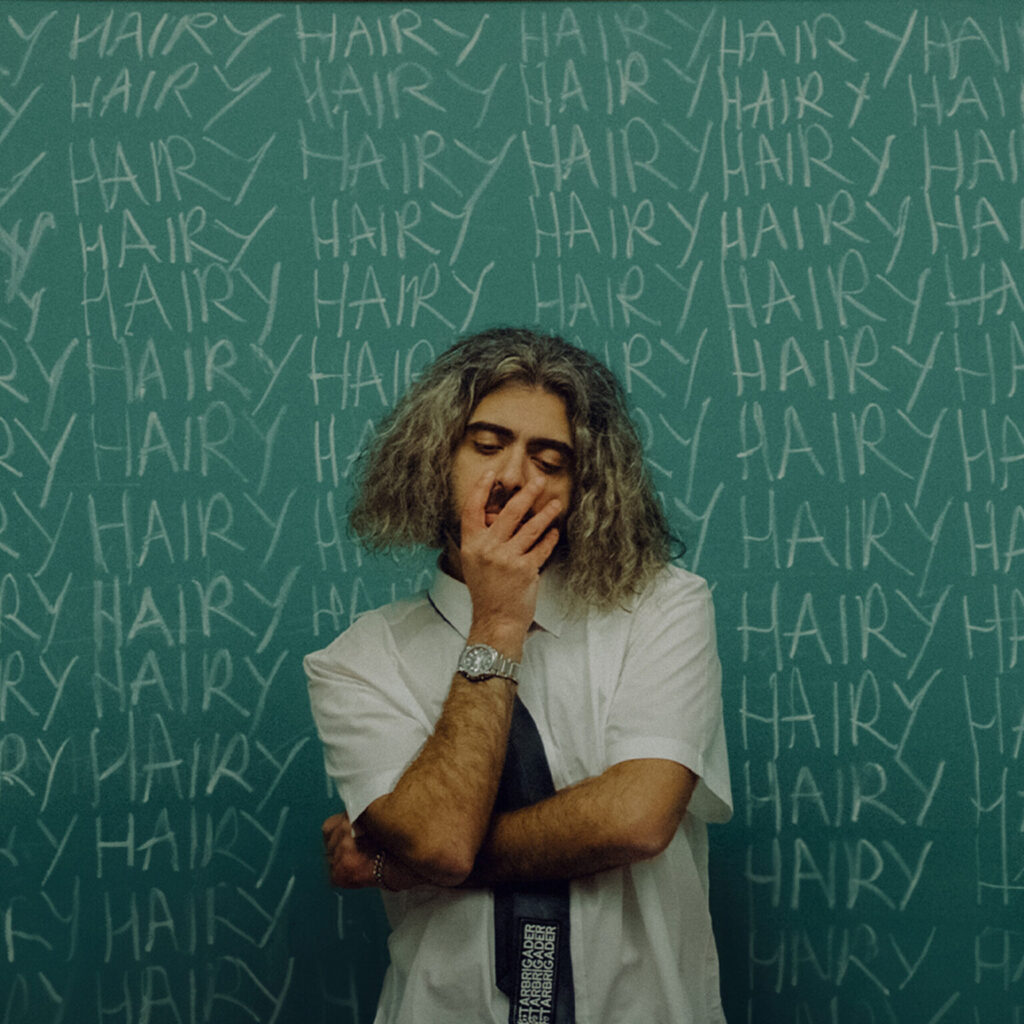
Who Shot Scott has always sounded like he’s been trying to shake something loose from under his skin. On Hairy, his long-awaited debut album, he finally does – but not by sanding anything down. Instead, he pushes further into the friction, delivering a record that feels intentionally unruly, full of contradiction, volume and vulnerability, sometimes all at once.
Who Shot Scott (aka Iraqi-born, Kiwi-raised Zaidoon Nasir) has built momentum through a genre-blurring mix of alt-hip hop, punk energy and electronic experimentation, with songs that return again and again to identity, belonging and mental health. Listeners may know him from the Mercy trilogy, Brain, support slots for Snoop Dogg and Yung Gravy, a sync in the Borderlands 4 trailer, and tours in Japan, with UK shows ahead. He’s also picked up two APRA Silver Scroll nominations. The first time I saw him was at WOMAD 2025, where he tore onto the Gables Stage with such force I was surprised the scaffolding held out.
It’s a record that refuses to smooth out its rough edges. Across its nine tracks, Hairy drifts between jagged, punk-leaning hip hop and more stripped-back, vulnerable moments, never sitting still long enough to be boxed in. One minute it’s all noise and forward motion, the next it eases right off. There’s even some outward jokey antics in there. That back-and-forth – just as emotional as it is musical – is what gives the record its shape. But let’s be clear: the messaging is deadly serious.
At its core, Hairy is about adolescence, alienation and reclamation. The title comes from Nasir’s experience of being mocked at school for his body hair, and he turns that insult into a badge of defiance. That idea comes into sharp focus on title track Ew Hairy Arab, a pumping, scathing rebuttal. All the racist taunts he’s endured are thrown back at the listener. He reframes humiliation as resistance. It is a brave premise for an album and one that will resonate with anyone who has been othered for their appearance, culture or beliefs.
Several tracks were released earlier this year. That includes Bad Girls, which revisits teenage betrayal with a bittersweet edge, matching smooth, groove-rich production with something far more wounded underneath. Problems In My Head is one of the album’s starkest moments, unpacking anxiety with an unguarded directness that suggests early encounters with therapy (check the video for that). It does have the catchiest choruses though, and will no doubt be the loudest chant-back live. Fast Car, by contrast, taps into the warped logic of teenage status anxiety, where something as trivial as a flash vehicle can seem like the difference between belonging and invisibility. To add insult to injury, he’s riding the bus in the video (not doing “140 kilometres up in the residential black tar”).
The album also allows for moments of dark, almost comic detour. French Fever is one of the sharpest: a parody-laced track circling allegations about a former French teacher. It opens with Nasir hiding in a bathroom to avoid someone he finds intimidating, before bluntly suggesting prejudice with the line, “I think she’s racist, I think she hates me…” That ambiguity – whether this is fact, fear or a mixture of both – makes the song more unsettling rather than less.
That uncertainty feeds a broader throughline across the album: everyday racism and the lingering historical baggage – “wish they knew I got problems passed to me from Baghdad” (Peaked In High School), referring to his own family’s journey and history. He doesn’t elaborate this time on what that is, but you have to know that it is there and respect that. He revisits the theme over and over and is quite literal about it on I’m Your Alien. You can’t help feeling it. We are becoming more and more aware of immigration intolerances as we watch scenes unfold overseas, and we see the vileness filling up column inches as our own election season starts to gain momentum. This is the truth. The record treats those tensions as lived and immediate rather than abstract, but it is unequivocal on one point – there is no justification for racism or intolerance.
Tracks like Peaked in High School and the title track take a more reflective stance, sharpening the album’s themes with wry hindsight. Nasir revisits old humiliations without pretending they no longer sting, but he reframes them with defiance rather than defeat. What anchors the record is his ability to turn vividly specific memories into something broadly recognisable, with storytelling that feels more controlled and fully realised than in earlier work.
If you’ve followed Who Shot Scott through the Mercy trilogy or the Brain releases, Hairy feels like both a continuation and a break. Those earlier projects leaned hard into trauma, isolation and fragmented intensity; this album keeps the volatility but gives it a clearer emotional arc. What some of those releases lacked was cohesion. Hairy is the first time all of Nasir’s impulses are held within a single deliberate shape: the chaos remains, but it is controlled; the songwriting is sharper; the emotional core clearer. In other words, he’s on message.
One of the most striking things about Hairy is its refusal to sand down its edges. At a stage where greater polish might have seemed inevitable, Nasir pushes the other way, embracing distortion, imbalance and contrast. The production lurches between blown-out bass, volatile percussion and warped vocals before collapsing into uneasy stillness. Guided by Nasir as producer and shaped visually with longtime collaborator Connor Pritchard and a tight creative circle, the album feels less like a calculated industry move than a personal reckoning.
One of my standing frustrations with modern commercial R&B and hip hop is how often it collapses into a smooth, overproduced blur – slick enough for radio, but too bland to leave much behind. In that sense, Hairy is an antidote. It rejects polish and restraint in favour of something messier, riskier and far more memorable. And did I mention these tunes are all super catchy? It won’t take much for you to be humming them back, especially Peaked In High School and Problems In My Head.
Teenage humiliation is a cruel place to be trapped, and on Hairy Nasir comes out swinging. He forces old social hierarchies aside and reshapes the aftershocks of cultural dislocation into something more powerful. There is still pain here, but unlike some earlier releases, it no longer simply sits inside the wound. Hairy refuses compromise: imperfect by design, deeply personal, and built from awkward memories, defensive wit and raw self-examination.
Related Acts:
About the author Tim Gruar

Tim Gruar – writer, music journalist and photographer Champion of music Aotearoa! New bands, great bands, everyone of them! I write, review and interview and love meeting new musicians and re-uniting with older friends. I’ve been at this for over 30 years. So, hopefully I’ve picked up a thing or two along the way. Worked with www.ambientlight.com, 13th Floor.co.nz, NZ Musician, Rip It Up, Groove Guide, Salient, Access Radio, Radio Active, groovefm.co.nz, groovebookreport.blogspot.com, audioculture.co.nz Website: www.freshthinking.net.nz / Insta @CoffeeBar_Kid / Email [email protected]
More by Tim Gruar
Album Review: Motoring For Beginners
Album Review: Te Ngahere
EP Review: Welcome To The Dance Bunker
Album Review: Leap!

Festival Review: Great Sounds Great Part 1 @ Cuba Street Precinct, Wellington – 5/09/2026
Festival Review: Great Sounds Great: The Night Before @ Newtown Village, Wellington – 4/09/2026
Gig Review: Mel Parsons @ Opera House, Wellington – 05/09/2026

Album Review: Descending Dreams
EP Review: Extended Paranoia
Album Review: Brain Storm
Album Review: Ceiling Waves
Album Review: Castle Hill