
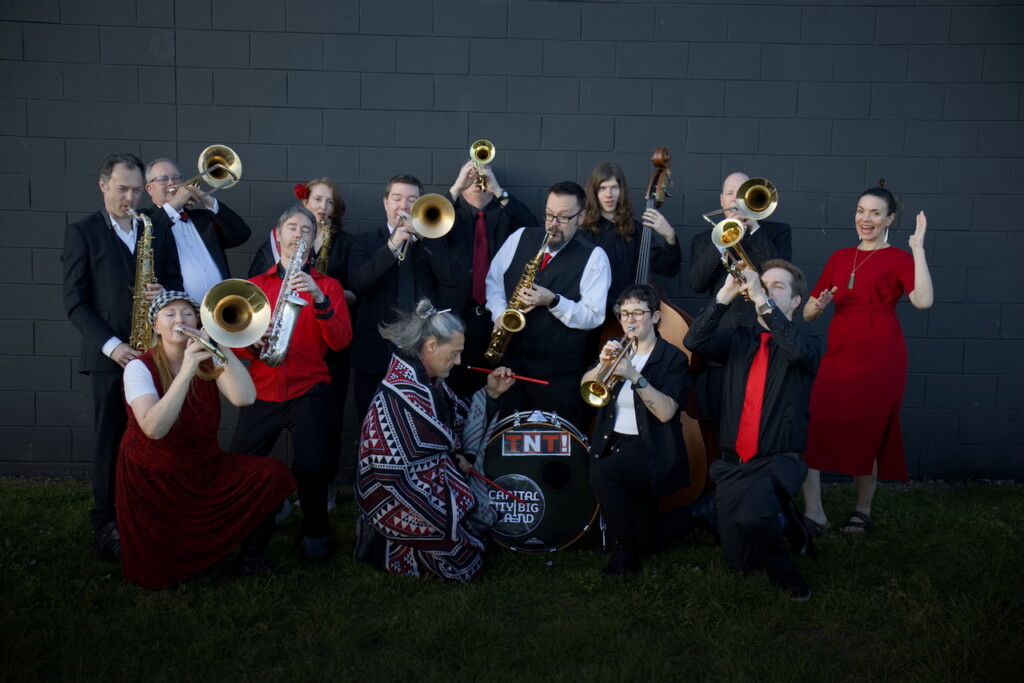
From a Tawa rehearsal room to the Wellington Jazz Festival, Capital City Big Band has grown into one of the motu’s most treasured big-band acts. On Friday 16 October 2026, the band brings TNT! (Tira Nui Tautito) to Hannah Playhouse: a bold, bilingual meeting of brass, swing, waiata Māori, Tautito (jazz) and Kōrangaranga (blues), with te reo Māori and te ao Māori at its heart. Ahead of the concert, Tim Gruar spoke with drummer, educator and project instigator Greg Crayford (Ngāti Kahungunu ki Te Wairoa, Ngāti Raukawa ki te Tonga, Ngāti Tūwharetoa) about turning a long-held vision into something both familiar and startling: saxophones burnishing melodies, trombones widening the sound, trumpets throwing sparks and a rhythm section driving it all forward beneath words unmistakably rooted in Aotearoa. “Come and see it because it’s unique and historic,” says Crayford. “This has never been done before in quite the same way.”
The group began more than 15 years ago in Tawa as Aspire Big Band, initially linked to the Salvation Army but no longer a church ensemble when Crayford arrived in 2014. A New Zealand School of Music postgraduate eager to return to big-band playing, he was steered there by the late Wellington jazz icon Rodger Fox because the Jazz School’s bands were reserved for undergraduates. Crayford rang, asked to play drums, and headed north for a Monday rehearsal, joking that Tawa felt so distant he needed his passport.
His first impression was hardly promising: “I thought, ‘Oh, this band’s not very good. I think maybe I won’t come back.’” But the teacher in him followed his own advice to try anything new four times. “Four times is the magic number,” he says. “It gives you enough time to feel comfortable, enough time to know whether or not it’s for you.” By rehearsal four, he heard the potential; after a concert, he stayed. Two years later, he took the organisational reins but resisted becoming musical director: elsewhere he directs plenty of music; here he wanted to “just play the drums”.
As personnel, rehearsal space and identity shifted, Aspire became Capital City Big Band. Only two other players from Crayford’s 2014 intake remain, reflecting the changing personnel of a large ensemble. Today, the volunteer-led band unites professionals, strong community players and emerging jazz specialists from Te Whanganui-a-Tara and the lower North Island. Its standard 17-piece line-up – rhythm section, five saxophones, four trombones, and four or five trumpets – expands with vocalists. “A big band is not just a band that’s big,” Crayford says. “It’s a specific instrumentation, a specific type of music. It’s a genre.” Its repertoire spans Basie-style swing and blues, funk, Latin music, contemporary charts and local composition.
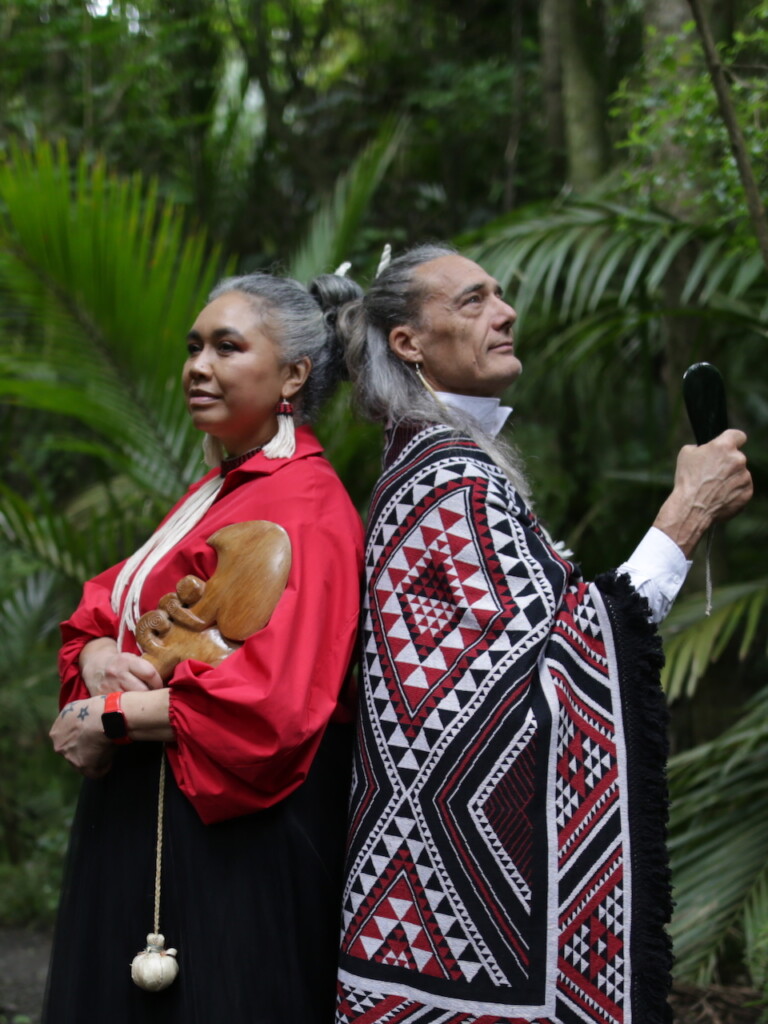
Photo supplied
Crayford first played big-band music at Hutt Valley High School; today he is head of music at Rongotai College. Music and whakapapa have never been separate lanes. During postgraduate study in 2014, he imagined combining composition, big-band language and te reo Māori, perhaps with a Pasifika dimension reflecting the Māori and Pacific students he taught. His degree took another direction, but the idea stayed. “Another very big thing in my life is my Māori side,” he says, “speaking the language and being involved in the Māori world and being connected to my whakapapa and to this amazing, lush, rich world we have here in Aotearoa.”
The fuse caught when arranger and trumpeter Vaughn Roberts returned to Wellington as musical director. Roberts had the craft to translate Crayford’s concept into a full brass-and-reeds vocabulary. Singer Lisa Tomlins was already trusted: Crayford had taught her drums at Upper Hutt College. “There were a few key people that came on board,” he says, “and it seemed like the time was right to pull this project together – this big-band jazz, te ao Māori.” Roberts would create bespoke arrangements, Crayford shape the kaupapa and language work, and Tomlins lead a rōpū kaiwaiata able to carry intimacy and big-band force.
The title comes from Māori arts vocabulary. “Tira – band. Nui – big. Tautito – jazz,” Crayford explains; rather than transliterating an English label, tautito reaches towards improvised music-making. TNT!’s repertoire follows five paths: concert-party classics – Hoki Hoki Tonu Mai, Pōkarekare Ana, Hoki Mai, E Pāpā Waiari and Tūtira Mai Ngā Iwi – in Roberts’ big-band arrangements; instrumental treatments such as Me He Manu Rere; contemporary waiata including Six60’s Kia Mau Ki Tō Ūkaipō, the reo Māori version of Don’t Forget Your Roots; originals by band members; and American Songbook and blues standards transformed through whakawhiti into te reo Māori.
Crayford calls this work whakawhiti: translation as movement, crossing and transfer. “When you do a whakawhiti of a song, you have to decide which direction the whakawhiti will go,” he says. Some standards travel almost line by line. L-O-V-E offered a direct route because its compact images could enter te reo without losing the musical shape. Others required radical choices. Performance translation is never dictionary substitution: the kupu must carry meaning, sit naturally in the waha and strike the melody’s pulse. “What’s a kupu that has the same rhythm?” Crayford recalls asking. “What word has a meaning that’s appropriate and has a rhythm that fits?”
The clearest example is Moon River. Its American imagery – especially the “huckleberry friend” – resisted literal Māori rendering, so Crayford listened for its conceptual world: water, distance, night, stars and a traveller looking beyond the horizon. “How can we make that concept into a Māori concept and talk about it in a very Māori way?” he asked. His answer was Matariki. The lyric’s gaze towards nature is re-centred through an Aotearoa constellation of meaning: “Matariki, ko te Puanga, ko Rangimatua, me Papatūānuku, ko te ono o ngā whetū, mātahi o te tau, mānawatia a…” It is less a copy than a culturally grounded companion.
The same method reshapes the blues. Crayford uses Te Reo o Ngā Toi, a specialist vocabulary resource for Māori music teaching. It supplies precise terms – pūtōiri for oboe – and names genres by meaning rather than borrowed sound. Its blues term, kōrangaranga, reaches beneath the form to hurt, heaviness and distress. That opened a pathway into Every Day I Have the Blues, which TNT! turns into an energetic finale. The aim is not to force Māori syllables into an inherited shell, but to find language that feels musically inevitable and culturally true: “That’s been the creative aspect,” Crayford says, making each choice “feel good inside your waha” while remaining right for the listener.
Tokoono ngā kaiwaiata carry the words. Lead singer, frontperson, and rōpū kaiwaiata leader Lisa Tomlins (Ngāti Kahungunu ki Heretaunga, Ngāi Tahu and Ngāti Toa) brings both authority and generosity: a voice powerful enough to crest the horns yet alert to the repertoire’s communal source. She initially felt whakamā about not speaking te reo Māori fluently, Crayford says, but TNT! offered a practical pathway. Rehearsals became language spaces where kaiwaiata, kupu and whakawhiti are working vocabulary, not footnotes. “Everybody’s level and proficiency and use of te reo Māori has increased,” he says.
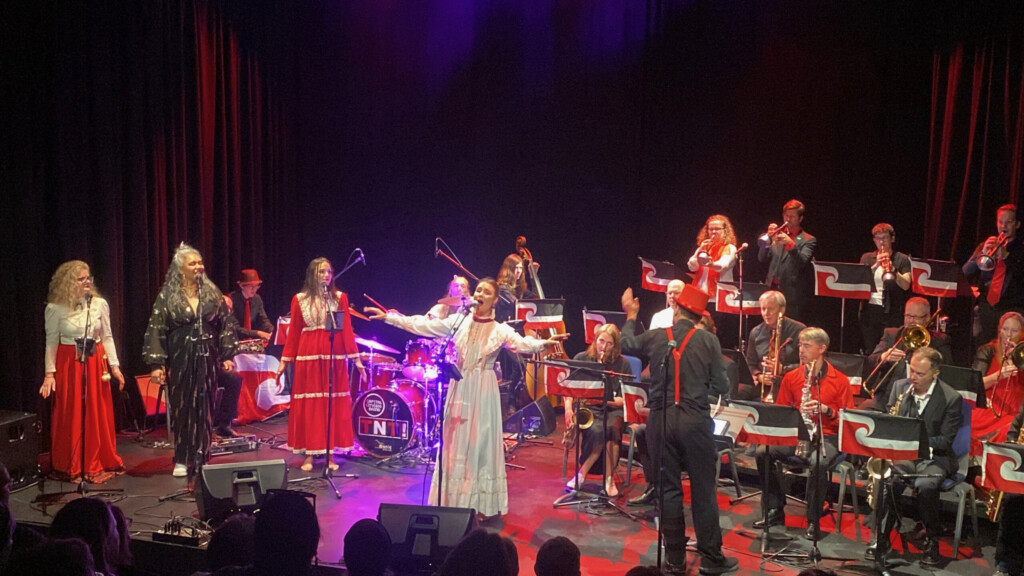
Also in the vocal team is one of Crayford’s three daughters, GiGi Crayford, who performs as Hine. Her role closes a particularly intimate circle: she sings an original song her father wrote decades ago, now newly arranged for big band by Roberts, while Crayford plays drums behind her. Born from what he describes as “new and fresh love”, the song has, over time, become something intergenerational. Crayford’s other daughter, Ella Rigby-Crayford, supports the kaupapa through merchandise and audience engagement rather than as a featured vocalist.
Crayford’s partner, Fran Rigby (Kāi Tahu), also became part of the singing circle that helped the repertoire take root. Their informal preparation followed a simple pattern: gather, share kai and sing the waiata until the material lived comfortably among them.
The wider vocal whānau includes CCBB house singer Stephanie Bishop, whose commitment to te ao Māori and learning te reo led her to ask to join; Crayford says TNT! is “so much better” for her presence. Educator, musician and Harmonic Resonators member Jeremy Hantler (Kāi Tahu, Ngāti Pākehā) brought existing reo Māori translations and strong relationships. When he could not make every performance, young singer JJ Popham (Ngāpuhi, Ngāti Hine) stepped into material prepared for him, adding another generational bridge.
TNT!’s cultural work reaches beyond pronunciation and presentation. The team sought permission from composers, whānau and descendants where required, revisiting songs many New Zealanders learned at primary school – sometimes, Crayford notes, incorrectly. The process demands humility: familiarity is not ownership, and waiata are not anonymous raw material. It also distinguishes TNT! from projects centred on taonga pūoro. Crayford says others have explored that meeting beautifully; this band asks instead what happens when te reo Māori, kaupapa Māori and Māori musical memory confidently inhabit the conventional big-band palette.
The kaupapa has changed the band itself. Its 20-plus instrumentalists and singers began with varied levels of reo: the Crayfords were the fluent speakers he identified; others were studying formally, while some were tentative beginners. TNT! gave everyone a reason to use the language repeatedly, socially and musically. “The purpose of this whole kaupapa is to share far and wide,” Crayford says. Te reo is not a ceremonial layer added on concert night but part of rehearsal-room practice. That normalisation may be TNT!’s quietest, most enduring achievement.
TNT! has grown in public through 2026 performances at the Wellington Fringe Festival at Hannah Playhouse, CubaDupa, Tauranga’s National Jazz Festival, Manawatū’s Big Band Bash, the Upper Hutt Music Festival and the upcoming National Big Band Festival in Ōtautahi. Crayford points to Tauranga as the documented complete project, including Hantler’s contribution and the repertoire’s full sweep. Each outing tested how the arrangements breathe, how the singers sit against 17 or more instrumentalists, and how audiences receive songs recognised from school, radio or jazz history in transformed form.
In September, TNT! played an 80-minute featured set at Wellington’s Opera House for a major Te Wiki o te Reo Māori celebration. “That was really cool to do,” Crayford says. “It’s just such a joy and such a privilege to be asked to do these things.” The next morning brought a free, whānau-friendly Wellington Jazz Festival warm-up at Te Matapihi ki te Ao Nui Central Library: Lisa Tomlins and the rōpū kaiwaiata, showband favourites, translated standards, new arrangements and the close-range impact of a full jazz orchestra. A St Peter’s Church concert on Willis Street will follow on Saturday 10 October, before TNT!’s main Wellington Jazz Festival show at Hannah Playhouse.
Jazz has always grown through encounters: African and European systems colliding under brutal American history, then travelling and becoming local. TNT! does not claim to resolve that history; it asks what responsible localisation sounds like in Aotearoa. The answer is no generic “Māori flavour” over swing charts, but months of whakawhiti, permission-seeking, arranging, pronunciation, shared kai, laughter, uncertainty and return. It is a band learning cultural fluency through use; a standard made newly legible when Matariki replaces an imported metaphor; a familiar waiata revealing fresh angles behind massed saxophones, trombones and trumpets.
TNT! feels like Crayford’s four-times rule writ large: stay with the unfamiliar until discomfort becomes understanding, and understanding becomes joy. The band he first met in Tawa has changed its name, membership and ambition, but remains communal – professionals, community musicians and emerging players building what none could make alone. Te Tira Nui Tautito extends that principle into language and whakapapa. At Hannah Playhouse, brass, rhythm and voices will fly, carrying the sound of an ensemble discovering that jazz in Aotearoa can speak more than one language – and mean more because it does.
Capital City Big Band’s TNT! (Tira Nui Tautito) performs at Hannah Playhouse, Pōneke, as part of the 2026 Wellington Jazz Festival.
Also look out for another performance on Saturday 10 October 2026 at St Peter’s Church on Willis Street, Pōneke.

Related Acts:
About the interviewer Tim Gruar

Tim Gruar – writer, music journalist and photographer Champion of music Aotearoa! New bands, great bands, everyone of them! I write, review and interview and love meeting new musicians and re-uniting with older friends. I’ve been at this for over 30 years. So, hopefully I’ve picked up a thing or two along the way. Worked with www.ambientlight.com, 13th Floor.co.nz, NZ Musician, Rip It Up, Groove Guide, Salient, Access Radio, Radio Active, groovefm.co.nz, groovebookreport.blogspot.com, audioculture.co.nz Website: www.freshthinking.net.nz / Insta @CoffeeBar_Kid / Email [email protected]
More by Tim Gruar
MNZ Interview: Louis TM
MNZ Interview: Tourist
Album Review: Te Ngahere
EP Review: Welcome To The Dance Bunker
MNZ Interview: Ones To Watch: Fables
MNZ Interview: Ones To Watch: Heidi Simpson

MNZ Interview: Ones To Watch: Dawson
Muzic.NZ Interview: Hina
Album Review: Leap!