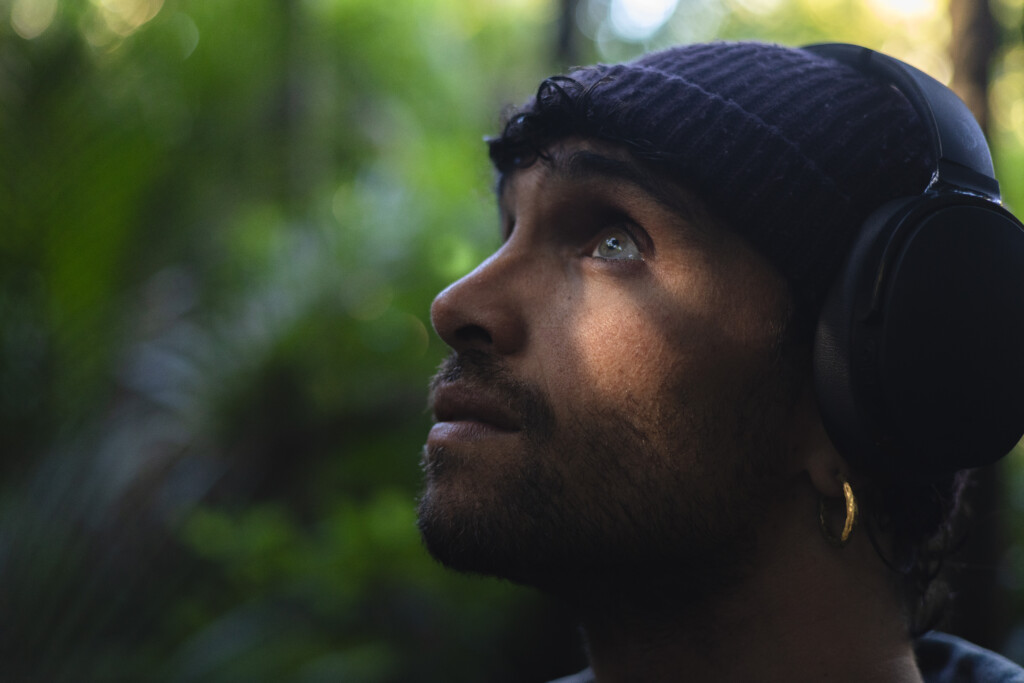
Devin Abrams is best known as a founding member of Shapeshifter, the artist behind Pacific Heights and the producer of Drax Project’s Woke Up Late. Having contributed music to He Kōrihi, he catches up with Muzic.NZ’s Tim Gruar, a day before jumping on a plane to Japan, for a bit of a kōrero about making music, film scores and finally putting Pacific Heights to bed.
Day One Hāpai te Haeata gives emerging filmmakers something more useful than encouragement: funding, guidance and a route to an audience. Its eight-film 2026 Shorts collection premiered through Show Me Shorts at Auckland’s Academy Cinemas on 10 October and Wellington’s Light House Cuba the next day, before reaching http://www.dofilm.co.nz, MĀORI+, RNZ and now on YouTube.
In Jordi Webber’s He Kōrihi – Birdsong, produced by Briar Rose and Rob Kipa-Williams, that voice belongs partly to the birds. A music producer returns to Kāpiti Island after his father’s sudden death, reconnecting with home and whakapapa through listening. Devin Abrams’ score threads original composition through the island’s natural soundscape. For the Pacific Heights musician, this new chapter began not with a script, but a friendship.
Webber first asked him to produce “a couple of songs”, he tells me. Sessions became conversations about recording manu (birds) on Kāpiti, where Webber has iwi and whānau connections. “The actual idea for the film came from us talking about recording The Birds,” Abrams recalls. “I got to be part of the conception of it.” Sound helped generate the story.
Filming on Kāpiti gives that relationship a physical anchor. The island is both setting and sonic presence, its bird recordings woven into the composition rather than borrowed as anonymous bush ambience. Visiting the island bird sanctuary is definitely on my bucket list. “Oh, man. You definitely have to go”. He recommends staying overnight, seeing kiwi and waking with takahē roaming nearby. “Special place,” he says. Sometimes two words do the job.
Webber also musically supervised, sharing references and refining the score over Zoom. “It was a little bit of searching to find exactly what was in his head,” Abrams says. Taonga pūoro recordings, made through Webber’s connections, entered alongside the electronics. “I’m really happy that we got it recorded for it specifically.” Bespoke sound, not a decorative shorthand for place.
I ask about the process. “I tried to do as much of it as I could really myself,” he says of the restricted budget. His studio supplies piano, guitars, Rhodes, synthesisers, rack gear, MIDI and software, alongside separately recorded singing and guitar. The final scenes prompted him to explore “how I was feeling watching it and create that soundscape for it”.
“It’s my happy place actually,” he says. Although promoted as his original film-scoring debut, He Kōrihi follows commercial and branded-documentary work. Narrative shorts are new territory. “I really want to get more into feature-length stuff and game music and anime,” he says. “I think it’s a beautiful world to create in.”
Abrams keeps several creative plates spinning. When we speak, he is five hours from a flight to Japan: another scored film premieres in Kyoto on 24 October, followed by work on pianist, composer and producer Mark de Clive-Lowe’s new album. His Japan connections stretch back roughly 23 or 24 years, from Shapeshifter tours to pop sessions, directors and a project with his Japan-based friend Nick. “It changes every time.”
He won’t reduce those experiences to one “Japanese sound”. How do collaborators communicate? “Briefs, they’re very good with briefs.” Requests range from jazz to contemporary R&B. But mention the late-1970’s and 1980’s electronic landscape and we shift gears. Haruomi Hosono and Casiopea are touchstones; Ryuichi Sakamoto and Yellow Magic Orchestra (YMO) open the wider discussion.
“Hugely inspirational to me as an artist and a creator,” he says of that era. “Some of the most incredibly future looking music, future sounding music came out of there.” Technology, community and imagination converged; musicians were making tomorrow’s sounds with instruments still revealing their possibilities.
Formed in 1978 by Hosono, Sakamoto and Yukihiro Takahashi, YMO helped turn synthesisers, sequencers and computer-assisted production into a new pop language, influencing synth-pop, electro and dance music. Programmer Hideki Matsutake contributed to that technical world. Casiopea approached the period from jazz fusion; Hajime Tachibana’s H offers another connection, featuring all three YMO members.
Sakamoto’s passage from Thousand Knives and B-2 Unit to cinema makes an illuminating parallel – not an equivalence. Abrams points to his later piano-and-electronics work with Alva Noto: “That was very futuristic still.” Looking back needn’t mean retreating. With Nick, he’s collaborating with three heroes from that earlier Japanese era. “When I get to announce that, it’ll be pretty exciting.” For now, names remain unannounced. We sit and wait.
Abrams’ own foundation was Shapeshifter, formed with Christchurch Jazz School friends in 1999. More than 15 years of songwriting, production and performance taught him how live musicianship could inhabit electronic momentum. Pacific Heights gave him another room: atmosphere, instrumental ideas, a personal conceptual world.
Leaving Shapeshifter in 2015 widened the possibilities. He produced and co-wrote Drax Project’s Woke Up Late, released in 2017 and reworked with Hailee Steinfeld in 2019, followed by Catching Feelings with Six60 and work on Drax Project’s debut album. “Everything’s been pretty organic,” he says. “I just had such a curiosity for it all.” Less blueprint than appetite.
That appetite reaches through Dallas Tamaira’s Levels EP – Joe Dukie of Fat Freddy’s Drop, with bandmate Mu engineering – and Louis Baker’s Love Levitates EP. Baker also appeared on Pacific Heights’ Buried by the Burden; Motte featured on A Lost Light’s title track. Collaboration changes the music’s possibilities, not just its credits.
Bands, pop songs and films demand different attention; listening connects them. Broader work also means broader income. “Finding more niche things that are built around communities,” he says of sustaining a career in a battered arts economy. Curiosity still has bills to pay.
Pacific Heights, however, is approaching a definite ending. The final album is expected in the first quarter of 2027. “I’m going to bookend it, kind of going back to the roots,” Abrams says: instrumental ambient space and jungle, his original concepts revisited “with a modern lens”.
Since Frozen Fears in 2003, the project has moved through electronics, soul, song and narrative atmosphere. “I feel like Pacific Heights has done everything I could have ever wanted musically and creatively.” Returning to the beginning gives that journey a shape.
For RDU’s 50th birthday in Christchurch, he plans a two-hour farewell set with Tahlia singing, live saxophone and returning DJs from earlier performances. He also mentions an Otago appearance; final arrangements remain unconfirmed. “Sometimes you’ve just got to call an end to something,” he says, rather than leave “an open circle”.
This isn’t retirement dressed as a farewell. “There’s never going to be a shortage of things to do and new spaces to explore.” He prefers beginnings to encores: “The inception stage of projects is just the best.” Finish one thing properly; discover another.
Next comes an album centred on what Abrams describes as lost Māori hymns. “I’m going to be producing and recording that with a choir.” There’s also a Māori dance-music writing camp in Tāmaki Makaurau later in 2026: inherited sounds meeting contemporary production without becoming museum pieces.
“They respect the past, but do something completely new,” he says of the musical ambition that excites him. It connects the Japanese records he loves with his hopes for new work from Aotearoa: not imitation, but discovery.
For now, there’s a plane to catch. Pacific Heights may be closing its circle, but Abrams is still listening outwards. On Kāpiti, a conversation about manu became a film. Somewhere beyond the next studio door, another beginning is waiting.
Related Acts:
About the interviewer Tim Gruar

Tim Gruar – writer, music journalist and photographer Champion of music Aotearoa! New bands, great bands, everyone of them! I write, review and interview and love meeting new musicians and re-uniting with older friends. I’ve been at this for over 30 years. So, hopefully I’ve picked up a thing or two along the way. Worked with www.ambientlight.com, 13th Floor.co.nz, NZ Musician, Rip It Up, Groove Guide, Salient, Access Radio, Radio Active, groovefm.co.nz, groovebookreport.blogspot.com, audioculture.co.nz Website: www.freshthinking.net.nz / Insta @CoffeeBar_Kid / Email [email protected]
More by Tim Gruar
Gig Review: Hikurangi Schaverien-Kaa @ Te Ao Kōhatu Wellington Jazz Festival, Wellington – 18/10/2026
Album Review: Motoring For Beginners
MNZ Interview: Capital City Big Band
MNZ Interview: Louis TM
MNZ Interview: Tourist
Album Review: Te Ngahere
EP Review: Welcome To The Dance Bunker
MNZ Interview: Ones To Watch: Fables
MNZ Interview: Ones To Watch: Heidi Simpson