This is the first in a series of interviews with artists performing next year at WOMAD 2027, Taranaki.
From a quiet kid with a New Kids on the Block routine to the WOMAD stage, Huia Hamon is weaving te reo Māori through drum and bass – and she wants Aotearoa’s music organisations to catch up.
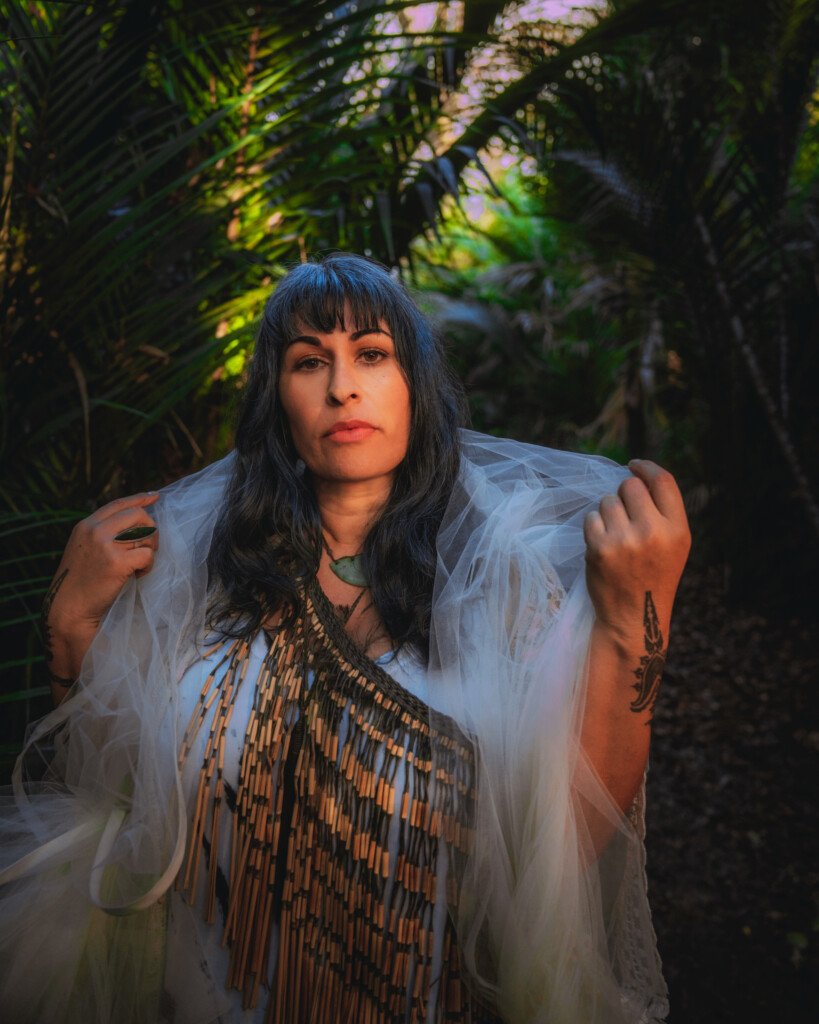
Huia Hamon (Ngāti Porou, Uawa, Te Aitanga-ā-Mahaki), who records simply as Huia, makes bilingual music that moves between ambient, dancehall and drum and bass, always led by te reo Māori. Her debut album Huia’s Waiata was followed by the EP Āta with releases such as Āio, then a bunch of singles before her latest drop Kawakawa. With favourites such as Kākano, Seed the album hit #4 on the Aotearoa charts. A three-time Best Female Artist nominee at the Waiata Māori Music Awards, she has also worked at Kog Studio with Rei, Pieter T, Baitercell, produced for Maisey Rika and many other artists over the years. Ahead of her WOMAD 2027 appearance next year, Tim Gruar talks to her about her career and taking the stage.
Ask Huia Hamon what she does for a living and the answer is bluntly simple: “My day job is my life.” The award-winning singer-songwriter, producer and engineer makes what she calls electro-Māori music: ambient world beats, big drum and bass floor tunes and warm, sensual vocals woven with the language of her tīpuna.
Huia’s first show was a school assembly, she tells me. At around eight years old she decided to round up her friends and stage a fully choreographed New Kids on the Block routine. “I think I approached my teacher and she said, “Sure, it sounds great,” she recalls. Six weeks of rehearsals later, the performance went ahead. “I don’t even know how I was so confident, because I was quite a quiet child, but I just decided that would be a thing, and I did it, and I think I kind of got the bug.”
She grew up in a very creative household, but music was a pastime long before it was a career. “I did it as a hobby, but I didn’t really know it was a job,” she says. There was guitar, singing and busking from the age of eight or nine, and little bands at school. Her childhood soundtrack came from the forest on the Coromandel Peninsula. “I was just listening to the rain at night and making songs,” she says. “My first musical inspiration was just the sounds of the bush, the rhythms of the rain.”
The turning point to electronic music was through the Te Kamakama Music Diploma (Toi Oho Mai Tauranga) in 2002, where she learned to produce, under the kaiako of Liam Ryan (of The Narcs fame). Suddenly a whole band could live inside a computer. “It was really handy to just not have to organise everybody,” she says. “I could write a whole song without having to instruct people and tell them what to do, which feels a lot easier for me.” Even so, she admits she tried to steer away from music for a while. “I ended up coming back to it through a fluke or someone offering me an opportunity, and I’m just like, “Oh look, I’m doing music again.”
The other half of Huia’s story is her partner in music and in life, Chris Chetland, the producer and audio engineer behind Kog Studio, who also releases as Baitercell. Kog’s roots run deep in early Kiwi electronic music: Chris created many underground warehouse parties of the 1990’s/2000’s, and the Kog Transmissions label he co-founded released the compilations of The Gathering, the legendary New Year’s dance festival at Canaan Downs near Takaka. If the name Kog is still niggling the old grey cells, a quick look at their website will jog the memory. The role of artists they work alongside is staggering: Savage, Six60, Te Matatini, LA Women, Benee, CHAII, Aarahdna, Kiki Rockwell, Maisey Rika, Muroki, Sons of Zion, Samoyed, Lovetta, Seth Haapu, Rei, Huia, Jakob, Ricky Paul, The Chills, Troy Kingi, Niko Walters, Prins, Flaxxies, Villainy, Shapeshifter, Tomorrow People, SWIDT, LAB, Flamingo Pier and, need I say it, many, many, many more!
Huia and Chris met in 2005, I’m told at a Shapeshifter gig at ‘The Hilly’ in Hamilton. “It was hardly a grand entrance, though. It was a party my friends were going to, and I just rocked up because it was free,” Huia says. At the time Chris was already deep in electronic music and performing at the Big Day Out, while Huia had little idea how the music industry worked. “I was just like, “What is this?”
Friendship came first. “We were just friends for ages, and then I think we realised we liked each other after a few months,” she says. Before long she started to help at the studio. “I started at Kog Studio to help out Chris, and I’ve been here ever since.” With a diploma in music and production and a marketing communications degree, she found she already had the skills the studio needed, and today she runs the business alongside her own engineering and production work. “21 years later, still here, and we’re still together!”
Huia is quick to resist any talk of destiny. “It seems like it’s fated, but I don’t believe in that stuff. I just think it’s a happy circumstance.” The two are in the middle of writing a new dance te reo Māori music project together and she says the secret to working with others is letting each other be truly themselves. “I think a good collaboration is to not try and control the other people you work with,” she says. “I want you to smash out and say whatever you want to say on this track. Otherwise, I should just do it by myself, which is no fun.”
Her résumé now includes some of the biggest stages in the country, among them the Big Day Out, Splore (mainstage) and Rhythm and Vines. Last year she travelled to Scotland, Wales and The UK for a creative residency supported by Matariki Cultural Foundation, the British Council, Trac Wales and Creative Scotland, collaborating with Gaelic singers from Scotland and artists from Cymru (Wales) before performing at Knockengorroch Festival. “I’m very grateful,” she says simply. For about five years she has also been travelling to global music conferences in Europe, Japan, UK and Australia as a speaker and artist, picking up first-hand knowledge about how other countries experience language, culture and music futurisms and what she calls “future sound.” Her kaupapa has been to look for ways to promote indigenous music into the world, especially Māori language artists and created the HuHā Music platform and network.
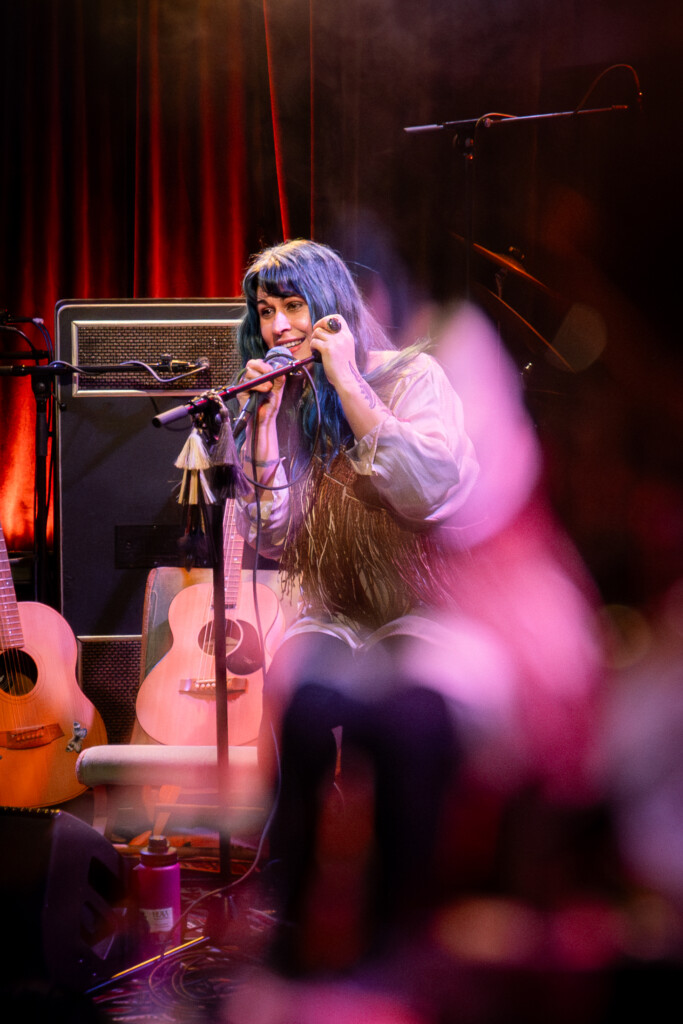
Photo Credit: Afrina Razi
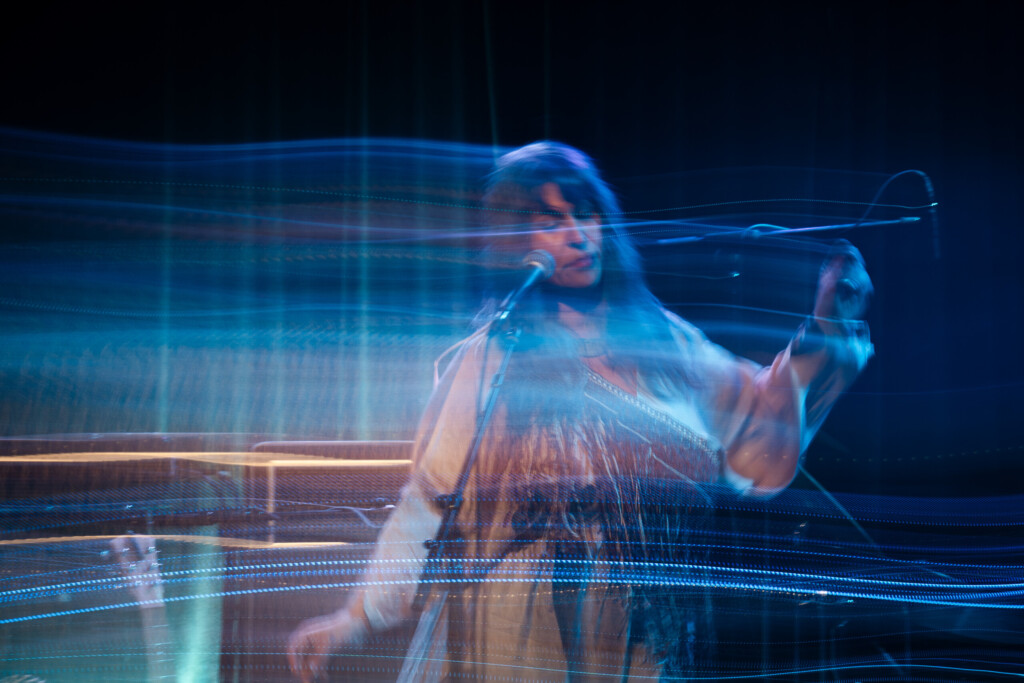
Huia’s signature move is setting te reo Māori over electronic music. Together with Chris she co-created Pakōpakō, a collective that blends drum and bass, dancehall and house with haka chants, te reo lyrics and live kuki log drums – a sound they call “hiko”, meaning “electrify”. “It’s a Māori language and culture dance music show,” she says. “We’ve got up to six vocalists, and we do live Kuki Islands drums, full electronic production and taonga puoro.” The set also features releases they did from two decades ago. “We’re like to reflect back to 20 years ago, when breaks and drum and bass were really kicking through and fresh in Aotearoa.”
For Huia, the pairing is more than a style choice. When it was suggested that te reo sits naturally alongside drum and bass, because both rely on rhythm and repetition, she agreed immediately. “Repetition of a melody to retain language,” she says. “Music is such a good way to retain language. I always encourage everyone to integrate all those stories and mythologies into songs. It’s such a good way to keep it.” Electronica, she adds, “seems to be a really good way to push forward culture.”
Not everyone in the Aotearoa music scene embraces the direction. “We are coming up against a lot of criticism as we want to change the narrative of what te reo Māori music is,” she says. “They can keep releasing more old-school sounds, that’s fine, but we want to take on the new sounds and depth in new areas and different ways. So yeah, being on the cutting edge, it’s a strange place to be.”
Much of what Huia writes about comes directly from her whānau. Her Kuia (grandmother) shared stories of growing up in an isolated coastal Māori Te Tairāwhiti (East Coast) community during a pivotal period of change, though she was hesitant to teach te reo Māori to her own children which was normal for the time. “I’m really lucky to have had her feel safe enough to share her stories with me, because she didn’t share it te reo Māori with her children because of that time of being, abused really, for speaking the language at school.” Huia was in her late teens before her Kuia realised she could speak enough te reo to share those memories with her. “My stories come a lot from my tīpuna, and I’m lucky enough that they preserved a lot of their stories and writing, and songs and books and artwork.”
Those stories shaped her album Kawakawa, which took about two years to finish. Some songs date back to her teens. “There are some songs that are really old in there, ones that I wrote when I was 17 years old, and I just needed to make it more relevant for myself,” she says. The result is a record of affirmations. “Every song carries a message, whether it’s about seeking joy from nature and using your natural environment to pick up your energy, or challenging the status quo. The intent is that each of the songs sets a certain kind of vibe to empower people.”
Huia is also a keeper of other people’s stories. “I’m very, very grateful because people give me their secrets,” she says, particularly within the music industry, where some things cannot be made public. “They’re like, “I don’t think I should put it out anywhere, but I need to tell someone,” and I’m like, “Yeah, you can tell me.” That trust inspired a song called Tuhi which is about keeping secrets and being “a temple without a key”. Written long ago in English and later translated into te reo, it carries a simple promise: “I could write a book, but I will never write it.”
Collaboration has shaped the record too. For one track Wairangi, The Waters, Devin Abrams aka Pacific Heights sent her a handful of one-minute beat ideas. She chopped her favourites into sequences, wrote the vocals and sent it back. “The idea is that the song is like a wave,” she says. “It rolls in really calmly, and then it drops.” He then wrote the music around what she had done and this is the same creative process for long time collaborators Rei, Sean Richards and Baitercell
The more Huia talks about her own career, the more she returns to the artists who are missing from the bigger picture. After years at international music conferences she is frustrated that Māori musicians so rarely feature where they should on a global scale. She describes a recent showcase festival The Great Escape in the UK, where New Zealand funded ten bands to attend to represent Aotearoa. “Guess how many were Māori?” she asks. The answer – none! “Because they don’t care, and that is the truth.”
Recently, at another world music conference called WOMEX in Spain, she says, her team attended as Māori. “We weren’t there as ‘New Zealand’, because ‘New Zealand’ decided it’s not important to go this year,” she says. “Our trade sector doesn’t value Māori music export. They only value English music export, and it’s boring.” Without a proper export office or investment, she says, Māori artists are forced to begin again every time. “Internationally promoting as a Māori world music artist, it feels like I’m starting from scratch. And that’s probably the biggest issue with our lack of trade path support.”
She points to research by Trade New Zealand which found that the number one identifier for Aotearoa overseas is Māori culture. “They are happy to point that out. How are they supporting the people that you’re taking from? Because that’s what they’re doing in many trade meetings and they often leave creative digital assets out of this discussion.” Her message to artists is to “stand up, rather than blend in”. She is equally direct about what gets sent abroad. When Aotearoa acts to present English-language songs to international audiences, she says, “that’s not what our world music is about. It’s about culture, language and fusion. ‘Where are the Māori’ is the main question I get asked!’
She sees a way forward in artists building their own pathways, and in established names handing the platform on. “You need to use your platform to bring the next ones through,” she says. “They feel like they have no place at the moment.” The 2027 WOMAD Aotearoa lineup, with more Māori artists on the bill, gives her hope. “It’s great, because it’s how it should have been.”
Huia is treating her WOMAD solo set as a step up. “Usually, I’m getting up and I’m singing my songs and I’m jumping around and being stupid and cracking jokes, because I get nervous,” she says. This time she wants a fuller production, more vocalists and live elements. “I want to be more conscious with this as a full show, as a diverse and interesting performance I can tour with.”
For a performer who has already ticked off Splore and international performances, WOMAD is a long-held ambition. “It’s a life goal,” she says. “This is another big bucket list item I’m going to check off.” Before then, Pakōpakō (also performing at WOMAD) will play the Festival of Lights in Taranaki over New Year, followed by a summer of writing with Chris, road trips and well-earned beach time with the whānau.
What drives her is the conviction that comes from being in the room. Of her time at conferences, she says: “This is actual first-hand information. I’m not getting it through the internet or through articles. It’s from people’s mouths.” Now she is bringing it home, with te reo, bass and kuki drums.
Huia isn’t waiting for the industry to find her a spot on the map; she’s busy drawing a bigger one, with a dance floor in the middle. At WOMAD, the only real question will be whether you can stand still. Consider this your fair warning: wear your best blinged up trainers, because the future sounds suspiciously like a very good time.
WOMAD Aotearoa 2027: Friday 12 to Sunday 14 March 2027 at the Bowl of Brooklands, Brooklands Park, New Plymouth, Taranaki. Huia performs twice: a solo set and a second show with Pakōpakō.
Related Acts:
About the interviewer Tim Gruar

Tim Gruar – writer, music journalist and photographer Champion of music Aotearoa! New bands, great bands, everyone of them! I write, review and interview and love meeting new musicians and re-uniting with older friends. I’ve been at this for over 30 years. So, hopefully I’ve picked up a thing or two along the way. Worked with www.ambientlight.com, 13th Floor.co.nz, NZ Musician, Rip It Up, Groove Guide, Salient, Access Radio, Radio Active, groovefm.co.nz, groovebookreport.blogspot.com, audioculture.co.nz Website: www.freshthinking.net.nz / Insta @CoffeeBar_Kid / Email [email protected]
More by Tim Gruar
MNZ Interview: Jean Thoral
Album Review: Sangria
EP Review: Destined for Loneliness
Album Review: Bits

Gig Review: So So Modern @ Newtown Community Centre, Wellington – 7/11/2026
Gig Review: Anthonie Tonnon @ Hannah Playhouse, Wellington – 31/10/2026
Album Review: ¡Blaze!

MNZ Interview: Devin Abrams
Gig Review: Hikurangi Schaverien-Kaa @ Te Ao Kōhatu Wellington Jazz Festival, Wellington – 18/10/2026