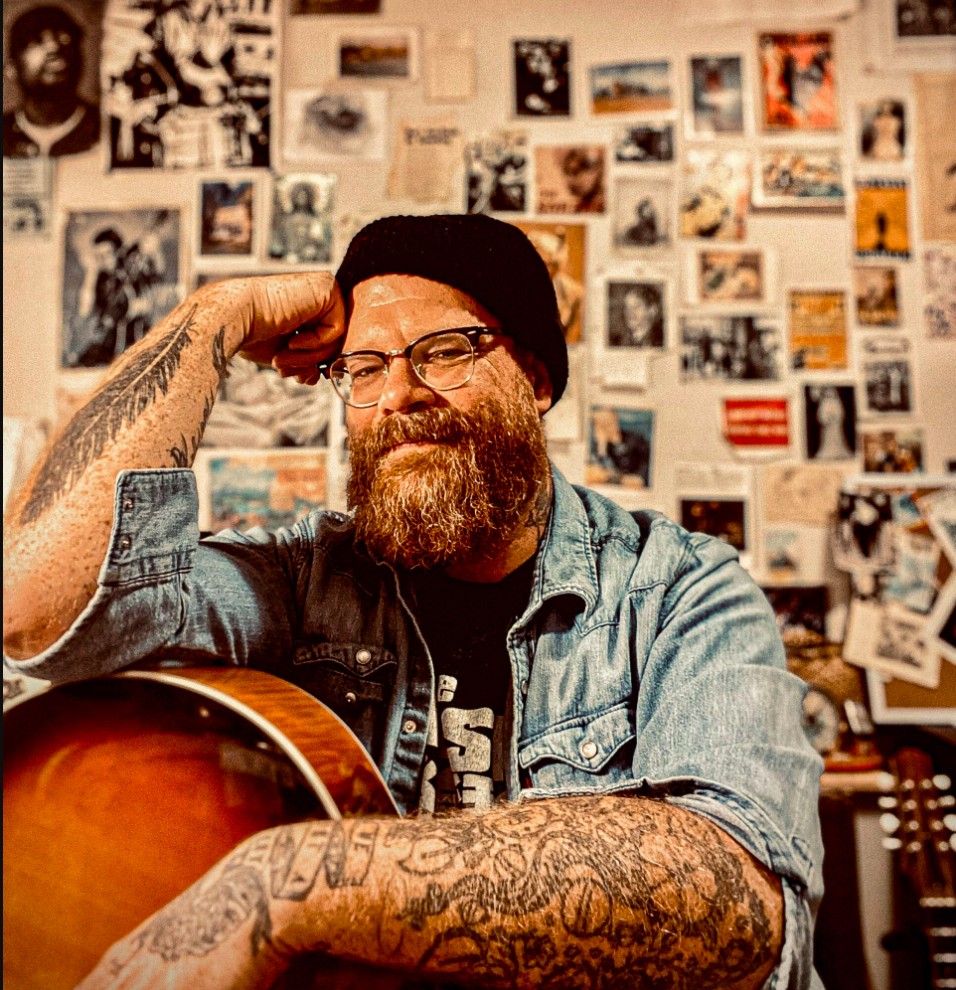
In March 2026, Adam McGrath will join the Feel the Fear panel at Aspiring Conversations in Wanaka, exploring how fear shapes creativity, choices, and courage. It’s a fitting platform for someone who calls himself “a totally fearful, panicked individual” – yet keeps stepping forward with purpose. Muzic.NZ’s Tim Gruar reconnected with McGrath for a bit of a kōrero about ‘Fear’ and everything and anything else that really matters.
Very few artists in Aotearoa carry the same blend of grit, heart, and unwavering dedication to their communities as Adam McGrath. He founded the Eastern with Jess Shanks in 2006, and since then the hard‑working folk‑country collective of musicians from Lyttelton and Ōtautahi have built a loyal following through relentless touring and a deep community ethos. Their albums include The Eastern (2009), Arrows (2010), The Harbour Union (2011, collaborative), Hope and Wire (2012), and The Territory (2014). Over the years, they’ve supported major international acts, opening for Fleetwood Mac and Jimmy Barnes, and touring alongside Old Crow Medicine Show and Steve Earle, further cementing their reputation as one of Aotearoa’s most respected live bands.
For close to twenty years, McGrath has built a reputation as one of the nation’s most arresting live storytellers. I talked to him early in his career about his past and how that’s shaped his songwriting, how he was on a ‘bad path’, as he calls it, to a nefarious life of crime and destruction. Growing up in Bishopdale with limited opportunities and carrying the weight of early trauma, Adam McGrath told me back then that as a young man his likely options were to “join the army, play league, or go to jail.”
As I remind him of those early conversations, he’s still aware that he carries that past with him. He says that the experience of growing up amidst constant upheaval and “interesting characters” and being shaped by trauma never really goes away. He now speaks about it plainly: “Those things sit in you.” But, he’s defiant in the face of it. Rather than letting that history define him, McGrath turned it into “drive – fuel for songs, activism, and community work.”
And there are many examples of that. His career has always centred on people. I know. I witnessed it firsthand. After the Canterbury earthquakes, he and The Eastern played backyard shows through damaged neighbourhoods, helping restore confidence and connection. I attended some of those fundraisers with impacted friends. Getting away from their problems and damaged houses for a night was also soothing.
During Covid, the band raised funds for struggling venues in New Zealand and abroad. Stuck at home, I attended online sessions and that, in its own way brought joy. I can only imagine the wider impact for everyone who was isolated at that time.
A constant advocate, speaker and performer, McGrath has been everywhere. He’s played shows in prisons and youth units, rural pubs, festivals, community halls, and of course those endless fundraisers – showing up whenever music or solidarity is needed.
His resilience was tested again in 2025 when he suffered a stroke, followed by further alarming health scares, including temporarily losing vision in one eye. True to form, he met it with humour and determination: “There’s no killing what can’t be killed. There’s no stopping what can’t be stopped.” Even in hospital, he was promising free future shows to thank supporters.
As McGrath’s face beams on to the screen, we do that wee game, trying to remember the last time we’d met. It was the Auckland Folk Festival, two years before Covid, I think. And as we get started, I have to ask, about his self-described “wonky year” – between the stroke and the eyesight issues, how he is now. “I’m good”, he smiles “I had myself worried a little bit. I had a bit of a wonky year… I lost some eyesight in one of my eyes. But I’m OK, man. I’m like The Predator”, he laughs, referring to the long‑running Predator franchise, first released in 1987, “There’s no killing what can’t be killed. There’s no stopping what can’t be stopped.” He recalls how the situation snowballed publicly. “I did a little post about it because I had to cancel some shows, and it took off a bit like Ferris Bueller’s Day Off. He starts off with the (fake) flu, and by the end he’s ‘dead’ (metaphorically).”
McGrath jokes about his size and lifestyle, but the truth behind the humour is sobering: “I’ve lived pretty hard. I don’t really understand rest. I’m like a big Great Dane – you don’t see too many giant old people around. That worries me.”
His career has blended punk ethos, folk storytelling, and relentless touring. So I ask where his creative direction heading now? “Nothing’s changed, man. That’s it. I’ve always written the songs and then taken them out into the world. Getting older and just needing to catch my breath a little bit, I’ve got to let the songs do some of their work on their own and find different ways for them to get out into the world.”
He is also expanding creatively. “I’m trying to write something at the moment – like a book – and I’m working on that.”
He describes this new phase “not as slowing down” but as moving differently. “I’ll never stop moving. I just have to do it in a more considered way.”
15th February marked the 75th anniversary of the 1951 Waterfront Dispute, New Zealand’s largest industrial confrontation. To mark the date, McGrath released the first single, Which Side Are You On?, from his forthcoming album Wrecker Songs featuring new verses about 1951 and Sid Holland, plus samples of Jock Barnes.
McGrath elaborates. “I’ve been working on this album based on songs and stories and histories of the Maritime Union of New Zealand… It goes back to the Watersiders’ Union and the Seafarers’ Union.” His father’s life gives the project personal weight: “My dad was a seaman, so there’s that connection. And we’ve always been connected with unions. We’ve played at heaps of strikes.”
The work became a tribute to solidarity, he tells me. “It’s about family and community and struggle… those ideas are needed just as much now as ever.” Even though it’s a “solo” record, it remains a collective effort: “Members of The Eastern are on it in various guises. We’re all a little community – whether it comes out under my name or The Eastern, it’s all kind of the same thing.”
Our maritime labour history is grounded in decades of industrial struggle by Watersiders and seafarers, culminating in the 151‑day, 22,000‑worker 1951 Waterfront Dispute – the country’s largest and most divisive industrial confrontation. The dispute, born of long‑standing tensions over extreme hours, unsafe conditions, and demands for a guaranteed 40‑hour week, triggered a government state of emergency with military deployment, censorship, and bans on supporting strikers, leaving lasting scars on port communities like Wellington and Lyttelton and shaping the identity of today’s Maritime Union, which traces its lineage to the old Waterside Workers’ Union.
He’s quick to note that this wasn’t a commissioned project, or applied for through the usual arts’ channels. “I don’t apply for any kind of funding – no Creative New Zealand, none of that. A lot of the money comes from pokie machines, and my mum had a problem with pokie machines. It’s not good money, so I leave that alone.” Everything he’s built has come from human connection. “Everything we’ve ever done has been done with help from outside people and goodwill and work.” This approach also shaped how the Maritime Union album came into being, he says. “I don’t want workers paying for me to sing songs about my feelings… so I thought maybe I can do something for you guys instead.”
We turn our attention to lost friends. Paul Huggins was a widely respected pillar of the Pōneke and Ōtautahi music scenes, shaping countless careers through his work at Real Groovy and later through Rough Peel Music (his shop and business in Cuba St.) and the Rough Peel Records label, where he supported artists including Graeme Jefferies and Adam McGrath. Even as he faced a brain tumour, his influence remained profound: McGrath rushed to finish his 2023 solo project Dear Companions so Huggins could hear it, and although Paul passed shortly after its release, the album stands as both tribute and testament to his quiet dedication, mentorship, and cultural impact.
Reflecting on making the record, McGrath admits recording never appealed to him. “Recording is not something I’ve ever been drawn to…I prefer working live…I like playing for people” – but Paul changed that. “Paul … he was such a special man. He got sick and I thought, I better get this album out for him just so he could hear it. He’d been such a big supporter of mine.” He was a quiet, steady presence behind the scenes. He had owned his little record label, shaping the musical lives of many in Lyttelton, Christchurch, and Wellington over decades.”
It was that nurturing of musicians that changed McGrath’s mind about recording. So, when Huggins became sick, McGrath felt compelled to act, making music to raise money for his medication, to help in any way he could. “He was such a special man… I thought I better get this album out for him just so he could hear it.”
Though Huggins passed soon after the release, the loss remains deeply felt, and the urgency that shaped the project has given rise to one of McGrath’s most meaningful works: “People have been really kind about it, and I feel in a way it might be my best record.” Dear Companions is, he says, in every sense, both an elegy and a thank you.
The upcoming The Feel the Fear panel at Aspiring Conversations festival in Wanaka will feature a session with McGrath, Emma Gilmour, a pioneering rally driver who became McLaren Racing’s first‑ever woman driver, and Lisette Reymer, the award‑winning journalist and former Newshub Europe Correspondent. Together the speakers will explore how fear shapes courage, creativity, and decision‑making. I ask him about ‘Fear’ and what he’s bringing to the panel discussion on that topic.
Acknowledging the talent on the panel, McGrath says he’s always worked with the situation at hand, adapted to it as best he can. His ‘survival’ is about that. “I never play a show with a set list… I try to be in the moment.” He expects the panel will be raw, honest, and improvisational. “I’ll talk about being a totally fearful, panicked individual full of anxiety and despair and worry – which is true – but somehow moving beyond that and getting stuff done.”
I probe deep. How has his difficult childhood shaped his relationship with fear? “Growing up was dynamic to say the least. I went through a number of pretty traumatic events when I was really young, and those things sit in you.” Those experiences shaped his defiance. “I’ve always just tried to beat them back, fight them down, spite them.” But he also acknowledges, it also shaped his worldview. “I don’t want to be kept in the victim box… As a kid you can’t fight much, but as an adult I’m empowered.”
McGrath has spoken widely about his life and experiences including to groups of young people. Some have said that his talks changed their lives. “I feel lucky that that has happened a few times.” One particular conversation stands out. “A young woman told me she was the first in her family to go to university, and my story gave her a bit of solidarity. That was really special”. He treats moments like this with caution and care. “I don’t take that responsibility lightly. That’s why I’ve got to keep doing this stuff.”
He’s played everywhere. Some of the most challenging situations have been in Prisons. What did those experiences teach him about hope? “I’ve played at the prison here in Christchurch and Rolleston and for the youth unit. I got nice letters from some of the guys… a couple of them we carried on an exchange.” He says that he full well knows how close he came to that same path. “Every single one of the friends I grew up with, almost without fail, have been in prison.”
His critique of the prison system is clear and compassionate. “Prisons are getting harder and darker. You’re deprived of hope. And that doesn’t serve the prisoner or the community when they get out.”
Hope is a big theme in McGrath’s work. Hope is central to who he is, he reminds me. “Hope is real.” He learned this during the Canterbury earthquakes, he says. “Resilience came from the bottom up. It didn’t come from the government… It came from people doing things together in solidarity.” He believes hope is a practical force, not a sentimental one. “Community, solidarity, connection – that’s what works. When the shit hits the fan, that’s what works.” Hope, for him, is lived experience, not an abstract ideal.
Finally, after everything – the hardships, the health scares, the decades on the road – what keeps you going, Adam McGrath? He smiles and sits forward. “I’m a people’s player. Each show, large or small, is equally meaningful. Whether it’s five people somewhere in the middle of nowhere or opening for Fleetwood Mac – it’s always the same. It’s always a privilege. I’m always grateful.” And he still sees his work as a form of service. “I’m always trying to get the message out. Whether that message is just, like, ’let’s have a beer and a good time’… or it’s something about supporting solo mums, mental health of victims, workers’ rights, libraries, or whatever – everything’s the same. It’s all about hope for the people.”
The Feel the Fear session takes place on Sunday, 29 March 2026, during the festival weekend of 27–29 March 2026 at the Lake Wanaka Centre. The panel brings together musician Adam McGrath, rally driver Emma Gilmour and Lisette Reymer, former Europe Correspondent.
About the interviewer Tim Gruar

Tim Gruar – writer, music journalist and photographer Champion of music Aotearoa! New bands, great bands, everyone of them! I write, review and interview and love meeting new musicians and re-uniting with older friends. I’ve been at this for over 30 years. So, hopefully I’ve picked up a thing or two along the way. Worked with www.ambientlight.com, 13th Floor.co.nz, NZ Musician, Rip It Up, Groove Guide, Salient, Access Radio, Radio Active, groovefm.co.nz, groovebookreport.blogspot.com, audioculture.co.nz Website: www.freshthinking.net.nz / Insta @CoffeeBar_Kid / Email [email protected]
More by Tim Gruar
Album Review: Motoring For Beginners
MNZ Interview: Capital City Big Band
MNZ Interview: Louis TM
MNZ Interview: Tourist
Album Review: Te Ngahere
EP Review: Welcome To The Dance Bunker

MNZ Interview: Ones To Watch: Fables

MNZ Interview: Ones To Watch: Heidi Simpson

MNZ Interview: Ones To Watch: Dawson