MNZ Interview: Hikurangi Schaverien-Kaa (Wellington Jazz Festival)
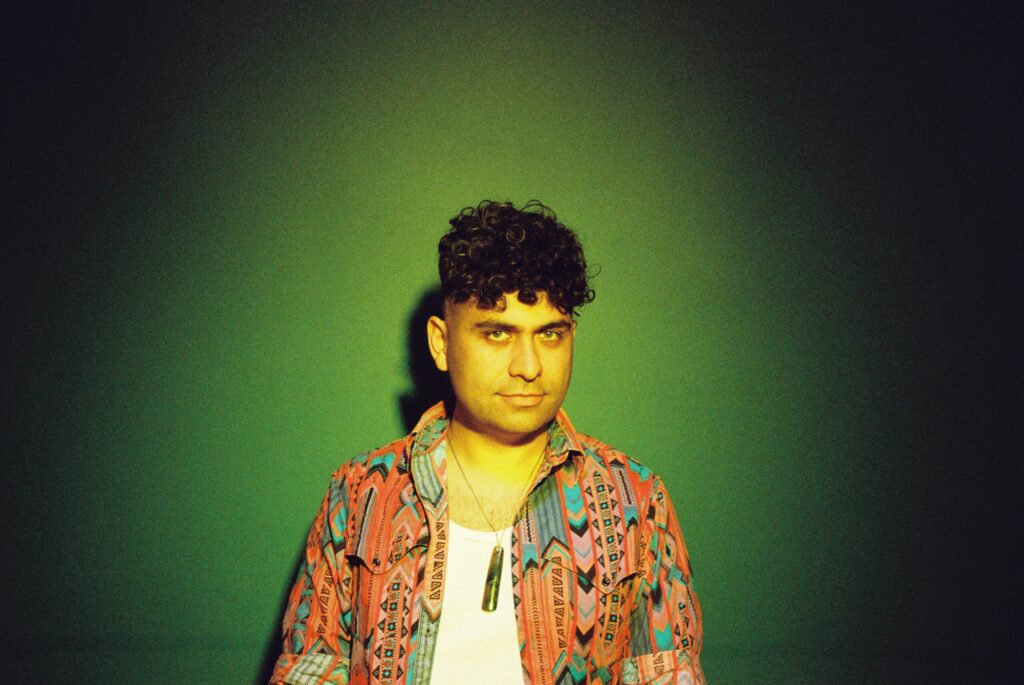
Pōneke’s much-beloved Jazz Festival is back again over the week of 14-18 October 2026. It features a range of international and local acts over multiple venues. One of the headliners is the Capital’s own composer and percussionist extraordinaire, Hikurangi Schaverien-Kaa, whose especially commissioned work Te Ao Kōhatu will be featured at Tāwhiri Warehouse as part of the Festival. Tim Gruar had a bit of an online kōrero with him.
Ruawaipu and Ngāti Porou drummer-composer Hikurangi Schaverien-Kaa has spent two decades as one of Te Whanganui-a-Tara’s most sought-after players, working across modern improvised music and popular song. His credits include Dateline, French for Rabbits, Glass Vaults and Ebony Lamb, while his own projects include jazz quintet The Unknot and experimental taonga pūoro collective Bub (z) and da Ouncle$. When we speak over Zoom, he is in a fourth-floor walk-up in New York, where his partner and friends are based. He is catching up, working, considering postgraduate study and preparing for a UK tour with Dateline, recording sessions back in Aotearoa and the premiere of his 2026 Wellington Jazz Festival commission, Te Ao Kōhatu.
Te Ao Kōhatu centres on the idea that some whakapapa descend from stone itself. What first drew you to that story, and why does it resonate with you personally?
There are a few meanings in the title, but broadly it refers to Māori prehistory – the pre-human times in Aotearoa. I have a vivid memory of the actor Eru Potaka-Dewes talking to my dad and saying that, while people came here on waka, some of us also descended from the stones themselves. It was the first time I had heard that. It seemed like such a wild and interesting idea, and I liked the possibility of a musical investigation of it.
This work sits between Māori and Pākehā constructions of history and knowledge. How do you navigate those different worldviews musically without simplifying either of them?
What interests me is the difference in how knowledge is constructed. Western traditions often build theories that map the universe in terms of verifiable fact, using writing, mathematics and repeatable science. Mātauranga Māori comes from an oral culture, where history, cosmology, medicine, myth and allegory can be woven together so knowledge can travel through generations. I’m not particularly interested in proving whether we literally came from stone; I’m interested in investigating the story and what it reveals about the way each worldview theorises and rebuilds reality.
As a drummer and composer, does rhythm lead the way when you are telling stories about whakapapa, origins and identity?
Surprisingly, all my writing starts with melody. It might become a bass line, remain the melody or break into fragments. Usually it arrives randomly, I sing it into my phone, then take it to the piano and build out from there. Once I have the melody, bass line and chords, the parts begin to expand and layer. I might even start with a title, but melody is normally the doorway.
You’ve assembled The Unknot, Bub (z) and da Ouncle$, and Ruby Hinepunui Solly’s Waitaki lithophone. What do those voices bring to the project?
It is a double ensemble and I’m in both groups – imagine a Venn diagram on stage, with me in the overlap. The Unknot is a modern improvised music ensemble built around drums, double bass, guitar, piano and saxophone. Bub (z) and da Ouncle$ brings taonga pūoro, modular synth, cello, voice and other textural elements. Ruby introduced me to taonga pūoro, and when we were recording the album that led to this commission she made me carry a bag of rocks into the studio. When we opened it, it was a lithophone: stones laid out like a keyboard, roughly around a G-major scale. The work therefore contains kōhatu in two senses – a prehistoric age and the instrument itself.
The festival describes a journey through loss, reflection, catharsis and whirling colour. Is this a single piece or a series of movements?
In earlier work the two ensembles alternated, but in this new piece they play together in an interlocking way. I have not combined them like this before. Some parts begin with conventional melodic material, while others are built from texture and movement. The modular synth, for example, does not necessarily follow a melodic role, and taonga pūoro can have percussive and textural functions. That lets the emotional journey emerge through the changing relationships between the players and sounds.
You’ve been part of Wellington’s music community for more than two decades. What does New York offer that feels different?
I’ve been in and out of New York over the years, often while touring. This visit is mostly about working, catching up with my partner and friends, and preparing for the Jazz Festival, recording sessions and the Dateline tour. The value of being here is that you can hear, almost every night, a standard of playing you might encounter once a year in Wellington. That is incredibly useful. I’m deciding between work and postgraduate study, so I’m working out what is viable, but I’ll definitely be back and forth.
Many people know you primarily as a drummer. What does composing a commissioned work allow you to express that sidemanship does not?
After decades of being behind the kit for other people, this is my work and my chance to bring these two ensembles together on my terms. It also pushes me outside my normal process. For some sections I use visual scores – graphs that place intensity or amplitude on one axis and time on the other – so musicians can see the shape and direction of a passage without every note being fixed on a stave. That has been an interesting challenge and a more intuitive way to write.
Improvisation sits at the heart of jazz. How do you balance it with a kaupapa that carries deep cultural meaning?
The visual score gives written instructions and an indication of intensity or movement, but the artists decide how they arrive there. That gives them a different kind of autonomy. It is closer to a script than live conduction, although there is room for improvisation on the day. If you give a jazz saxophonist a written melody, you do not get only what is on the page; you get their personal imprint. That is why these people are in the ensemble. I want their voices interpreting a broad direction, and I will guide them mostly through the way I play.
For listeners unfamiliar with Māori cosmology or whakapapa traditions, what do you hope they take away from Te Ao Kōhatu?
I hope people can listen generously and allow the story to operate on its own terms. In an oral culture, a compelling story can carry knowledge without needing to separate fact from fiction, myth from allegory or cosmology from history in the same way a written Western tradition might. The lithophone makes that idea tangible: the stones are not perfectly tuned instruments, but each has a voice shaped by its density and size. There is something animate in that.
After audiences leave the venue, what feeling or conversation would you like them to carry home?
I would like them to keep thinking about the story rather than trying to settle it as fact or fiction. The commission is a way of sounding out how different worlds of knowledge meet, and how whakapapa, memory and identity can be held in music. If the stones seem to acquire a voice, and the audience stays curious about what that voice might be saying, that would be a beautiful outcome.
Te Ao Kōhatu: Hikurangi Schaverien-Kaa
Tāwhiri Warehouse, 6pm on Sunday 18 October 2026
Photo Credit: Nicola Sandford
Related Acts:
About the interviewer Tim Gruar

Tim Gruar – writer, music journalist and photographer Champion of music Aotearoa! New bands, great bands, everyone of them! I write, review and interview and love meeting new musicians and re-uniting with older friends. I’ve been at this for over 30 years. So, hopefully I’ve picked up a thing or two along the way. Worked with www.ambientlight.com, 13th Floor.co.nz, NZ Musician, Rip It Up, Groove Guide, Salient, Access Radio, Radio Active, groovefm.co.nz, groovebookreport.blogspot.com, audioculture.co.nz Website: www.freshthinking.net.nz / Insta @CoffeeBar_Kid / Email [email protected]
More by Tim Gruar
Festival Review: Great Sounds Great Part 1 @ Cuba Street Precinct, Wellington – 5/09/2026
Festival Review: Great Sounds Great: The Night Before @ Newtown Village, Wellington – 4/09/2026
Gig Review: Mel Parsons @ Opera House, Wellington – 05/09/2026
MNZ Interview: The Broken Heartbreakers
MNZ Interview: Electric Tapestry
MNZ Interview: Jon Toogood
Album Review: Descending Dreams
EP Review: Extended Paranoia
Album Review: Brain Storm