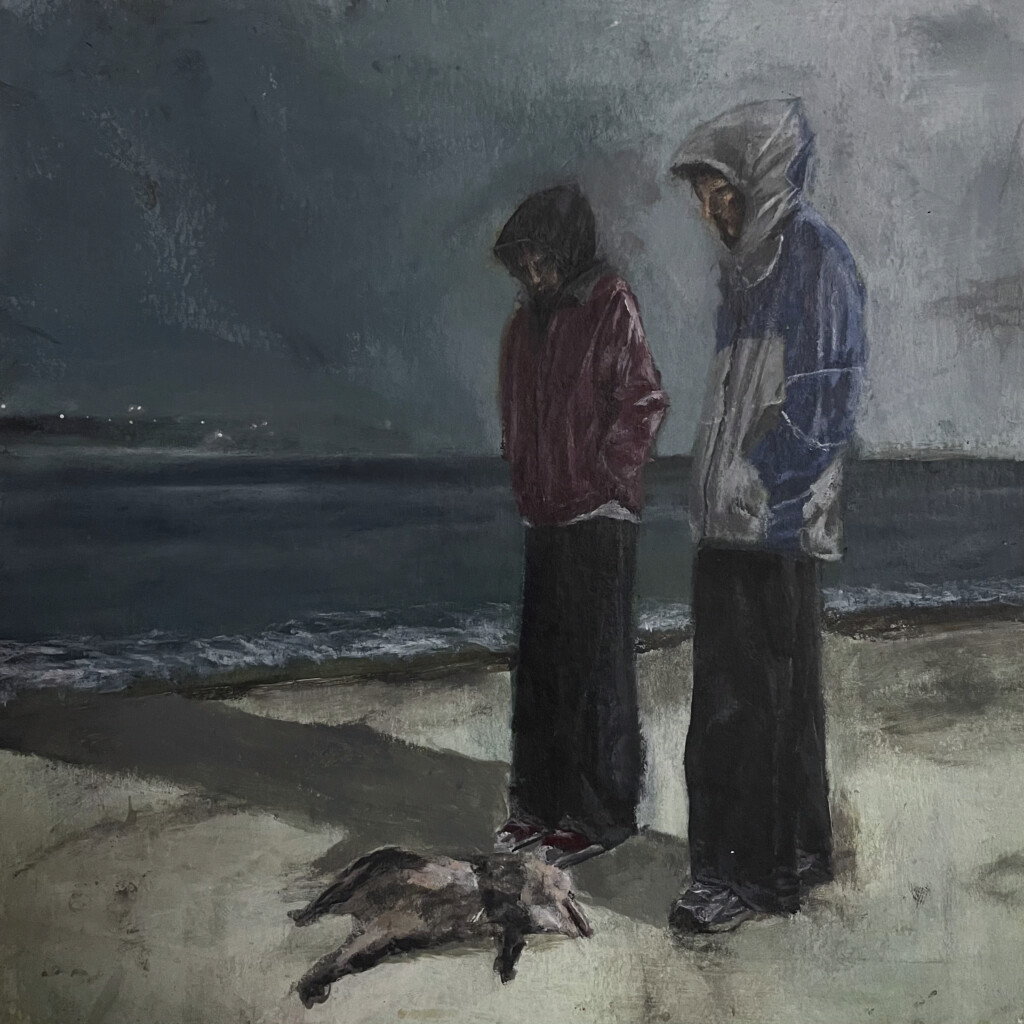
Wellington’s The World Is Against You (or TWIAY as the band is known locally now) began as the solo project of Thomas Waddington before expanding into a five-piece live band. Their music occupies the overlap between shoegaze, drone and post-punk, with Patron Saint representing a deliberate move towards a more experimental and abrasive version of that sound. Released through Glasshead Records on 2nd October 2026, the album follows their 2025 debut single Bleed Your Soul and arrives alongside an Australian tour.
At only 42 seconds, opening track Intro (Patron Saint) functions as a doorway into the album rather than a conventional song. Atmosphere and increasing density establish TWIAY’s sonic world before the piece disappears almost as quickly as it arrived. Second track Star Thrower introduces a steady rhythmic pulse beneath dense, distorted guitars. The shoegaze influence is clear, but TWIAY use distortion as part of the composition rather than decoration. Melody remains present beneath the noise, giving the track both atmosphere and direction. Miracle Cut develops the album’s melodic side. Its guitars operate simultaneously as riffs, harmony and texture, creating a blurred boundary between songwriting and sound design. Dynamics prevent the track from becoming an undifferentiated wall of noise. The longer track Horse gives TWIAY room to explore repetition and gradual development. Its stronger rhythmic drive brings out the post-punk influence, while layers of guitar keep it firmly within the album’s shoegaze/noise territory.
The brief transition of Horse Interlude reinforces the sense that Patron Saint has been sequenced as an album rather than simply assembled from individual tracks. It provides a short reset before the record’s first single.
Skyrim III is arguably the album’s clearest statement of intent and, appropriately, its first single. The title draws directly from The Elder Scrolls V: Skyrim, whose enormous open world can continue generating quests and activities even after the main storyline has been completed. Skyrim itself is the northernmost province of Tamriel, known for its mountainous landscape reaching towards the sky. That idea of an apparently endless world provides an interesting conceptual framework for the song. TWIAY’s music similarly relies on repetition without necessarily feeling static. A musical pattern can recur while the surrounding textures continue changing, giving the impression of movement within a fixed environment. The song’s greater length allows that approach to develop. Melody remains present beneath the distortion, but the noise becomes an active part of the composition rather than something added to make an otherwise conventional rock song sound heavier. There’s something really expansive about Skyrim III, but it isn’t an idyllic expansiveness. The guitars are abrasive and dense, making the track feel like an enormous landscape viewed through distortion. As the album’s first single, it makes sense that TWIAY chose a song that so clearly communicates their progression. Skyrim III retains their melodic instincts while pushing further into noise, experimentation and immersive repetition.
Eye (mould) feels more enclosed than Skyrim III. Its dense guitars create an inward-looking atmosphere, while the title suggests perception and decay. TWIAY show here that tension can come from sustained texture as much as volume. At just over two minutes, Kicking Up is a burst of energy after the density of Eye (mould). Its brevity gives the album useful contrast, preventing the heavily textured production from becoming predictable. 1000mages introduces another fascinating aspect of TWIAY’s aesthetic. The title could be read as “one thousand images” or “one thousand mages”, while its compressed spelling resembles a filename, username or piece of internet shorthand. That digital compression contrasts nicely with the physical heaviness of the music. Positioned near the end of the album, it feels like a brief transmission before the final track. runlikeagirl continues the compressed syntax of 1000mages. “Run like a girl” becomes something resembling a hashtag, username or filename, giving the title a distinctly contemporary quality. Musically, the track closes the album with increased urgency. Rather than ending with a grand resolution, TWIAY finish by moving, providing an energetic release after an album dominated by atmosphere and texture.
Patron Saint is an album about texture, movement and immersion, but its most interesting quality is the way TWIAY refuse to treat shoegaze as a fixed formula. Across ten tracks, the band move between drone, post-punk, alternative rock, noise and shoegaze while maintaining a recognisable sonic identity. The guitars can function as riffs one moment and an almost environmental sound the next. Repetition becomes a way of creating immersion rather than simply repeating a chorus, while distortion is used compositionally rather than merely as an indication of heaviness.
The sequencing is also important. The short Intro (Patron Saint) opens the door; Star Thrower and Miracle Cut establish melody; Horse expands the scale; Horse Interlude creates a transition; Skyrim III becomes the album’s expansive centrepiece; Eye (mould) turns inward; Kicking Up provides a burst of momentum; and the compressed digital language of 1000mages and runlikeagirl brings the record to an energetic close. The titles add another layer. Skyrim III references an enormous virtual world that can continue beyond its main narrative, while 1000mages and runlikeagirl compress language into forms that resemble contemporary digital shorthand. This gives the album a subtle connection between physical noise and digital culture: massive walls of guitar on one side, compressed words and internet syntax on the other.
For a band that originated as Thomas Waddington’s solo project, Patron Saint feels like a substantial statement from TWIAY as a five-piece. It doesn’t simply announce that the band can make shoegaze; it demonstrates that they are interested in what happens when shoegaze is pushed towards noise, drone, post-punk and experimental rock. The result is an album that asks the listener to spend time inside its sounds rather than simply moving from song to song. Its strongest moments come when melody and abrasion coexist; when there is something recognisable underneath the noise, but the noise changes how that something is experienced.
Related Acts:
About the author Nicholas Clark
Aspiring Writer / Musician / Philosopher / Caffeine enthusiast. I like to create, write about and talk about music. Let’s have a coffee sometime and nerd out.
More by Nicholas Clark
Gig Review: Wet Denim @ San Fran, Wellington – 26/09/2026
Album Review: Foothold
Album Review: Plastique
Gig Review: Katelyn Henshall @ Vogelmorn, Wellington – 04/09/2026
Gig Review: Mister Unit @ San Fran, Wellington – 18/08/2026
Book Review: Home Again by Jon Toogood
Album Review: An Olive Tree and a Warm Breeze
Album Review: The Fallen
Album Review: Prime Corner
Album Review: Wanda’s Bicycle
Gig Review: Adult Friends @ Valhalla, Wellington – 19/03/2026
Gig Review: Earth Tongue @ San Fran, Wellington – 21/02/2026