
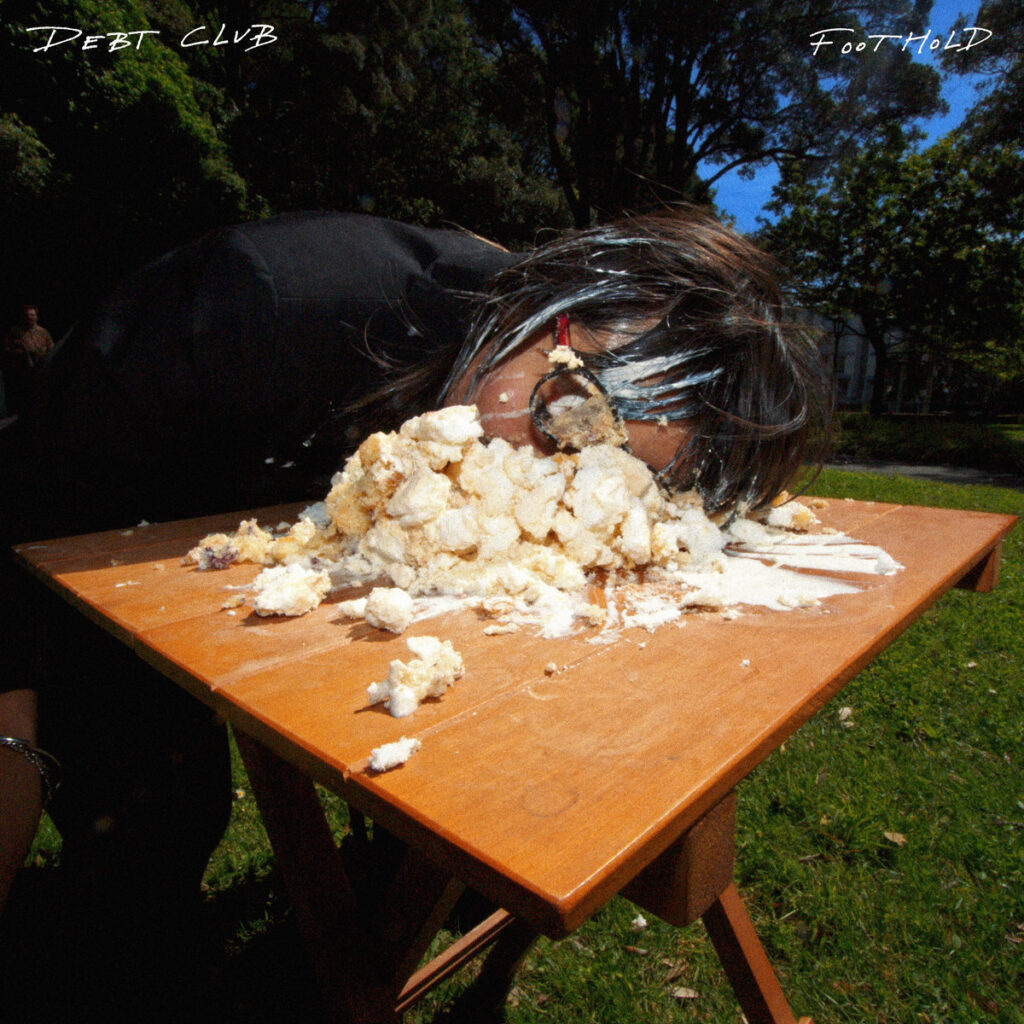
Wellington six-piece Debt Club arrive with their debut full-length Foothold, an album that refuses to sit comfortably inside a single genre. Built around guitars, bass, drums and three-part vocal harmonies, the band expand their palette considerably across nine beautifully catchy tracks, incorporating saxophone, lap steel, banjo, strings, mandolin and an additional horn section along the way. It’s a rich palette. The result is a record that feels distinctly rooted in Aotearoa’s independent music culture while drawing from indie rock, folk, roots, country, alternative rock and more expansive arrangements than previous releases.
There is a strong sense that Foothold is interested in the messy business of being human. Love, regret, grief, nostalgia, frustration and reconciliation recur throughout the album, but Debt Club rarely approach these subjects with excessive melodrama. There’s – how should I refer to it? – irony at play. Along with humour, there is warmth and a certain conversational intimacy running through the songwriting – almost confessional at the album’s most personal moments.
The album opens with I Do Mine, immediately establishing much of what makes Debt Club compelling. Guitars provide the foundation, but the band’s three-part harmonies quickly become one of their most recognisable musical signatures. There is a looseness to the performance that prevents the song from feeling overly constructed, while the expanded instrumentation gives it a rootsy character beneath its indie-rock framework. The lap steel adds another dimension, bringing a slightly wistful quality to the arrangement.
That combination of melancholy and musical warmth continues into How I Can Fix It All. The song demonstrates Debt Club’s willingness to let folk and roots influences sit naturally alongside their rock sensibilities. Banjo and strings broaden the sonic picture, while the vocal harmonies provide an almost communal quality. Rather than simply accompanying the lead vocal, the additional voices make the emotional content feel shared. The title is revealing, too. There is something characteristically human about the idea of believing that a complicated situation might somehow be fixed if only you could work out the right solution. Debt Club’s songwriting repeatedly finds these little contradictions (hope mixed with resignation, affection mixed with frustration) and turns them into something musically engaging.
Texas Headphones shifts the mood again, and this is where Foothold starts to demonstrate just how comfortable Debt Club are with genre hopping. The song has a different rhythmic and textural character from what precedes it, yet it still sounds unmistakably like the same band. The guitars remain an anchor, while the rhythm section gives the song forward motion without overwhelming the more conversational qualities of the songwriting. There is an appealing lack of preciousness throughout. Debt Club are clearly capable musicians, but Foothold never sounds like a record designed to demonstrate technical ability for its own sake. The playing serves the songs. Even when the arrangements become increasingly elaborate, the emotional centre remains the priority.
That becomes particularly evident with Marble Hill, one of the album’s previously released singles. Here, Debt Club demonstrate their ability to turn melancholy into something melodic and inviting. The guitars carry much of the emotional weight, while the vocal harmonies add a sense of intimacy. The song sits comfortably within the album’s broader themes of relationships and emotional uncertainty without becoming interchangeable with the tracks around it. The expanded instrumentation again proves important. Debt Club’s six-piece configuration gives them considerably more possibilities than a conventional guitar-band setup, and Foothold makes good use of that. The lap steel in particular becomes an effective emotional colour rather than a novelty addition.
Orange continues the album’s exploration of texture and atmosphere. By this point, the listener has become accustomed to Debt Club refusing to remain in one musical lane. The song feels like another piece of the larger emotional landscape, with the band balancing melodic accessibility against a slightly rougher, more organic performance style. One of the album’s great strengths is precisely this sense of movement. Foothold doesn’t sound like nine variations on the same arrangement. The instrumentation changes, the rhythmic approaches shift and the balance between rock and folk-derived elements continually evolves. Yet the vocal harmonies and the band’s instinct for emotionally direct songwriting provide continuity.
Then comes Brand New Lovers, another of the album’s singles and one of its more immediately memorable moments. The track demonstrates how effective Debt Club can be when they combine a strong melodic hook with their characteristic instrumental richness. The lap steel makes another appearance, giving the song a slightly bittersweet edge that complements the subject matter. There is a lovely tension here between the freshness implied by the title and the melancholy that runs through the album as a whole. Debt Club are interested in relationships not as simplistic romantic narratives, but as complicated things capable of producing excitement, disappointment, nostalgia and grief simultaneously.
I Couldn’t Care (In The Slightest) takes that contradiction and pushes it towards irony. The title itself sounds like a declaration of emotional indifference, but the music suggests something considerably more complicated. Rather than sounding genuinely detached, the song feels like somebody insisting they don’t care because caring has become inconvenient. The mid-tempo arrangement gives the track an unhurried, conversational momentum. The guitars retain the looseness that characterises much of Foothold, while the vocal harmonies once again soften the edges. There is a studied casualness to the performance, and that works because the emotional subtext remains visible underneath it. This is one of those songs where the apparent simplicity becomes more revealing with repeated listens. Debt Club understand that emotional detachment can itself be an emotional response. The contrast between the words and the warmth of the music creates a subtle tension that rewards attention.
The album’s title track, Foothold, then arrives as something of a thesis statement. The song has a stronger sense of propulsion, with the guitars and rhythm section creating forward momentum while retaining the band’s characteristic looseness. The arrangement feels restless, almost as though it is constantly searching for somewhere stable to land. That makes the title particularly appropriate. A foothold is something solid enough to hold onto when the surrounding terrain is uncertain, and that metaphor seems to capture much of the album’s emotional world. Debt Club repeatedly explores people trying to find something stable amid relationships, memories, regret and change.
The track also demonstrates the band’s maturity as arrangers. Instead of relying on a single huge riff or obvious climax, they create movement through changes in intensity and the interaction between the instruments. The result is energetic without losing the reflective quality that runs throughout the record.
And then comes Mandolin, the album’s closing statement. At more than five minutes, it is given plenty of room to unfold, and its relatively brisk pulse creates an interesting contrast with the song’s more reflective qualities. Most importantly, the mandolin is not simply a decorative flourish attached to the title; it becomes part of the album’s broader argument about instrumentation. Debt Club have spent the preceding eight tracks demonstrating how much colour can be extracted from a relatively large ensemble, and here they bring another distinctive timbre into the foreground.
The additional horn section is particularly significant. Alongside the mandolin, guitars, bass, drums, vocals and the other instrumental colours introduced elsewhere on the record, it makes the closing track feel expansive. What began as an album grounded in the familiar language of the guitar band has gradually opened outward into something considerably more orchestral and texturally diverse. That makes Mandolin a fitting conclusion. It doesn’t simply summarise the album musically; it demonstrates what Debt Club have been building towards. Folk instrumentation, rock dynamics, vocal harmonies and larger ensemble arrangements can all coexist without the result becoming confused. Instead, they create a distinctly Aotearoa take on contemporary independent songwriting.
Taken as a whole, Foothold is an impressively ambitious debut. Its greatest achievement isn’t any single instrument or stylistic influence, but the way Debt Club bring so many different musical languages into the same record. The album can move from indie rock towards folk and roots, touch country-inflected territory, introduce saxophone and lap steel, bring in banjo and strings, and eventually incorporate mandolin and a horn section – yet it never feels as though the band are simply ticking genres off a list. The transitions are organic because the songwriting remains consistent. That consistency comes largely from the voices. The intimate three-part harmonies are the thread running through the album, giving even its more heavily arranged moments a human centre. There is also a pleasing sense of imperfection in the performances. Foothold feels like music made by people rather than a product engineered to eliminate every rough edge. The sheer range of instruments involved is remarkable for a debut LP. Guitar, bass and drums provide the backbone, while saxophone, lap steel, banjo, strings, mandolin and horns repeatedly alter the colour and emotional temperature of the songs. Rather than making the album sound overcrowded, the instrumentation gives Debt Club an unusually broad sonic vocabulary.
Culturally, Foothold arrives at an interesting time for Aotearoa’s independent music scene. It represents something that remains important within local music: a band drawing from international musical traditions while creating something grounded in their own community, their own experiences and the collaborative possibilities of a local ensemble. The album doesn’t need to announce itself as culturally significant; its significance is partly in its reflection of a thriving independent songwriting culture in which genre boundaries are increasingly porous. There is something reassuringly analogue and human about Debt Club’s approach. In an era when music can be increasingly compartmentalised by algorithms, playlists and genre tags, Foothold makes a convincing case for simply allowing songs to be whatever they need to be. Rock can coexist with folk. Country textures can sit beside indie songwriting. A horn section can appear alongside a mandolin. Three voices can become more powerful than one.
Ultimately, Foothold is an album about trying to find stability without pretending that life is stable. Debt Club turn that uncertainty into something warm, melodic and richly textured. As a debut, it establishes a band with both a strong musical identity and an obvious appetite for exploration – a band that understands where its roots are, but isn’t particularly interested in staying in one place. Foothold, as the name suggests, gives them somewhere substantial to build from. Watch this space.
Related Acts:
About the author Nicholas Clark
Aspiring Writer / Musician / Philosopher / Caffeine enthusiast. I like to create, write about and talk about music. Let’s have a coffee sometime and nerd out.
More by Nicholas Clark
Album Review: Plastique
Gig Review: Katelyn Henshall @ Vogelmorn, Wellington – 04/09/2026
Gig Review: Mister Unit @ San Fran, Wellington – 18/08/2026
Book Review: Home Again by Jon Toogood
Album Review: An Olive Tree and a Warm Breeze
Album Review: The Fallen

Album Review: Prime Corner
Album Review: Wanda’s Bicycle
Gig Review: Adult Friends @ Valhalla, Wellington – 19/03/2026
Gig Review: Earth Tongue @ San Fran, Wellington – 21/02/2026
Album Review: Soothsayer

Album Review: For If The Flies