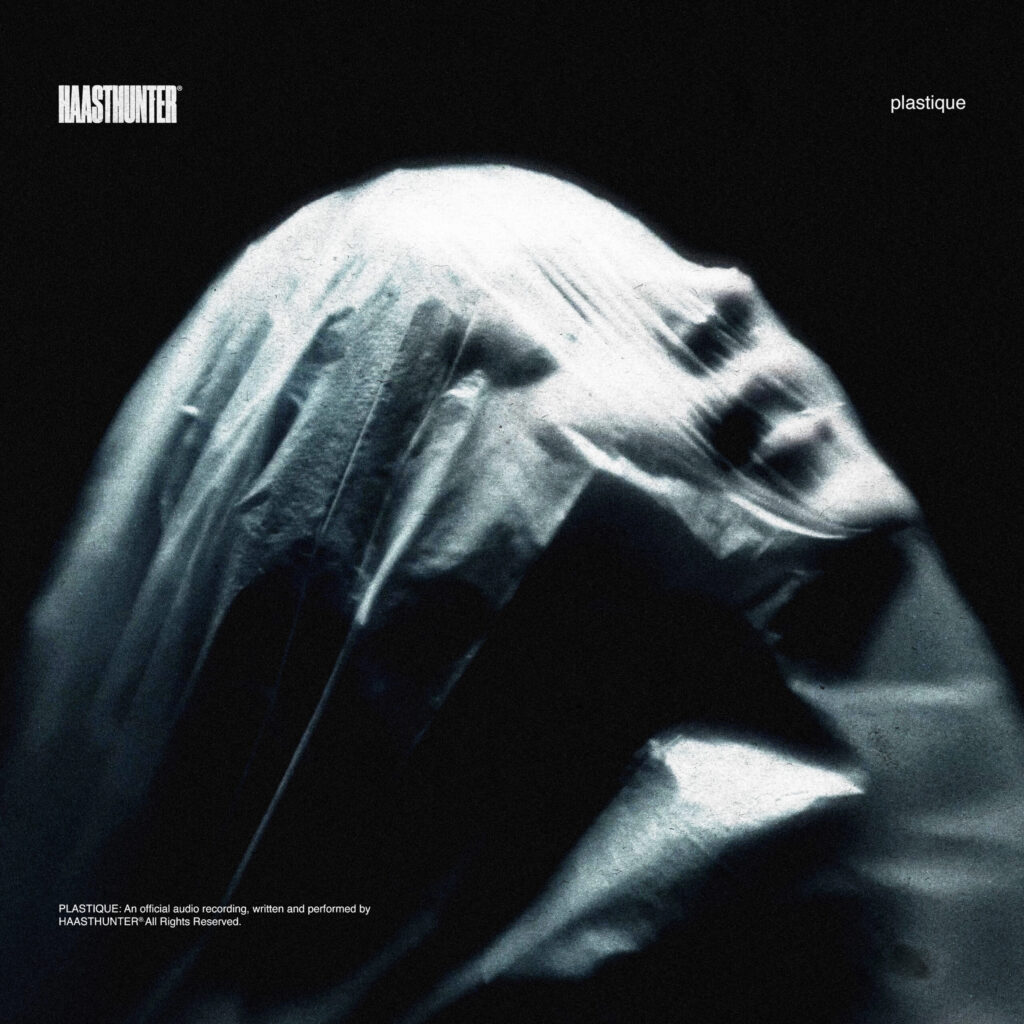
There is something particularly compelling about heavy music that understands that volume and aggression mean very little without something underneath them. Haast Hunter clearly understand this distinction. On the opening two tracks of their debut album Plastique, the Kirikiriroa/Hamilton four-piece demonstrate a knack for combining the sheer physicality of metalcore with atmosphere, melody and, most importantly, emotional weight. Plastique is an ambitious introduction to a band who aren’t particularly interested in keeping things simple. Built around a dystopian “Post System” universe, the album explores some very human territory – loss, addiction, mental health, grief, love and the possibility of transformation. It is heavy music, certainly, but there is a sense that the heaviness is being used as part of the storytelling rather than simply as an end in itself.
The title track, Plastique, immediately establishes that intent. There’s a substantial density to the production, with guitars, drums and atmospheric textures occupying a broad sonic space. The riffs have the necessary weight, but Haast Hunter resist the temptation to simply throw breakdown after breakdown at the listener. Instead, there is a strong sense of movement between tension and release, allowing the more spacious passages to make the heavier moments hit considerably harder. Vocalist Sinaea Elizabeth, alongside founding member James Harper, is particularly important to the band’s sound. Their contrasting voices provide Plastique with a useful dramatic dimension, allowing the music to shift between vulnerability and outright aggression. Rather than simply layering two vocalists over the same musical template, Haast Hunter appear to understand the value of contrast – the emotional impact comes from the distance between fragility and fury.
That same approach becomes apparent on Soul (e) Scape, which feels like a natural progression from the opening track. There’s an urgency to the song that gives it considerable forward momentum, while the atmospheric elements prevent it from becoming just another straightforward modern metalcore track. The guitars retain plenty of bite, but there is also a cinematic quality to the arrangement, creating the impression that these songs belong to a much larger world. There’s an increasingly crowded field of contemporary heavy bands capable of producing enormous guitar sounds, technically proficient drumming and devastating breakdowns. Far fewer manage to make those ingredients feel like part of an actual narrative. Haast Hunter’s willingness to explore psychological and emotional subject matter gives Plastique an identity beyond its production and genre tags.
Producer Scott Seabright deserves credit for helping create a sound that is suitably expansive. The production has the scale you’d expect from a band with cinematic ambitions, while still allowing the guitars to retain their physical impact. The result sits somewhere between modern alternative metal and contemporary metalcore, with enough atmosphere and melodic sensibility to broaden its appeal without diluting the heaviness. There’s also an encouraging sense of restraint in these opening tracks. The biggest moments work because the band understands the importance of building towards them. Quiet, atmospheric passages and more melodic sections provide breathing space before the guitars come crashing back in. It is this dynamic approach that could ultimately prove to be one of Haast Hunter’s greatest strengths, particularly in a live environment.
Haast Hunter continue to demonstrate that their particular brand of heavy music isn’t interested in simply turning the amplifiers up to 11 and leaving them there. Reflections and Chrysalis expand the Hamilton four-piece’s sound into something considerably more atmospheric, while retaining the muscular riffs and weight that underpin the album. At around three minutes, Reflections feels like a song built around tension and release. There’s an immediate sense of movement in the rhythm section, with the guitars occupying that particularly effective space between metalcore aggression and more expansive alternative rock. The track has a strong rhythmic pulse, but Haast Hunter avoid making it feel overly mechanical; there’s enough dynamic movement in the arrangement to keep the listener waiting for the next shift. What particularly works here is the contrast between density and space. The heavier passages have genuine physicality, with the guitars sounding thick without completely swallowing the rest of the arrangement. When the intensity pulls back, the resulting breathing room gives the subsequent heavier sections considerably more impact.
The production also deserves credit. There’s a cinematic quality to Reflections, with the atmosphere functioning almost as another instrument. Rather than simply placing a wall of distortion over everything, Haast Hunter use texture to create a sense of unease. It gives the song an emotional dimension that separates it from more straightforward metalcore fare. There’s a pleasing darkness running underneath the track, too. Even when the arrangement becomes more melodic, there’s rarely a feeling that the tension has completely disappeared. It’s more a case of the band allowing the listener to see the light before dragging them back into the shadows. Vocally, the contrast between aggression and melody is central to the song’s character. The heavier delivery gives the riffs the necessary bite, while the more restrained moments provide a human vulnerability that makes the track feel considerably more personal.
If Reflections is concerned with tension, Chrysalis feels more like transformation. It is the faster and more immediately propulsive of the two tracks, with a fast tempo giving the song a particularly energetic, nearly frantic, forward momentum. There’s an almost restless quality to the arrangement. The guitars have a sharper, more urgent character, while the drums provide the track with plenty of propulsion. It’s a song that feels designed to move, and there’s enough rhythmic aggression here to make it particularly well suited to a live environment. Yet, once again, Haast Hunter aren’t content with simply writing a collection of heavy riffs. The atmospheric elements are important to the song’s identity. The band understands the value of contrast, allowing darker and more spacious textures to sit alongside the heavier material. That gives Chrysalis a sense of scale beyond what its relatively compact running time might suggest.
The title is particularly appropriate. There’s a feeling throughout the track of something being contained, compressed and gradually trying to break free. The music repeatedly seems to push against its own boundaries, with the arrangement providing moments of expansion before returning to the heavier core. The guitar work is especially effective in this respect. Rather than relying exclusively on low-register chugging, Haast Hunter introduce enough melodic and textural detail to make the guitars interesting in their own right. There’s a nice understanding of how a riff can be both percussive and melodic, and that balance is one of the strengths of the band’s sound.
The production again allows the track to breathe. Despite the considerable amount of information being thrown at the listener, the mix retains a sense of separation between the instruments. That matters with music this dense: heaviness is much more effective when you can actually hear what is making the heaviness. Placed together on Plastique, Reflections and Chrysalis feel like important tracks in Haast Hunter’s development of their sound. They demonstrate that the band’s identity isn’t simply based around crushing riffs. There’s a genuine interest in atmosphere, dynamics, melody and emotional weight.
There is also something encouraging about the songwriting here. These aren’t songs that feel as though the atmospheric passages have been added simply to provide variety. The quieter and more expansive elements are integral to the compositions. That gives Plastique a more cohesive identity and suggests a band thinking about the album as a complete artistic statement rather than merely a collection of heavy songs. For listeners coming to Haast Hunter through the heavier side of the metalcore spectrum, these tracks offer enough weight, rhythmic aggression and guitar muscle to satisfy. For those more interested in the atmospheric and emotional possibilities of modern heavy music, there is plenty here to dig into as well.
“Dead Moon” feels like a track built around tension rather than simply brute-force heaviness. At around three minutes, it has enough space to establish its ideas without overstaying its welcome. What works particularly well here is the contrast between weight and atmosphere. The guitars carry the expected muscularity of Haast Hunter’s sound, but there is a darker, more brooding quality underneath them. Rather than relying on constant intensity, the arrangement appears to understand the value of restraint, allowing the heavier passages to have greater impact when they arrive.
The guitar work is central to the track’s identity. There’s a pleasing sense of rhythmic precision to the riffing, with the guitars functioning almost percussively at times. That approach suits the band’s metalcore foundation while retaining the rock sensibility that prevents the song from becoming overly mechanical. The low-end provides considerable physical weight, while the upper-midrange guitar presence gives the track its abrasive edge.
The production is suitably dense, but importantly, the heaviness doesn’t completely obscure the individual components. The drums provide a strong structural framework, with the kick and guitars locking together to give the song its forward motion. There’s also enough atmosphere around the heavier instrumentation to reinforce Haast Hunter’s stated interest in the space between crushing heaviness and haunting ambience. Vocally, the song fits naturally into that aesthetic. The performance feels emotionally committed rather than simply aggressive, which is an important distinction for this style of music. Haast Hunter’s strongest work is where the emotional content behind the heaviness is as convincing as the heaviness itself, and Dead Moon moves firmly in that direction. The final section is particularly effective because the song avoids repeating the same idea until the clock runs out. There’s a sense of progression through the arrangement, and the reduction in overall energy towards the conclusion gives the track a slightly unresolved, lingering quality.
Then Why takes some of the ideas heard in Dead Moon and pushes them into a more expansive and dynamically varied song. At nearly 3:45, it’s one of the longer tracks, giving Haast Hunter more room to develop the song instead of hitting hard from start to finish. There’s a noticeably strong dynamic trajectory to this track. The energy builds and shifts throughout the arrangement, giving the listener a sense that the song is travelling somewhere. That is particularly important in metalcore, where the temptation can be to make every section sound as huge as possible. Then Why benefits from allowing different levels of intensity to exist.
The guitars are again the primary architectural element. There is plenty of rhythmic attack, but the arrangement also has a more melodic and atmospheric character than a straight-ahead hardcore track. This is where Haast Hunter’s combination of rock, metalcore and cinematic atmosphere starts to become a genuine musical identity rather than simply a description of their influences.
The drums are crucial in maintaining that sense of movement. The track isn’t especially fast on paper, but the rhythmic subdivisions and interaction between drums and guitars create considerably more momentum than the tempo figure suggests. The result is a song that feels physical without needing to rely on speed. One of Then Why’s strengths is its sonic density. There is a lot happening in the middle and upper-mid frequencies, giving the track a particularly full sound. That works extremely well when everything is firing simultaneously, although this is also an area where a little additional separation could potentially make future mixes even more powerful. Sometimes allowing a guitar, vocal or drum element a fraction more space can make the entire mix sound heavier rather than thinner.
The emotional character is also convincing. The title itself suggests questioning and uncertainty, and the music has an appropriately unsettled quality. Rather than sounding triumphant, the song feels conflicted – and that emotional ambiguity gives the heaviness something to latch onto. Compared with Dead Moon, Then Why feels more ambitious structurally. It demonstrates that Haast Hunter can sustain interest over a longer arrangement and can move between atmosphere and aggression without losing their identity.
There’s also something here that could work particularly well live. The song has identifiable shifts in energy that could give an audience obvious moments to respond to – something that becomes increasingly important when a band moves from recording to performing.
World I Knew feels like one of the more emotionally expansive tracks in Haast Hunter’s arsenal. Rather than relying purely on the crushing weight that characterises much of Plastique, the song creates a stronger sense of dynamic contrast, allowing the heavier passages to hit with considerably more impact. The guitar work is particularly effective. There’s a satisfying balance between low-register heaviness and more atmospheric textures, giving the track a sense of movement rather than simply presenting one huge wall of sound. The arrangement gradually develops its intensity, and the transitions between sections give the song a cinematic quality that fits Haast Hunter’s description of blurring the boundary between heaviness and atmosphere.
Vocally, this is an important track because the emotional delivery feels central to the composition rather than simply sitting on top of the riffs. The contrast between more restrained passages and the heavier vocal moments gives the song a feeling of internal conflict and release. That emotional trajectory is one of the album’s strengths. The rhythm section is suitably muscular without becoming unnecessarily busy. The drums provide a solid foundation for the guitars, while the bass helps give the heavier sections their physical weight. There’s a pleasing rhythmic tension, especially in the moments where the song pulls back before surging forward again.
Lost Now Found takes a somewhat different approach. At around 140 BPM, it has a noticeably greater sense of forward momentum than World I Knew, and the song feels more immediate and energetic as a result. The opening is particularly effective because it doesn’t give everything away immediately. The arrangement builds into the heavier material rather than simply dropping the listener straight into it. Once the full instrumentation arrives, however, Haast Hunter’s metalcore credentials become very apparent. There’s a strong push-and-pull between melody and aggression throughout the track. The guitars provide the obvious heaviness, but there is enough melodic material within the arrangement to prevent the song becoming rhythmically or harmonically predictable. One of the strongest aspects is the way the song appears to continually accumulate energy. Rather than feeling like a collection of riffs stitched together, the different sections contribute to an overall trajectory. That’s an important quality for a band working in metalcore, where songs can sometimes become overly dependent on the predictable verse/chorus/breakdown formula.
The latter portion of the track is especially effective. The increased intensity gives the song a satisfying sense of arrival, and the contrast with the opening makes it feel like the listener has gone somewhere.
World I Knew represents the atmospheric/emotional side of Haast Hunter particularly well, while Lost Now Found demonstrates their momentum and aggression. The two tracks also strengthen the impression that Plastique isn’t simply an album designed to be heavy. There’s an underlying interest in tension, release, emotional vulnerability and sonic scale, which gives the material considerably more longevity. If the earlier tracks established Haast Hunter’s ability to hit hard, these two demonstrate that they also understand when not to hit hard – and that’s often the difference between competent heavy music and genuinely compelling heavy music.
Bleed and Release feels appropriately consequential. At just under four minutes, it has the sense of a song that is preparing the listener for the album’s final statement rather than simply filling a position in the tracklist. Its impact comes less from speed than from the gradual build of weight and intensity. The most striking aspect of the track is its dynamic trajectory. It begins comparatively restrained before steadily expanding into something much larger and more aggressive. The production has plenty of low-end presence, while the guitars occupy an increasingly dense and abrasive space as the song develops. That contrast between restraint and heaviness works particularly well for Haast Hunter’s approach to metalcore: the heaviness feels earned rather than being delivered at maximum intensity from the opening bar.
There’s also a strong sense of cinematic progression here. Rather than treating the guitar riff as the entire song, the arrangement appears to be built around successive increases in density and energy. The result is a track that feels almost claustrophobic at its peak, before opening enough space for the melody and atmosphere to register. That balance between crushing heaviness and atmosphere has been one of Plastique‘s defining characteristics, and Bleed and Release is a particularly good example of it. The rhythm section deserves considerable credit. The drums provide the track with a solid, deliberate foundation rather than simply chasing technicality. The medium tempo gives the riffs room to breathe, while the heavier passages gain their power from the interaction between the kick, bass and guitars.
There’s a satisfying physicality to the production: this is music that seems designed to be felt as much as heard. The vocal arrangement is another important part of the song’s effectiveness. Haast Hunter’s best moments come when the vocals act as another instrumental layer, and Bleed and Release benefits from that. The contrast between vulnerability and aggression reinforces the song’s apparent theme of emotional pressure reaching a breaking point. The title itself suggests catharsis – bleeding out what has been held inside and finally letting it go – and the arrangement supports that idea. What makes the song especially effective in the context of Plastique is its position near the end of the album. Earlier tracks such as Dead Moon, Then Why, Reflections and Chrysalis establish different aspects of the band’s emotional and sonic vocabulary. By this point, Bleed and Release feels like a culmination of those ideas. The heaviness isn’t simply there to demonstrate what Haast Hunter can do; it carries a sense of emotional exhaustion and release.
If there is one area where the track could potentially be pushed further, it would be contrast. The heavier sections are convincingly massive, but giving the quietest moments even more negative space could make the eventual climaxes hit harder. Haast Hunter clearly understand the value of atmosphere, and leaning even further into that juxtaposition could make an already powerful arrangement even more dramatic.
Curtain Fall is noticeably more deliberate than the preceding Bleed and Release. That slower pace gives the song considerable weight. The guitars aren’t required to race to create impact; instead, the arrangement allows the riffs and low-end to occupy space. There’s something almost processional about the track, which works particularly well as the closing chapter of Plastique. What really makes the song work, however, is its sense of finality. The band have spent the album moving between crushing metalcore passages and more atmospheric, melodic sections, and Curtain Fall feels like the point at which those two worlds finally converge. There’s still plenty of aggression, but it feels less like confrontation and more like aftermath. The title is particularly apt. A curtain falling implies that the story has been performed, the lights are going down and whatever has happened on stage is now finished. That’s essentially what Haast Hunter have achieved across Plastique: they have constructed a musical world and invited the listener inside it for ten tracks, before finally closing the door.
Individually, the songs on Plastique can be appreciated as modern metalcore with strong atmospheric and cinematic tendencies. Taken as a whole, though, the album is much more interesting. Haast Hunter have created a world that feels dark, damaged and emotionally claustrophobic, but it isn’t devoid of beauty. The album constantly moves between those two extremes. Crushing guitars and visceral vocals are balanced by melody, ambience and moments of genuine vulnerability. That contrast is arguably the album’s greatest strength. Throughout Plastique, it feels like the listener is moving through a psychological landscape rather than just hearing a collection of rock songs. Reflections and Chrysalis suggest introspection and transformation; Dead Moon and Then Why introduce darker emotional territory; World I Knew and Lost Now Found broaden the narrative towards memory, loss and rediscovery; and Bleed and Release provides the cathartic eruption that naturally precedes Curtain Fall.
Consequently, the album feels narrative without needing to be a conventional concept album. Individual songs have their own identities, but they also contribute to something larger, and that is where the title Plastique becomes increasingly appropriate. There is something artificial, fractured and malleable about the world Haast Hunter have created. It isn’t a comfortable place, but it is a convincing one.
A defining characteristic of the album is its cinematic production. The guitars are capable of sounding enormous without completely destroying the atmospheric elements underneath them. The drums provide the physical force expected from metalcore, while the quieter passages create enough breathing room for the emotional content to come through. The production also allows Haast Hunter to occupy a space somewhere between modern metalcore, alternative metal and atmospheric hard rock. They aren’t simply chasing brutality. There is an obvious concern for texture and mood. That makes Plastique more accessible than an album that remains relentlessly aggressive from beginning to end. Across the record, the most compelling thing about Haast Hunter is the balance between heaviness and emotion.
There are plenty of bands capable of writing a heavy riff. There are plenty capable of writing an emotional song. The harder trick is combining the two without allowing one to undermine the other. Their best moments occur when the emotional content dictates the musical intensity – when a riff sounds heavy because the subject matter demands it, rather than because the band simply wants to sound heavy. That gives the record an authenticity that carries it beyond genre exercises. There’s also an appealing sense that the band aren’t afraid of melody and atmosphere. The quieter, spacious passages aren’t interruptions; they’re essential to the album’s vocabulary. It’s dark without being monotonous, heavy without being one-dimensional, and emotional without becoming sentimental. There are moments where the production and songwriting could potentially benefit from even greater dynamic contrast, but those are relatively minor criticisms within an album that demonstrates a clear artistic identity.
Curtain Fall is a strong closer because it understands an ending doesn’t need to be the biggest moment. After the emotional pressure of the preceding songs, the slower, heavier final chapter feels appropriate. They aren’t simply borrowing the aesthetics of metalcore. They’ve taken the genre’s heaviness and used it as the foundation for something more atmospheric and personal.
Haast Hunter have created more than a debut metalcore album. They’ve created a distinct sonic world (similar to Crooked Royals, but less complex, but darker) – one filled with tension, grief, transformation and fleeting moments of light. There are riffs designed to hit physically, melodies designed to linger, and vocal performances that give the material its emotional centre. But it is the journey between those elements that makes Plastique memorable. For a debut, that’s an impressive achievement. Plastique feels like stepping into a dark room where you don’t immediately understand what has happened – but by the time the curtain falls, you’ve lived through enough of the story to feel its weight. Haast Hunter may be exploring the collapse of a world, but Plastique sounds very much like the beginning of something.
Related Acts:
About the author Nicholas Clark
Aspiring Writer / Musician / Philosopher / Caffeine enthusiast. I like to create, write about and talk about music. Let’s have a coffee sometime and nerd out.
More by Nicholas Clark
Gig Review: Amped Up @ Brewtown, Upper Hutt – 24/10/2026
EP Review: Mezdalorani
Album Review: Patron Saint
Gig Review: Wet Denim @ San Fran, Wellington – 26/09/2026
Album Review: Foothold
Gig Review: Katelyn Henshall @ Vogelmorn, Wellington – 04/09/2026
Gig Review: Mister Unit @ San Fran, Wellington – 18/08/2026
Book Review: Home Again by Jon Toogood
Album Review: An Olive Tree and a Warm Breeze
Album Review: The Fallen
Album Review: Prime Corner
Album Review: Wanda’s Bicycle