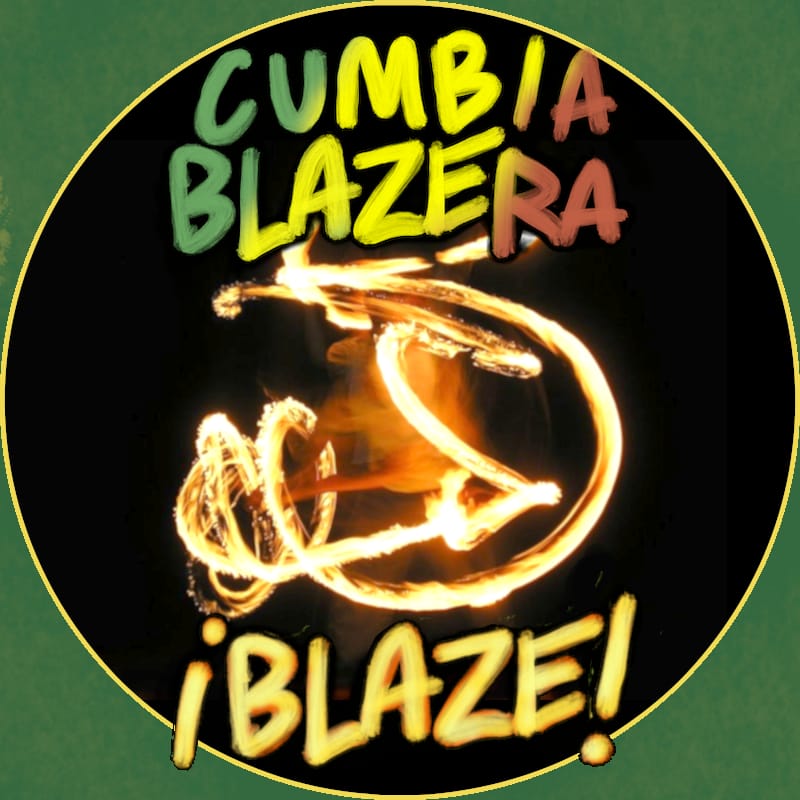
On ¡Blaze! Pōneke’s football-club orchestra, Cumbia Blazera, kicks Latin rhythms across hemispheres on a brass-bright second album built for dancing!
Cumbia travels light: an irresistible pulse with room for new dance partners. Born on Colombia’s Caribbean coast from African rhythms, Indigenous flutes and European melodic forms, it pairs alegre, llamador and tambora drums with gaitas or cane flute, maracas and guache. Its traditional night-time dance circled the musicians, candlelight tracing the steps. Through the twentieth century, it danced across Latin America, going orchestral, accordion-led, psychedelic, electronic or punkish along the way. The rhythm stays recognisable; the party welcomes whatever the next town brings.
In Te Whanganui-a-Tara, cumbia arrived wearing football boots. Cumbia Blazera began at a 2013 Sunday Blazers Football Club prizegiving, where musical teammates slipped cumbia rhythms into Kiwi songs and turned a post-match jam into a bilingual party band. A pub yarn? Perhaps – but more than a decade later, this 11-piece collective is still scoring. Punchy brass, jangling guitars, percussion and massed voices lift terrace chants onto the dance floor. English and Spanish share the microphone; the groove does the introductions.
Soon the touchline couldn’t contain them. Multiple Aotearoa tours and major festivals took them through Newtown Festival, the Performance Arcade, Havana Bar, the Rogue & Vagabond and El Barrio, plus Nelson’s Boathouse and Mohua/Golden Bay’s Mussel Inn. Then came the away fixture of a lifetime: in April 2017, 13 travellers headed to Colombia for ten performances across Bogotá, Cartagena and Medellín, a national television appearance, school shows and a week-long residency at Medellín cultural centre Plazarte.
Colombia brought more than passport stamps. At Plazarte, local artists, musicians and activists introduced them to new perspectives, including Afrokuisi’s acoustic mix of kuisi flute, drums and voice. The band joked that they finally understood why South American listeners called their sound “Argentinian cumbia”. Curiosity keeps the joke generous: these aren’t self-appointed guardians of tradition, but eager teammates mixing inherited rhythms with football-club camaraderie and Aotearoa indie-pop scruff.
Their 2021 debut, Don’t Argue With the Ref!, planted the corner flag. Historia, Game We Should Have Won, Aotearoa and Sunday Blazers Thanks & Praises sent team folklore dancing, while a Lambada / Popcorn mash-up let Latin American repertoire, novelty melody and Wellington bar-band instincts play in the same loose formation. Communal before it was studio-made, the album prized exuberance over polish: a slightly unruly squad with connection firmly in its sights.
This winter, the squad regrouped for second album ¡Blaze!, recorded in June with ‘Dr’ Lee Prebble at Wellington’s The Surgery. His credits – The Black Seeds, Trinity Roots, The Phoenix Foundation, Mel Parsons, L.A.B and Sir Dave Dobbyn – suggest someone who knows how to catch a groove without ironing out its personality. With eleven players, that’s crucial: nobody wants a brass section stuck in peak-hour traffic. Percussion powers ahead, horns find their gaps and wiry guitars dart between them. That separation is more persuasive than the happy-team mythology: the arrangements give the party shape. The worthwhile question is whether the songs offer as much to return to as the groove offers to dance to.
The titles hop from Bolivia to the vegetable market, from solar swagger to loss, with springy cumbia rhythms keeping the itinerary moving. Opener and lead single Uyuni tackles crossroads, obstacles and helping hands through Bolivian travel – with a donkey possibly waiting around the next bend. Its strongest move is the balance of sincerity and cheek: the humour gives the journey personality rather than merely waving a novelty flag. The bounce gets you aboard; the sense of a road worth travelling gives you a reason to stay.
This song title sent me exploring, too. My research suggests “Uyuni” comes from Aymara, spoken in the central Andes of Bolivia, Peru and Chile: uyu means “pen,” “enclosure” or “concentration point,” while -ni means “place of” or “with”. Put together: “the place of enclosures”. My interpretation? A song about slipping those fences, taking the road and letting surprise ride shotgun.
Found Someone gave me goosebumps. Sweet enough for a wedding playlist, this romantic cumbia makes emotional arrival an invitation to the floor. That sweetness is both its charm and its limitation: the sentiment is familiar, so the groove has to make it feel personal. For me, it does. No elaborate footwork required – just a connection that lands.
Never short on ambition, the band – and football team – aim straight for the sun. Blazeros Del Sol recasts the Blazers as mythic heroes beneath blazing brass, with World Cup swagger and tongues firmly in cheek. The horns make the grand entrance convincing; the team mythology is a tougher sell if you’re not already wearing the scarf. It’s a useful distinction: the musical swagger travels further than the in-joke. Even a suburban pitch deserves a little Estadio Metropolitano theatre, but the brass earns the applause.
Guero With You gives Crowded House’s Weather With You a swaggering Latin makeover. The retitle had me scratching my head: Guero is Mexican slang for a ‘blonde’ person. A cheeky companion for the journey, perhaps? The wordplay is less persuasive than the nimble guitar pickings, which give the familiar tune a fresh rhythmic setting. That’s the test for a makeover: not simply changing its shirt – but finding another way for it to move. And is that a charango I hear?
The Good, The Bad, And The Vege Market stages its western showdown among the weekend vegetables. A comic title can only carry so much shopping; fortunately, the arrangement does the heavy lifting. Funky opening bass, woodwinds and brass set the scene, while a silky flute solo earns the spotlight. The Morricone-meets-mariachi mischief works because there’s musical detail beneath the gag. Here, local absurdity becomes a setting rather than the whole attraction. Draw your shopping bags – but listen to the flute.
Invisible Cities fires up 60’s funk and jazz-floor stomp, before delicious fretwork ushers in How Bizarre! The Kiwi classic trades its soft-top cruise for a Saturday soccer soirée: orange slices at kick-off, offside explanations to the police by closing time. Recognition supplies an easy cheer, but the fretwork is the stronger argument for revisiting it. The album is more interesting when the playing reshapes familiar material than when familiarity alone threatens to become the main event.
Que Blazar captures that famous South American football passion by retelling the match through an unfair penalty and escalating cartoon violence: “While everyone is fighting/ And one guy is going nuts/ He’s looking for a weapon now, anything that cuts/ He’s found a piece of 4×2 with a nail sticking out / He’s brought it on to the field / And that’s when we all shout ‘Que Blazar! Que Blazar!’”
With a samba shuffle, Ya Se Ha Muerto Mi Abuelo revisits Juaneco y su Combo’s famous 1979 Peruvian Amazonian cumbia, or chicha. Its title means “My grandfather has already died,” yet the music bursts with life. Inspired by a friend in mourning, singer Wilindoro Cacique improvised a hook about a grandfather happily drinking traditional jungle liquor; keyboardist Juan Wong Popolizio supplied the psychedelic melody. An unlikely party starter became part of Peru’s musical fabric.
That contrast gives the dancing depth: grief joins cumbia’s communal pulse, carried together rather than left alone in a quiet room. It also broadens the album beyond its football-club mythology. Here, celebration isn’t simply a good time; it has something difficult to carry. That emotional weight makes the buoyancy more compelling.
Chinito En Onda and Greet That Dawn send the album home buoyant. The latter looks towards first light, gathering endurance and fellowship into a warm finish. After the punchlines and borrowed favourites, that directness matters: connection becomes the subject rather than merely the atmosphere. It’s an affectionate exit, not a grand revelation, but it gives the party a destination beyond one more round.
Cumbia Blazera translate cumbia through ‘Welly-shaped’ brass, indie guitars and football-club camaraderie. From a 2013 prizegiving to Medellín and The Surgery, theirs is a journey of listening, learning and joining in – but a good backstory isn’t the same as a strong record. ¡Blaze! makes its best case through instrumental detail and moments of emotional directness; the novelty titles and club mythology are seasoning, not the meal. Brass flares, guitars chatter and jokes wander cheerfully offside. Bright, affectionate and scruffy, it earns its invitation to the dance floor most convincingly when the music, rather than the banter, leads.
Related Acts:
About the author Tim Gruar

Tim Gruar – writer, music journalist and photographer Champion of music Aotearoa! New bands, great bands, everyone of them! I write, review and interview and love meeting new musicians and re-uniting with older friends. I’ve been at this for over 30 years. So, hopefully I’ve picked up a thing or two along the way. Worked with www.ambientlight.com, 13th Floor.co.nz, NZ Musician, Rip It Up, Groove Guide, Salient, Access Radio, Radio Active, groovefm.co.nz, groovebookreport.blogspot.com, audioculture.co.nz Website: www.freshthinking.net.nz / Insta @CoffeeBar_Kid / Email [email protected]
More by Tim Gruar
Gig Review: Hikurangi Schaverien-Kaa @ Te Ao Kōhatu Wellington Jazz Festival, Wellington – 18/10/2026

Album Review: Motoring For Beginners
Album Review: Te Ngahere
EP Review: Welcome To The Dance Bunker

Album Review: Leap!

Festival Review: Great Sounds Great Part 1 @ Cuba Street Precinct, Wellington – 5/09/2026
Festival Review: Great Sounds Great: The Night Before @ Newtown Village, Wellington – 4/09/2026

Gig Review: Mel Parsons @ Opera House, Wellington – 05/09/2026

Album Review: Descending Dreams
EP Review: Extended Paranoia
Album Review: Brain Storm

Album Review: Ceiling Waves