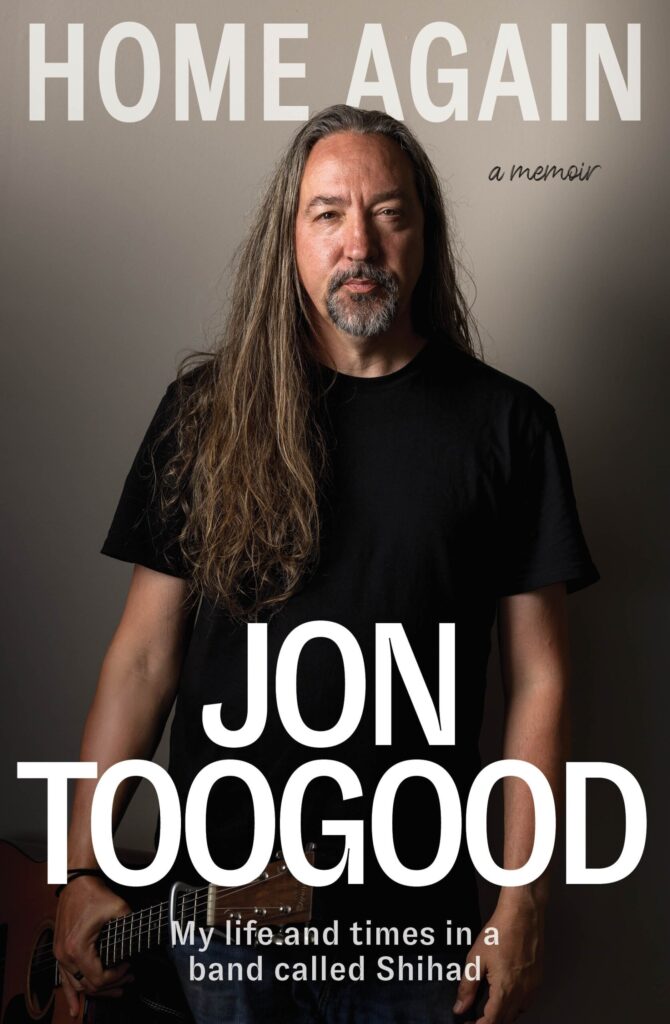
Shihad fans, New Zealand music fans and kiwi musicians, rejoice! The tell-all book chronicling Shihad’s frontman private sphere and musical career is an incredible, if occasionally unsettling, read. Fans of Aotearoa’s most prominent and successful hard rock act will enjoy following the journey of Jon Toogood’s life through his humble childhood, finding his love of music, his uneasy relationship with heavy metal that he alternates reveling in or deliberately denying, and his ambition to make his musical act succeed amidst many setbacks and challenges. The book contains much advice for both discontented, young men unsure of their position in society and musicians alike; however, most of the lessons the book offers are imparted by Toogood making the wrong decision until the end of the book when Toogood finds himself. The book itself is written with energy and gusto, much like Toogood himself, and sentences are peppered with Kiwi slang. The writing is almost in the style of Hemingway via the use of simple sentences following longer paragraphs that follow the pattern of speech Toogood employs on stage and in interviews. The tales are relatable because of the informal language used which puts the reader at ease, as if in conversation with a friend telling a farfetched story, but also because of the nature of the voice which remains charmingly humble throughout – even if some of the events that occur are nearly unbelievable.
Many might think the story of Jon Toogood is synonymous with the story of Shihad the band. The foreword of the book (as well as warning the reader of distressing topics) reminds the reader that this memoir is not the history of the band. Events throughout the book, particularly after the turn of the millennium when the band faced both their biggest dilemmas and greatest commercial peak, are examples of when opinions and memories may differ between members. This splintering of the group’s once solid relationship in the decade preceding this era makes you realize how united and determined they were, even while facing daunting challenges. Tom Larkin, Shihad’s drummer and Toogood’s closest confidante, is a central hero to this story, but his own may differ considerably from this biography. The book lays bare the unassuming and occasionally embarrassing realities of being in a touring rock show, but also offers a fascinating (though brief) glimpse into American culture and the musical industry in Los Angeles during the Bush administration’s ill-fated War on Terror. Even if you’re not a fan of Shihad or The Adults, music lovers and musicians (particularly New Zealanders) will enjoy this memoir specifically because of the bumpy road.
Toogood paints a relatively quaint Island bay childhood, surrounded by ‘British Boat people’. He mentions his asthma and fear of heights and these vulnerabilities allow us to establish rapport easily. Within this immigrant community he discovered music through his parents. There are some vivid vignettes of his childhood, such as examining a vinyl record playing closely; in order to feel the music in his body, he rested his chin on the player and the black plastic rubbed off on his teeth. His older siblings also influence his musical tastes: “I distinctly recall [my older sister] warning me not to get into metal. She actually said, ‘If you get into metal, I’ll never talk to you again.’ She should’ve known that was the wrong thing to say to me. I instantly needed to know why this music was forbidden and why she thought it sucked.”
Toogood strikes the reader as an assured youth, which makes his temporary slip into teenage delinquency surprising. These early chapters offer a window into Toogood’s personality and the quirks that make him an oscillating figure between assemblies. This also introduces his lifelong uneasy relationship with heavy metal music as a genre that brings cultural artifacts Toogood doesn’t easily accept. “Even though I was the captain of the Wellington cricket team, I definitely wasn’t a jock. I was nerdy, into comics and art, but I was also good at sports and got along with most people. I could flip between worlds. I could hang out with the sporties but also with the metal kids or the art kids.” Toogood is candid with his competitive nature but also his selectiveness into what activities he chose to excel in. This creates the picture of Toogood as both the young man who became a Wellington cricket representative but who lost interest in the sport once he was given the responsibility of the role of captain. These early chapters also hint at the adult to come who obsessively threw himself into activities like a fanatic. “One thing I’ve struggled with my whole life is that I only want to do things I can be competitive in from the word go.” It is these quirks, such as not wanting to even learn the rules of chess as he had no time to master it, that make his later decisions in life more understandable.
Tom Larkin as a character in this book is pivotal. Not only did Larkin introduce Toogood to Metallica, he also saved him from his own savage self-critique and moments of doubt throughout their shared career. Once familiarized with thrash metal, Toogood applied his obsessive nature: “Once Master of Puppets came into my life, my whole life revolved around that album specifically. I spent three weeks just learning side one. And when I’d done that to death, I learned side two. It was everything I wanted to be.” His relationship with Larkin fortified in his later teenagehood and the reader can’t help but think his parents may have been concerned for him spending all of his time with his bandmate aiming for the impossible.
Fans of the band will enjoy a large chunk of the book recounting their determined climb to success. There’s the modest recording of the Shihad Demos at Crescendo Studios with Malcolm Welsford, skinheads in Blenheim Road Hotel, playing Molly Malones while being underage: “Sometimes, the police would come through and the bar staff would have to hide us behind the bar until they left. We thought it was the most fun thing ever.” Even though the band is self-proclaimed nerds, there was always a driven business-like seriousness to operations that assured their success.
Toogood, at least at this part of his career, is unassuming about his lyric writing. He was influenced by Stephen King’s It to inspire his first song, but other early songs like Tengu he admitted to not even having read at all but basing his lyrics on the blurb alone. It is also during this time he would regularly dismiss entire songs, music and all, if the lyrics weren’t acceptable and he laments how many he discarded in this process. Early on, Toogood expanded his musical influences to include Faith No More, My Bloody Valentine, Pixies and Big Black. It’s nice to see connections with other New Zealand bands such as King Kapisi, Trinity Roots, Bailterspace / The Gordons, The Skeptics, Flesh D-Vice, Fat Freddy’s Drop and Weta weave into this story. Toogood writes about the influence of Brent McLachlan and Nick Roughan, but more importantly, their tragic first manager, Gerald Dwyer of Flesh D-Vice. There’s also the friendly rivalry between Shihad and Head Like A Hole that develops into sincere jealousy. Producer Jaz Coleman inspired the young Toogood by presenting rock musicians as “…part of the lineage of the shaman and the tribe who would speak to God or the universe by getting themselves into a transcendental state.”
It’s really nice to see the members of the band appear in the story. However, while they must be multifaceted individuals themselves, how they are introduced is how they remain in this memoir: Tom Larkin endures as the ambitious yet steadfast friend; Phil Knight continues throughout the book as a shy, yet gifted member of the band; and Karl Kippenberger (initially disliked by Toogood for being a fan of Shihad and wearing a Metallica shirt to his audition) remains remarkably dedicated to the band even during enormously taxing circumstances for him. The reader can’t help but feel sorry for the members who endure their various trials, and while most of the challenges they face are not created by Toogood personally, those few are noted by the author apologetically. Certainly, there is luck at play in their rise to fame (such as Frenzal Rhomb’s singer, Jason Whalley, breaking his arm) but the majority of their success resides from sheer determination.
Of all the relationships mentioned in the book, (at least for the first half of the book), the most fascinating to muse on is the long distance relationship with Ronise Paul and Toogood’s step-daughter, Anaya. This bond and subsequent marriage inspired much of the Shihad catalogue and their tumultuous pairing is emotional to read about. Curiously and karmically enough, the marriage ended when Anaya was eighteen, the exact age Toogood was when he met his step-daughter to be as a baby.
There are early career milestones that are written about with regretful language, such as signing to German label Noise Records and the stylistic pivot of their self-titled album (The Fish album) but Toogood writes rather philosophically about it all when returning to topics and he has a knack for making them seem fatefully out of his control and a lesson waiting to be understood.
There is much humour to be enjoyed, but almost all of the examples are essentially dark humour and at the expense of those that lived through a difficult moment. There’s their fifteen-second-long first gig in a Methodist church playing Megadeth’s version of Anarchy in the U.K., or Kippenberger smacking Toogood’s guitar out of tune seconds before they go on stage. Later on, Toogood mocks their band name change and wallows in the bad luck that follows: “It turned out there was already a band called Pacifier in Washington, DC that had somehow been missed by those at The Label. The record company had to pay them out. It wasn’t chump change, either. When we found out, we couldn’t believe that any band would willingly call themselves Pacifier. It was a terrible name. And now that was us. We were that band. We were Pacifier.” There’s also the bleak humour to be found when Tom Larkin interrupts Toogood’s new found meditation with the news of 9/11, or when crickets are released into their tour bus. One of the funniest moments comes from the band deciding to scrap recordings made at producer GGGarth’s studio, only to receive a present from him: “We found out later that GGGarth only heard about our views on his recording when management told him about our re-recording. We got a package in the post from him, and when I opened it, it was a T-shirt, screen-printed with my effusive review from his guestbook: ‘I loved this recording session and everything GGGarth has done.” However, the most hilarious point of the book has to go to Johnny’s inappropriate joke that completely cleared the Viper Room in Los Angeles.
At the height of their fame, Toogood comes off as an attention seeking egotist who throws out of tune guitars at techs and gives drum equipment to the audience when performances weren’t up to his high standards. This era of Toogood also specifically writes the song Pacifier after being goaded by his record label there were no hits on a record, and thus explicitly wrote a pop song, lyrically inspired by Aaron Tokona from Weta and his bipolar disorder, which subsequently haunted his career. At times, even given the pressure he was under, Toogood seems arrogant and I felt genuinely sorry for his bandmates who have had to deal with his dramatic ups and downs. No one is more critical of this than Toogood himself who realizes shortly after the mental breakdown, or burnout, or frustration he is experiencing to get over himself.
Then, there’s the peak of their career offering perhaps the most thought-provoking chapters of the memoir. This section of the book offers a glimpse into the Los Angeles music (and film) industry at the turn of the century, along with the operation of The Label and its parent company The Firm. Toogood is at his most swayable in these chapters, keen for fame and success and being influenced by those surrounding him and distancing him from his own band. Toogood writes critically of the American culture the band was thrust into in these chapters, but he doesn’t lay blame at anyone but himself. Actress Tara Reid, Wes Scantlin of Puddle of Mudd, writer Dave Bassett and even producer Josh Abraham are critiqued by Toogood for a variety of reasons, but a few Americans escape his disapproval such as Scott Weiland and Mark McGrath of Sugar Ray.
Knowing who Toogood was going into this era, and who he is now, it’s nearly comical to think how unlikely he was going to accept this world, especially given how critical Toogood was as a writer of free-market capitalism. But it’s fascinating to see Shihad attempt to make it work during one of the most unusual times in American history.
The book has a charming mirroring quality to its structure, placing the Pacifier era at the very middle. After drifting away from heavy metal to explore alternative music and pop, the band eventually returns to what they do best. So too do Toogood’s lyrics shift from being critical of contemporary society, to becoming more personal, and then a return to societal critique. Helping to move in the 1974 Neve recording desk into York Street Recording studios for their debut, the first album recorded there, is reflected by them being the last band to record an album, FVEY, before it was closed also, twenty-one years later. Similarly, Toogood returns to the family life from the early part of the book when he meets his new wife, Dana Salih, after becoming single. The presence of immigration, via the ‘British Boat people’ at the beginning, is reflected by his Sudanese wife.
It is Salih who instigates creativity in Toogood in the last chapters of the book. When confronted with converting to Islam, Toogood is characteristically hot-headed: “ ‘Well, that’s bullshit,’ I said. ‘Why don’t you convert to what I believe in?’ ‘What do you believe in?’ she asked, genuinely curious. ‘Nothing,’ I replied.” Being a staunch, antagonistic atheist all his life, his belief systems are challenged by Dana’s example of presence and peace. Questioning his motivations, Salih inspired Toogood to identify that it was injustice that he was outraged about all along.
When Toogood establishes supergroup The Adults (featuring Shayne Carter, Julia Deans, Anika Moa, Tiki Taane and Ladi6) he discovers his validity and proves to himself he was worthy of his peers creative endeavours. This version of Toogood at the last part of the book is a far calmer and more assured individual – strangely similar to the young man I thought of him before he became interested in music. He reawakens as a socially aware activist amidst the George Floyd protests and the Christchurch mosque terror attack which leads directly into Shihad’s final and brilliant album, Old Gods. This album unfairly received some negativity about being too political, but really, it’s just Toogood being more articulate with his anger.
At the end of the book, Toogood encounters tinnitus from years of playing music at high volumes and makes use of cognitive behavioural therapy. The breakup of Shihad is inevitable, and even a reader knowing it’s coming is saddened by the decision. Looking at it from afar, the band was one of the many, indirect victims of the lockdowns by losing a chance to capitalize on their album by not being able to play live. Still, the band ends on a high point with their farewell tour culminating at Wellington’s Meow Nui. Toogood writes about this era closing with fondness and no regrets at all. In his own words, the ending was “perfect”.
The guitar becomes a therapeutic object for Toogood at the end, used to express his new-found peace in his solo album Last of the Lonely Gods (which is still critical, but calmer). The tinnitus becomes a blessing in disguise as it is catalyst for him to change gears and explore his solo performance.
There’s surprises even for Shihad fans: learning of the band’s appreciation of Oasis, the airport handling accidently creating the tuning for the FVEY and Old Gods record, Toogood’s love for Aghani Al-Banat music … but it is Toogood’s endless imposter syndrome and questioning of metal as a genre, or his validity as a performer that is the most surprising. For the most part of his career, despite what fans thought of him or how he was mediated, he was probably a nervous wreck.
At the end of the book, it is Tom Larkin who nicely concludes the memoir returning a text back to Toogood: “ ‘Yo’, it read. ‘Life goals complete, bro.’ ”
I highly recommend this book to anyone involved or interested in the music industry, but also to those who like an enjoyable memoir about a man finding his peace after an unbelievable journey of self-determination.
Book Launch 2026:
Off The Record with Jon Toogood
Songs and Stories with host Charlotte Ryan
Q Theatre, Auckland
7pm, Tuesday 25th August
Books and signings on the night
Jon Toogood at WORD Christchurch:
The Piano, Christchurch
6pm, Saturday 5 September
Books and signings on the night
Jon Toogood at Verb Wellington:
The Hannah, Wellington
7.30pm – 8.30pm, Saturday 26 September
Books and signings on the night
Tauranga Arts Festival
Saturday 31 October, 5–6pm
Tauranga City Library and Community Hub
About the author Nicholas Clark
Aspiring Writer / Musician / Philosopher / Caffeine enthusiast. I like to create, write about and talk about music. Let’s have a coffee sometime and nerd out.
More by Nicholas Clark
Album Review: Patron Saint
Gig Review: Wet Denim @ San Fran, Wellington – 26/09/2026

Album Review: Foothold
Album Review: Plastique
Gig Review: Katelyn Henshall @ Vogelmorn, Wellington – 04/09/2026

Gig Review: Mister Unit @ San Fran, Wellington – 18/08/2026
Album Review: An Olive Tree and a Warm Breeze

Album Review: The Fallen

Album Review: Prime Corner

Album Review: Wanda’s Bicycle
Gig Review: Adult Friends @ Valhalla, Wellington – 19/03/2026
Gig Review: Earth Tongue @ San Fran, Wellington – 21/02/2026