Gig Review: Anthonie Tonnon – Cinematographer @ Hannah Playhouse, Wellington – 31/10/2026
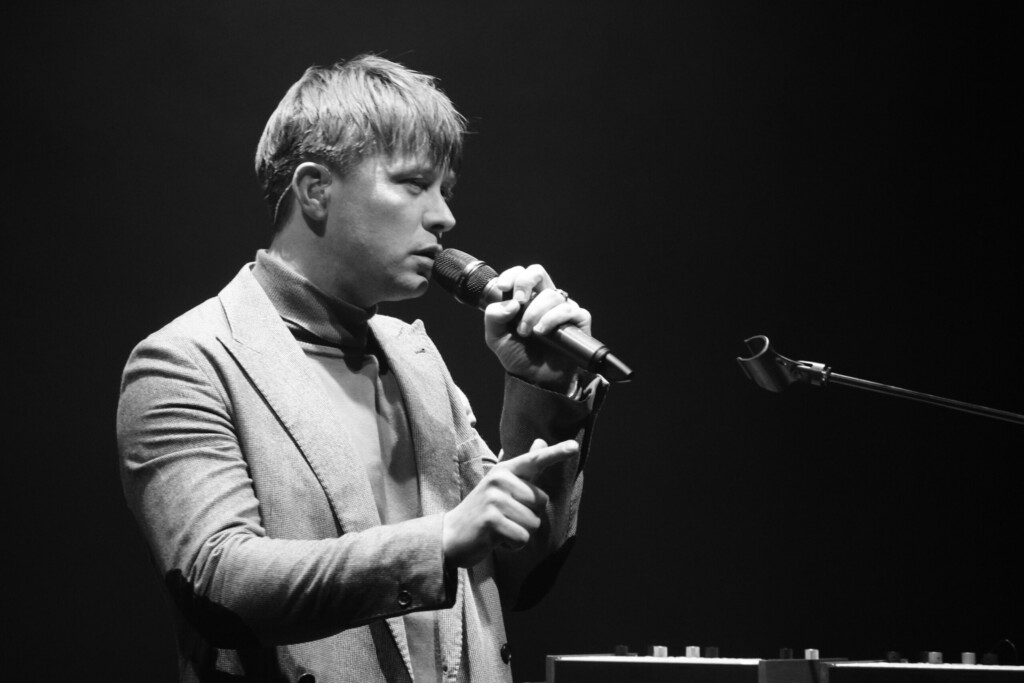
Some concerts ask you to sing along. Some ask you to dance. Anthonie Tonnon’s Cinematographer asks whether a city can lose its soul, whether architecture has a psychology, whether public memory can survive capitalism, and whether a derelict Whanganui nightclub might be as culturally significant as Paris in May 1968.
And somehow, against all odds, it’s also a terrific pop show.
Trying to describe this show in regular terms somehow feels inadequate. Calling it ‘a concert’ is a bit like calling what Kraftwerk does ‘just a gig’. There are songs, certainly, but that’s only part of the machinery. Over two wildly ambitious hours, Tonnon stitches together live electronic music, archival film, political theory, local history, urban mythology and deadpan comedy into something resembling a TED Talk hosted by David Byrne, possessed by the ghosts of Rev. Samuel Marsden and Jimmy Swaggart, produced by Adam Curtis and Man Ray and soundtracked by a malfunctioning Y2K nightclub.
The show opens with the Situationist International, the legendary European revolutionaries who spent the 1950’s and 60’s interrogating consumer culture and attacking what Guy Debord called “the spectacle”. This is the movement associated with the political and cultural upheavals of May 1968 in France. “They nearly overthrew France in 1968,” Tonnon told me earlier this year. “Or at least they would claim it, and some would claim it was them. They were a very mysterious group that sort of melted away.”
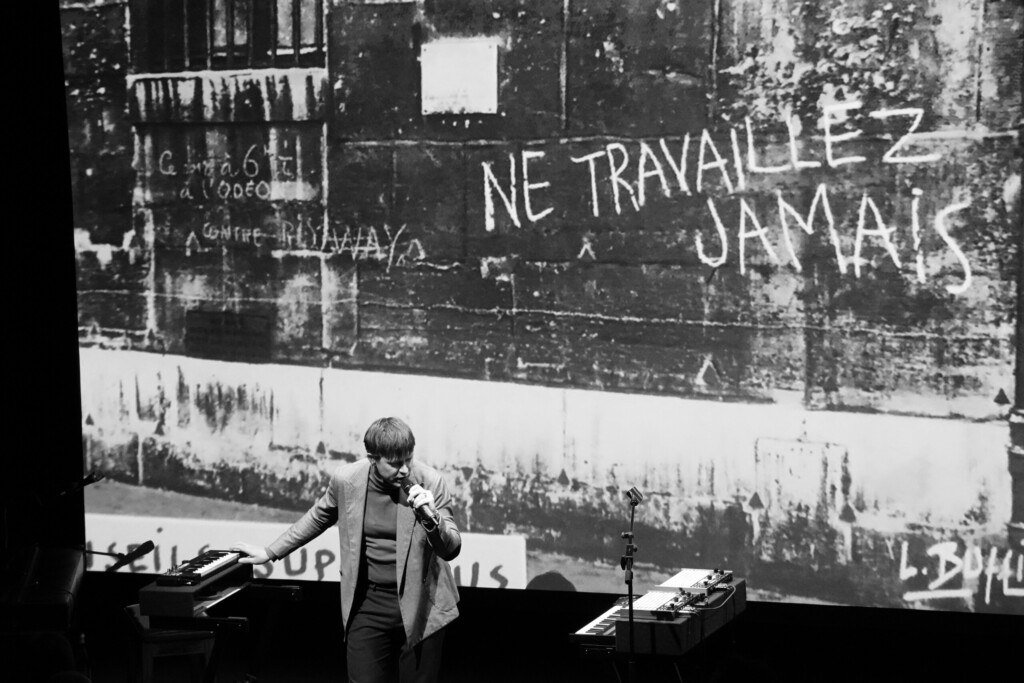
Part of their appeal, he says, lies in the collision between intellectual seriousness and outright absurdity.
“Because they’re just beautiful and funny. They come straight out of a Wes Anderson movie: turtlenecks and blazers, trying to save the world from advertising. They were so grandiose to the point of ridiculousness, but they had some incredible ideas that have really lived on.”
You can feel Tonnon delighting in their contradictions. Dressed like he’d stepped straight out of a Left Bank café circa 1967, he doesn’t just explain the Situationists, he inhabits them. The evening’s recurring theme is détournement, which he described to me as “a revolutionary technique” designed to save us from the spectacle. The spectacle being advertising, commercialism, society, influencers, modern life and politics. Hell, everything we hold dear now and tweet about constantly.
That may sound forbiddingly academic. In Tonnon’s hands it’s unexpectedly hilarious. There are jokes about government conspiracies, forgotten suburbs, towns disappearing from maps and the strange bureaucratic ways communities erase themselves. The audience laughs often. Not because the material is dumbed down, but because Tonnon understands that if you want people to follow you into political theory, you’d better bring jokes. Power-pointed procrastination required humour to cut through.
The story he tells centres on Whanganui, his hometown, presented here as a kind of Antipodean psychogeographic laboratory. Historic photographs sit alongside contemporary footage. Lost buildings converse with surviving landmarks. Streets become political documents. Entire philosophies are built from bus routes, office blocks and suburban naming disputes.
The songs follow suit – yes there are costume changes. But this is a sort of album launch, too. The Opener is Cinematography, which sets the scene. Executive Assistant (the first single from his upcoming album) transforms 80’s office culture into mythology (not as creepy as the Devine Comedy song, though). It emerges as an early highlight. Accompanied by images of modernist and brutalist architecture, the song transforms office work into something almost heroic. Few New Zealand songwriters can find emotional resonance in commercial buildings and municipal infrastructure. Tonnon somehow keeps doing it.
An entire suburb loses its identity. A long-defunct Greyhound bus service becomes a symbol of community itself. A sequence devoted to Tonnon’s favourite subject, public transport, recalling the transport-themed performances that first established him as one of the country’s most imaginative live artists. Buses roll across the screen. Civic history becomes cultural archaeology.
He doesn’t announce the tracks, so I’m a little vague on a few, but I did hear Don’t Go Alone. For this one, footage of passengers, the ‘famous river-access road, Drews Avenue and fragments of local history are all combining into the emotional nostalgic centre. In a show obsessed with atomisation and spectacle, the title becomes more than travel advice. It lands as a plea for collective experience.
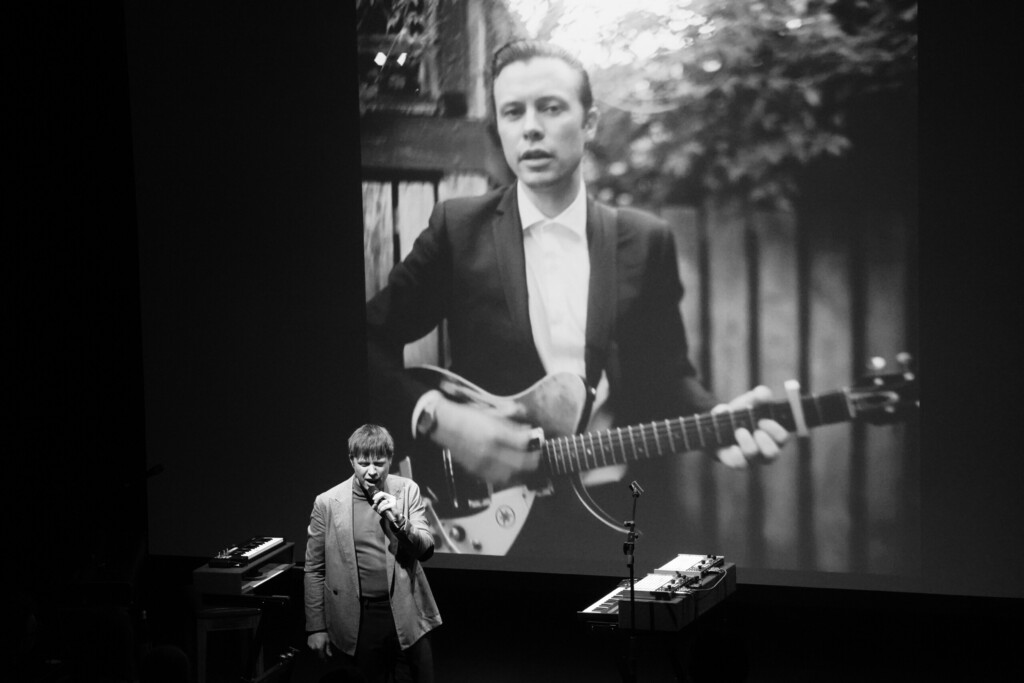
A switch of scene moves to the extremely provocative Part Time Dental Nurse (I’m still not over those primary school horror visits to the ‘Murder House’!). A very clever intro to an unnamed piece opened with grainy film and crystal sound of a brass band playing in the rotunda in the Wanganui Gardens. There was significant political chanting on I Want To Believe, after strong references to the Wanganui Chronicle’s 1990’s optimistic insert proclaiming the future of the city is sparkling!
At one point Tonnon effectively invites the audience to return to 2004 and reinvent themselves as a “21st-century DJ”. The soundtrack shifts accordingly. Gone is the guitar-centred songwriter. In its place are synths, sequencers and programmed rhythms.
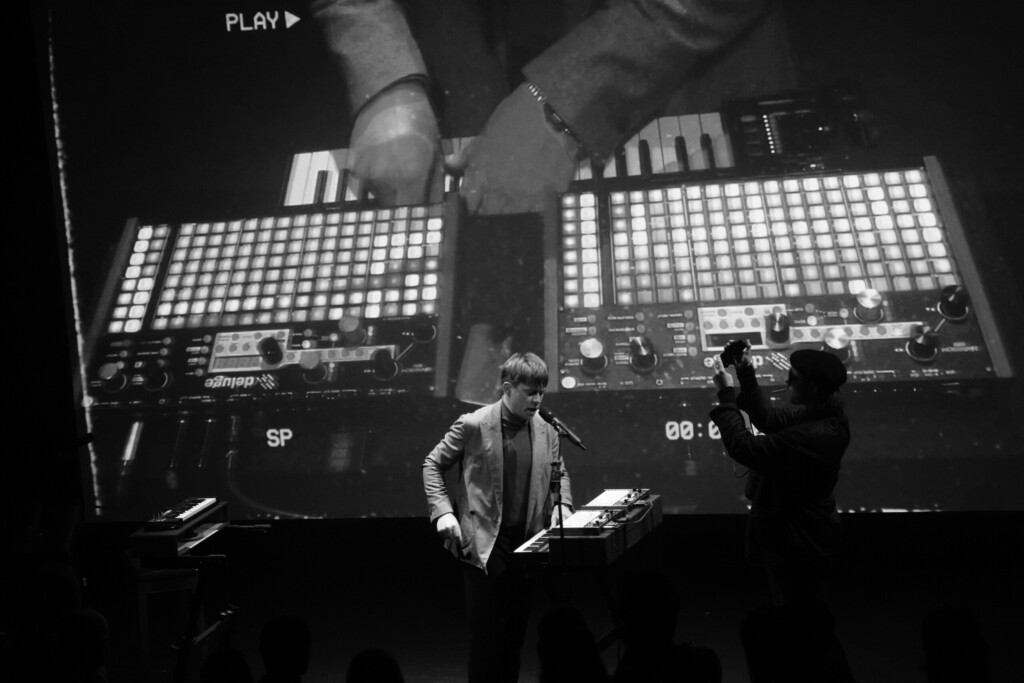
The stage setup is almost comically minimal. A few electronic devices. Almost no visible cables. Behind him, a towering projection screen dominates the room. The music pulses with Italo-house pianos, sequenced beats and charmingly primitive electronic textures that sound as though they were generated by a Commodore 64 with an unhealthy interest in urban planning.
The result is unexpectedly euphoric.
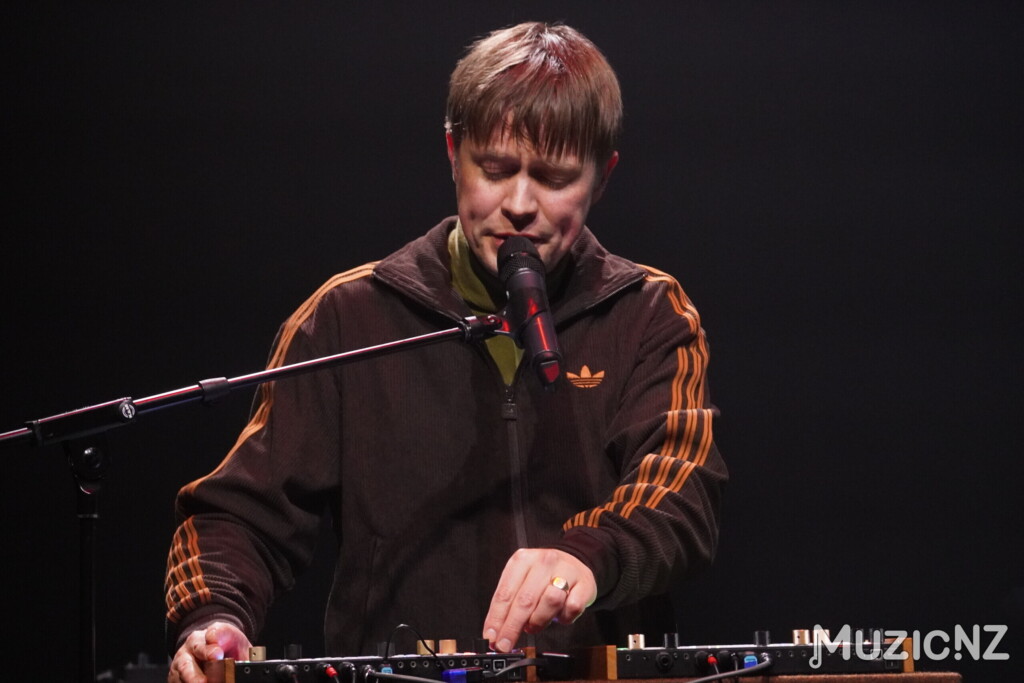
Even more surprising is the setting. Hannah Playhouse is hardly nightclub territory. Normally it’s home to Baxter, Chekhov, Pinter and Roger Hall. Tonight most of the audience stands throughout. The queue stretches down the street. The place is packed. And for good reason.
Visually, Cinematographer operates like a conspiracy theorist’s evidence board. Images, maps, news clippings, film footage and photographs flash across the screen in endlessly fascinating combinations. Erica Sklenars’ visual design is crucial, connecting France, Italy and provincial New Zealand with dream-logic precision. Theo Taylor’s handheld live footage, via a dinky handycam, gives everything a restless documentary energy. He dresses sans Franco-artist in a beret and suitable attire. A mock Gitane dangling from his arrogant smirk.
The evening’s most memorable sequence revolves around Space Monster, the legendary Whanganui nightclub housed inside a former commercial building. He gets in a plug for one of what appears to be several causes to preserve the city’s heritage architecture. Ever the skilful orator, Tonnon delivers its history with the conviction of a revivalist preacher. “Do you believe in Space Monster?” By the end, clutching their chequebooks, many seem ready to convert.
And not forgetting the day job, scenes of the Durie Hill Elevator get a brief airing, triumphantly rattling into action, it appears on screen. What begins as nostalgia quickly becomes something deeper: a meditation on memory, architecture and what happens when cities forget parts of themselves. Discussions of earthquake strengthening and multi-million-dollar restoration costs somehow become gripping. Tonnon may be the only performer alive capable of making building compliance regulations sound like revolutionary literature.
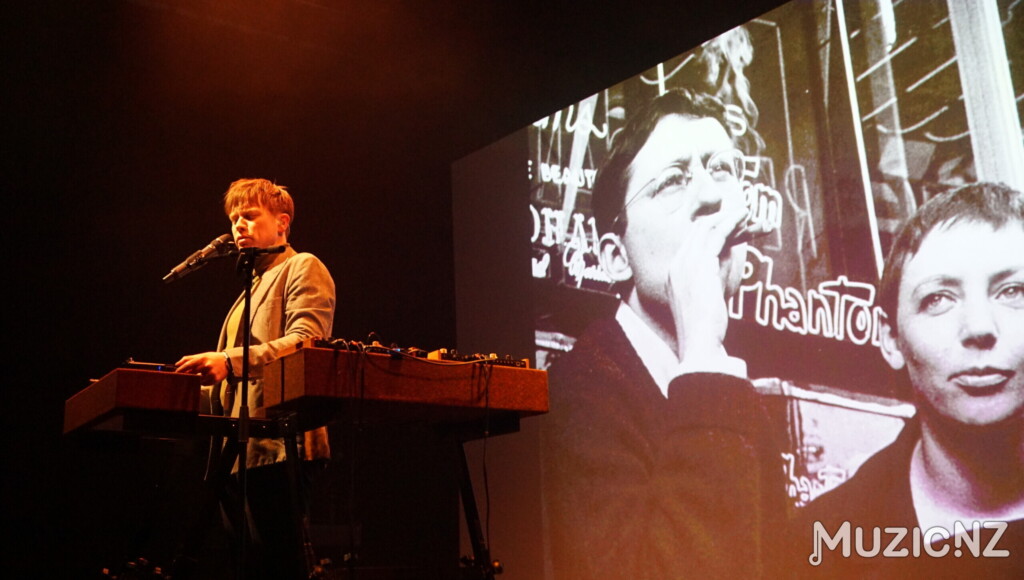
Midway through comes a costume change. The tweed-clad lecturer disappears and a tracksuit-wearing athlete emerges. Sports footage floods the screen. Runners train. Boxers pose. Lost generations become local myths. The music blends with archives of Commonwealth Games and Royal Tours and track meets and athletic achievements. It’s funny. It’s moving. It’s weirdly effective.
Later the tracksuit gives way to a white jacket and suddenly Tonnon appears to be channelling peak-era David Byrne: part preacher, part motivational speaker, part suburban futurist.
Even a technical malfunction becomes part of the narrative. When a computer briefly requires a restart, the interruption feels oddly appropriate. The machine falters. The spectacle briefly collapses. The audience glimpses the gears beneath the illusion.
Throughout the evening, architecture remains the show’s hidden protagonist. Ian Athfield projects, unrealised developments, civic ambitions and modernist dreams drift through the narrative. Buildings become characters. Streets acquire personalities. The Situationist concept of psychogeography, the idea that cities shape us in ways we’re barely aware of, becomes the show’s central argument.
Perhaps nowhere is this clearer than during a gloriously eccentric sequence about Gonville, pronounced in pseudo-French as “Gonvee” with affectionate insistence. This leads into a quick trip down Bedford Avenue and eventually into that song: I Want To Believe, one of the night’s strongest. Its subject: Warnock’s Clothing. Remember them? Their futuristic headquarters is presented as a kind of spaceship designed to ‘transport New Zealand into tomorrow’. It’s a ridiculous image. But it’s also perfect. As the images flicker across the screen, the building becomes a monument to a vanished future.
The factory disappeared. The optimism faded. The song lingers.
By the finale, everything has merged into one vast network of associations connecting architecture, royalty, sport, local history and revolutionary theory. Then Tonnon starts marching his keyboard around the stage like a soldier shouldering his rifle. It should look ridiculous. Instead, it’s yet another triumphant moment.
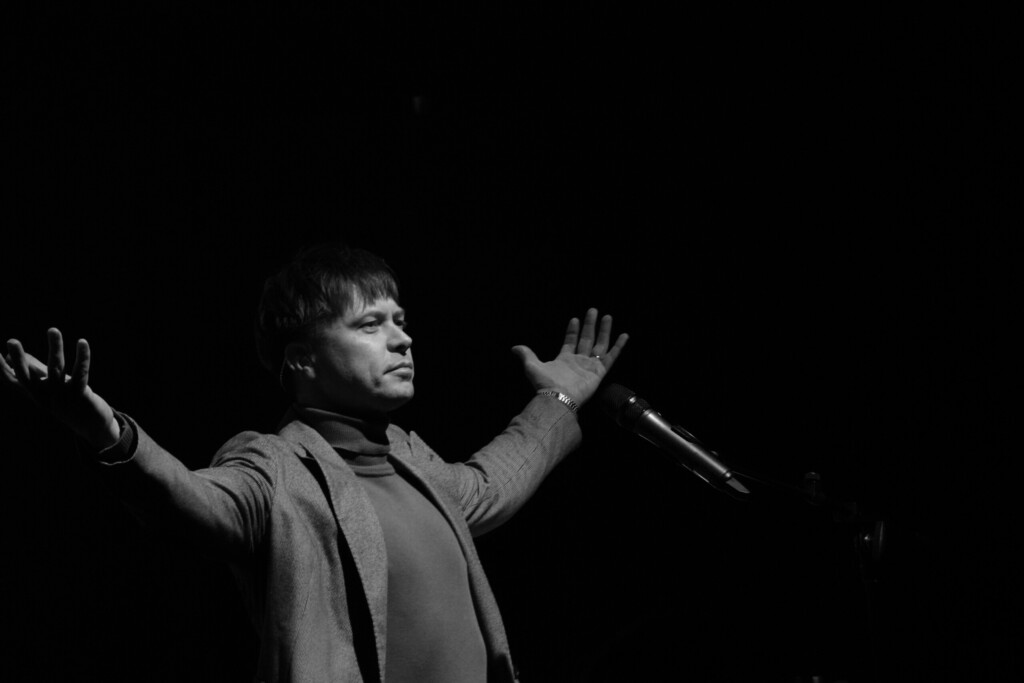
While waiting in the pre-show queue, I listened. No one would be entirely surprised. Tonnon has a reputation for creating the unusual and challenging when it comes to a show. He once hired buses to take his audience to a disclosed venue in the countryside. Audio-visuals and electronic shenanigans is his stock and trade, alongside his passion for ‘people-centred’ architecture and transport. So, for him this show was on brand.
As Another Chance builds toward its climax, synths swirl, images flash and digital textures expand into a glorious electronic maelstrom. It’s a joyous ending to a show preoccupied with disappearance, memory and loss. In Tonnon’s own words: “You leave Cinematographer struggling to explain what you’ve actually witnessed.” Was it a concert? A lecture? A film essay? A civic history project? A dance party?
The answer is yes.
At a time when so much live music feels interchangeable, Anthonie Tonnon has created something genuinely singular: avant-garde French political theory rubbing shoulders with Whanganui bus routes, Ian Athfield sharing a stage with nightclub elevators, and local history transformed into euphoric electronic pop. Most musicians want to entertain an audience. Tonnon wants to change how they see the street outside the venue.
Go and see this strange, brilliant show while you can. You’ll spend the walk home trying to figure out what happened, and enjoying every minute of it.
Photo Credit: Tim Gruar for Muzic.NZ
Photo Gallery
Related Acts:
About the author Tim Gruar

Tim Gruar – writer, music journalist and photographer Champion of music Aotearoa! New bands, great bands, everyone of them! I write, review and interview and love meeting new musicians and re-uniting with older friends. I’ve been at this for over 30 years. So, hopefully I’ve picked up a thing or two along the way. Worked with www.ambientlight.com, 13th Floor.co.nz, NZ Musician, Rip It Up, Groove Guide, Salient, Access Radio, Radio Active, groovefm.co.nz, groovebookreport.blogspot.com, audioculture.co.nz Website: www.freshthinking.net.nz / Insta @CoffeeBar_Kid / Email [email protected]
More by Tim Gruar
Album Review: ¡Blaze!
Gig Review: Hikurangi Schaverien-Kaa @ Te Ao Kōhatu Wellington Jazz Festival, Wellington – 18/10/2026
Album Review: Motoring For Beginners
Album Review: Te Ngahere
EP Review: Welcome To The Dance Bunker
Album Review: Leap!

Festival Review: Great Sounds Great Part 1 @ Cuba Street Precinct, Wellington – 5/09/2026
Festival Review: Great Sounds Great: The Night Before @ Newtown Village, Wellington – 4/09/2026
Gig Review: Mel Parsons @ Opera House, Wellington – 05/09/2026
Album Review: Descending Dreams
EP Review: Extended Paranoia
Album Review: Brain Storm